1 2 3 4 5 6 7 8 9 10 11 12 E 13 14 15 16 17 18 19 20 21 22 23 24 25 26 27 28 29 30 31 32 33 34 35 36 37 38 39 40 E 41 42 43 44 45 46 47 48 49 50 51 52 53.
Open form follow the instructions
Easily sign the form with your finger
Send filled & signed form or save
How to fill out the Doyle Tree Scale Form Class 78 online
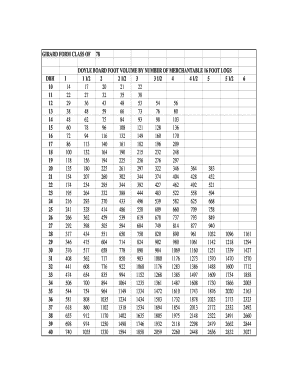
Completing the Doyle Tree Scale Form Class 78 online can be a straightforward process with the right guidance. This step-by-step guide will help you navigate the form’s sections, ensuring that all necessary information is accurately provided.
Follow the steps to successfully complete the Doyle Tree Scale Form Class 78.
- Press the ‘Get Form’ button to acquire the form and open it for editing.
- Review the form’s introductory information, ensuring you are familiar with the purpose of the Doyle Tree Scale Form Class 78.
- Begin with the first section, which involves entering the diameter at breast height (DBH) in inches for each tree, ensuring the values align with the corresponding categories.
- Continue through the sections, indicating the number of logs of different lengths, and ensure all numerical entries are accurate and reflect your measurements.
- Once all sections have been filled out, review your entries carefully to confirm all information is correct, with special attention to the totals calculated for board foot volume.
- After reviewing, you can proceed to save, download, print, or easily share your completed form as needed.
Complete your documents online today for a more efficient process.
Experience a faster way to fill out and sign forms on the web. Access the most extensive library of templates available.
Related content
tree volume. The Int ¼ and Doyle form class 78 volume tables were used to calculate the...
Form Class Volume Tables ... Scale of 16-foot logs… ... based on three basic...
Ten-pin bowling is a type of bowling in which a bowler rolls a bowling ball down a wood or...
Get answers to your most pressing questions about US Legal Forms API.
What is the Doyle scale for board footage?
The Doyle scale is one of the most commonly used formulas for calculating board feet. Developed in the 1800's, it is based on a mathematical formula and is most prominently used in the South and the Midwest United States. The Doyle scale is the standard by which hardwood lumber is bought and sold.
What is the Doyle log scale?
The Doyle rule is the most common rule used in hardwood log scaling in Tennessee. Edward Doyle developed this rule prior to 1850. This rule estimates the volume based on log length, diameter, slabs, edgings, shrinkage and production of sawdust.
How many board feet is a 20 inch log?
For example, a 20-inch DBH oak tree with a merchantable height of 2½ logs contains 260 board feet Doyle rule or 350 board feet International 1/4-Inch rule.
What is the Doyle scale used for?
The Doyle rule is the most common rule used in hardwood log scaling in Tennessee. Edward Doyle developed this rule prior to 1850. This rule estimates the volume based on log length, diameter, slabs, edgings, shrinkage and production of sawdust.
How do you use a Doyle log scale?
To use the scale, first measure the average diameter of the small end of the log inside the bark (in inches). Locate that row on the scale. Next, measure the length of the log (in feet). Move over on the scale to that length column.
What is the difference between Doyle and International scale?
Much of the timber industry operates with the Doyle rule, while some use the International ¼” rule. It is commonly understood that the Int. ¼” rule is the more accurate, in that Doyle underestimates lumber volume, particularly in the smaller-diameter trees.
How do you calculate Doyle log scale?
The Doyle Rule (Table 1) is the most widely used rule, especially on private timber in the east and south. The formula is simple and easy to remember. This formula says to subtract four inches from the diameter for slabs and edgings, square the result, and adjust for log length.
What is form class for trees?
"Form class is the percentage ratio between the diameter inside the bark at. the top of the first 16' log and the diameter outside the bark at DBH (4 1/2. feet above the ground) For example, a tree with a first log scaling diameter. 16" and a DBH of 20" the tree has a form class of (16/20 X 100) 80.
Use professional pre-built templates to fill in and sign documents online faster. Get access to thousands of forms.
If you believe that this page should be taken down, please follow our DMCA take down process here.