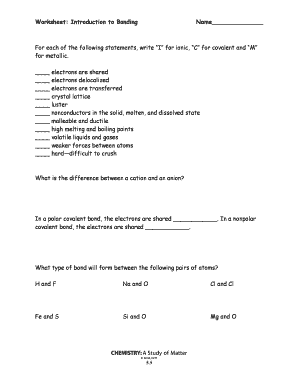
Get For Each Of The Following Statements Write I For Ionic C For Covalent And M For Metallic
How it works
-

Open form follow the instructions
-

Easily sign the form with your finger
-

Send filled & signed form or save
How to fill out the for each of the following statements write I for ionic C for covalent and M for metallic online
This guide provides a clear and systematic approach to completing the form for identifying the types of chemical bonds. By following these steps, users can accurately fill out the worksheet while gaining a better understanding of ionic, covalent, and metallic bonds.
Follow the steps to successfully complete the bonding worksheet.
- Click ‘Get Form’ button to access the worksheet and open it in your preferred online editor.
- Begin with the first section where statements about bonding are presented. For each statement, determine if the characteristic described corresponds to ionic, covalent, or metallic bonds. Fill in the appropriate letter: 'I' for ionic, 'C' for covalent, and 'M' for metallic.
- Proceed to the next section that asks about the differences between cations and anions. Provide the definitions based on your understanding of ionic bonds.
- In the polar and nonpolar covalent bond section, complete the sentences by identifying how electrons are shared. Use terms like 'unevenly' or 'evenly' based on your knowledge of these concepts.
- Look at the final questions that require you to identify the types of bonds that will form between different pairs of atoms. Analyze each pair and indicate the bond type using the same notation as before.
- Once all sections are filled out, review your answers for accuracy. Make any necessary adjustments.
- Finally, save your changes, and choose to download, print, or share the completed form as needed.
Start filling out your bonding worksheet online today for a deeper understanding of chemical bonds.
To determine whether a bond is ionic, covalent, or metallic, consider the elements involved. Ionic bonds typically form between metals and nonmetals, resulting in electron transfer. Covalent bonds occur between two nonmetals that share electrons. Metallic bonds involve metal atoms that collectively share electrons, which gives them unique properties. For each of the following statements, write I for ionic, C for covalent, and M for metallic to help categorize the bonds.
Industry-leading security and compliance
-
In businnes since 199725+ years providing professional legal documents.
-
Accredited businessGuarantees that a business meets BBB accreditation standards in the US and Canada.
-
Secured by BraintreeValidated Level 1 PCI DSS compliant payment gateway that accepts most major credit and debit card brands from across the globe.