Loading
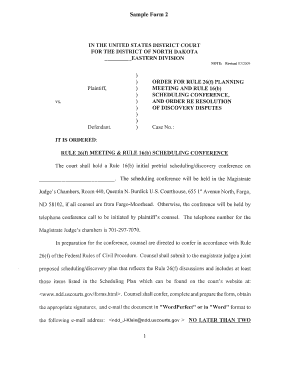
Get Rule 26 F Conference Form
How it works
-

Open form follow the instructions
-

Easily sign the form with your finger
-

Send filled & signed form or save
How to fill out the Rule 26 F Conference Form online
The Rule 26 F Conference Form is a critical document for initiating discussions on case management in the federal court system. This guide provides clear, step-by-step instructions for filling out the form online, ensuring that users can navigate the process confidently.
Follow the steps to complete the Rule 26 F Conference Form online.
- Click the ‘Get Form’ button to access the Rule 26 F Conference Form and open it in your preferred editor.
- Begin by entering the case caption at the top of the form, including the names of the parties involved and the case number. Ensure accurate spelling and formatting.
- Date and sign the document in the designated signature area, confirming that you have conferred with all parties involved as required.
- In the section for the joint proposed scheduling/discovery plan, clearly detail agreed deadlines for discovery and motions, ensuring mutual agreement among all parties is achieved.
- Specify disclosures required under Rule 26(a)(1) by summarizing the areas of agreement on subject matter, timing, and form of disclosures.
- Address any disagreements that may arise in the discovery process, outlining each party's position on the dispute.
- Discuss and document the options for alternative dispute resolution (ADR) that the parties have considered and agree upon.
- Finalize all entries, checking for accuracy and completeness, as incomplete forms may lead to delays or denial of claims.
- Once completed, save the form in an appropriate format, and follow any filing instructions required by the court, such as submitting it via email.
Begin filling out your Rule 26 F Conference Form online today to ensure your case proceeds smoothly.
Rule 26(f) describes a conference of two parties (the plaintiff and defendant) to cooperate and set out a clear plan for the process of discovery. In terms of responsibility for arrangement, both parties are jointly responsible—and this remains true as the case progresses.