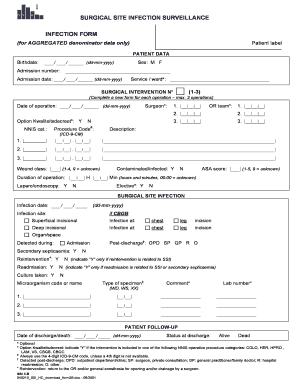
SURGICAL SITE INFECTION SURVEILLANCE INFECTION FORM for AGGREGATED denominator data only Patient label PATIENT DATA Birthdate Sex M F // dd-mm-yyyy Admission number Admission date // dd-mm-yyyy Service / ward 1-3 SURGICAL INTERVENTION N Complete a new form for each operation max. 3 operations Date of operation // dd-mm-yyyy Surgeon 1. OR team Option Kwaliteitsdecreet Y N Procedure Code NNIS cat. Description ICD-9-CM. Wound class 1-4 9 unknown Contaminated/infected Y ASA score 1-5 9 unknown Duration of operation H Min hours and minutes 00. 00 unknown Laparo/endoscopy Y Elective Y Infection date // dd-mm-yyyy Infection site if CBGB Superficial incisional chest leg incision Deep incisional Organ/space Detected during Admission Secondary septicaemia Y Reintervention Y Post-discharge OPD SP GP R O N indicate Y only if reintervention is related to SSI Readmission Y Culture taken Y Microorganism code or name Type of specimen Comment Lab number WD WS XX PATIENT FOLLOW-UP Date of discharge/deat....

How it works
  • Open form

    Open form follow the instructions

  • Easily sign form

    Easily sign the form with your finger

  • Share form

    Send filled & signed form or save

How to fill out the Surgical Site Infection Form online

Filling out the Surgical Site Infection Form online is a crucial step in monitoring and managing surgical site infections. This guide provides you with clear and detailed instructions to help you navigate each section of the form effectively.

Follow the steps to complete the form successfully.

  1. Click the ‘Get Form’ button to obtain the form and open it in your preferred editor.
  2. Complete the patient label section by entering the patient's birthdate, sex, admission number, and admission date.
  3. Fill in the service or ward information, specifying where the patient received care.
  4. For each surgical intervention, enter the date of operation, surgeon’s name, and operating room team members’ names.
  5. Input the procedure code and NNIS category, then provide a detailed description using the ICD-9-CM format.
  6. Select the wound class and indicate if the wound is contaminated or infected.
  7. Enter the ASA score and the duration of the operation, including hours and minutes.
  8. Indicate if the procedure was elective and whether laparoscopy or endoscopy was used.
  9. Document the infection date and infection site, specifying the type of infection if applicable.
  10. Specify if the infection was detected during admission or post-discharge along with any details on readmission or reintervention.
  11. Record whether cultures were taken and provide details on microorganisms and specimen types.
  12. Finally, fill in the date of discharge or death, and indicate the status at discharge.
  13. Review all filled information for accuracy, then save, download, print, or share the completed form as needed.

Take action and complete your Surgical Site Infection Form online today!

Get form

Experience a faster way to fill out and sign forms on the web. Access the most extensive library of templates available.

Related content

Surgical Site Infection (SSI) - CDC

Form Approved. OMB No. 0920-0666. Exp. Date: 12/31/2022 www.cdc.gov/nhsn. Surgical Site...

Learn more
Surgical site infection surveillance...

Surgical site infection surveillance post-operative data collection form. All follow-up in...

Learn more
Breast cancer - Wikipedia

Breast cancer is cancer that develops from breast tissue. Signs of breast cancer may...

Learn more
Questions & Answers

Get answers to your most pressing questions about US Legal Forms API.

Contact support

What is an example of a surgical site infection?

An example of a surgical site infection may include a patient developing redness, warmth, or discharge at the incision site following a surgical procedure. These symptoms indicate an infection that may require treatment. By employing a Surgical Site Infection Form, healthcare providers can quickly document these cases, facilitating timely intervention and better patient outcomes.

Calculating a surgical site infection involves monitoring the number of infections that occur post-surgery relative to the total number of surgeries performed. You can use the formula: (Number of infections / Total surgeries) x 100 for a percentage. Implementing a Surgical Site Infection Form simplifies this process, offering a structured way to collect data and analyze infection rates efficiently.

The CDC defines a surgical site infection as an infection that occurs within 30 days after surgery or within one year if an implant is placed. It involves the incision or tissues surrounding the surgical site. To manage these infections effectively, utilizing a Surgical Site Infection Form can help track and document any signs of infection, ensuring you maintain quality care and meet necessary health regulations.

Antibiotics are used to treat most wound infections. Sometimes, you also may need surgery to treat the infection. You may be started on antibiotics to treat the surgical wound infection. The length of time you will need to take the antibiotics varies, but will typically be for at least 1 week.

redness and swelling at the incision site. drainage of yellow or cloudy pus from the incision site. fever.

Prophylaxis has been shown to reduce the incidence of severe wound infection by approximately 50 percent. Either or cephalosporin-based prophylaxis is effective. is commonly used.

Call your doctor if you develop a fever or pus, redness, heat, pain or tenderness near the wound or any other signs or symptoms of a surgical site infection.

Will an Infected Cut Heal on Its Own? While some minor wound infections can heal on their own, untreated infected wounds can leave a scar, at best, or lead to more serious complications — including death — at worst.

A surgical site infection (SSI) is an infection that occurs after surgery in the part of the body where the surgery took place. Surgical site infections can sometimes be superficial infections involving the skin only.

The four wound classifications available within the NHSN application are: Clean (C), Clean-Contaminated (CC), Contaminated (CO), and Dirty/Infected (D].

Get This Form Now!

Use professional pre-built templates to fill in and sign documents online faster. Get access to thousands of forms.

If you believe that this page should be taken down, please follow our DMCA take down process here.

Get Surgical Site Infection Form