Loading
Form preview
  • US Legal Forms
  • Other Templates
  • More Forms
  • More Uncategorized Forms
  • Form 1 Science Unit 7.4 : Application Of Expansion ... - Heat

Get Form 1 Science Unit 7.4 : Application Of Expansion ... - Heat

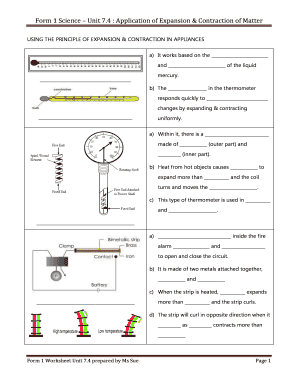
Form 1 Science Unit 7.4 : Application of Expansion & Contraction of Matter USING THE PRINCIPLE OF EXPANSION & CONTRACTION IN APPLIANCES a) It works based on the and of the liquid mercury.

How it works

  1. Open form

    Open form follow the instructions

  2. Easily sign form

    Easily sign the form with your finger

  3. Share form

    Send filled & signed form or save

How to fill out the Form 1 Science Unit 7.4: Application of Expansion and Contraction of Matter online

This guide provides a step-by-step approach to filling out the Form 1 Science Unit 7.4 related to the application of expansion and contraction of matter. Users will find clear instructions to help them navigate each section of the form effectively.

Follow the steps to complete the form with ease.

  1. Press the ‘Get Form’ button to retrieve the form and open it within your preferred online editor.
  2. Begin by filling in the first section that pertains to the working principle of a thermometer. Input the appropriate responses relating to the expansion and contraction of mercury in the designated blanks.
  3. Proceed to the next section, which discusses the materials used in the thermometer. Identify the outer and inner components of the thermometer and provide the correct terminology where required.
  4. Continue to the section on fire alarms. Fill in the blanks regarding how the metal strip functions within the fire alarm system, including the metals used and the reactions to heat.
  5. Next, complete the portion regarding electrical equipment controls. Describe the components that help turn appliances on or off, ensuring to use terms related to fire alarm mechanisms.
  6. In the section discussing metal tires, describe the process of fitting the tire onto the wheel frame and how it attaches firmly once cooled.
  7. Move on to the rivet application section, detailing the use of heated rivets for binding metal sheets together and the consequences of cooling.
  8. Fill out the area concerning railway tracks. Explain the implications of heat on the tracks and how gaps are made to alleviate expansion issues.
  9. Complete the form by addressing the construction features of bridges, including the importance of leaving a gap to accommodate movement.
  10. Wrap up by detailing the final sections about tiled walls and concrete slabs. Describe how they are constructed to prevent damage during temperature fluctuations.
  11. Once all sections are complete, save your changes, and make sure to download, print, or share the completed form as needed.

Complete your Form 1 Science Unit 7.4 online today for a thorough understanding of the principles of expansion and contraction.

Get form

Experience a faster way to fill out and sign forms on the web. Access the most extensive library of templates available.
Get form

Related content

Negative thermal expansion materials:...
Feb 2, 2012 — Such negative thermal expansion (NTE) materials have enormous industrial...
Learn more
13.2 Thermal Expansion of Solids and Liquids –...
V. 5 Further Applications of Newton's Laws: Friction, Drag, and Elasticity ... The...
Learn more
Chapter 1
When SI units are plugged into an equation, it is found that the units balance. ... Yes...
Learn more

Related links form

Duluth Trading Company Returns Form DXCC Record Sheet Dye Test Payment Dynamic Touch Chair Massage Sign In Sheet

Questions & Answers

Get answers to your most pressing questions about US Legal Forms API.

Contact support

Expansion and contraction are everyday phenomena that affect various aspects of life. For instance, sidewalks often have cracks filled with flexible material to accommodate changes in size due to temperature variations. Additionally, glass jars sometimes become difficult to open after being refrigerated, as the glass contracts, making them tighter.

The applications of heat expansion are varied and vital to many industries. In construction, builders use heat expansion principles to ensure that materials can withstand temperature fluctuations without causing structural failures. Furthermore, automotive industries use thermal expansion in engine design to enhance performance and efficiency.

The expansion of metal finds several practical applications. First, it is crucial in the design of metal bridges, which include expansion joints to allow for movement. Second, metal fittings in plumbing systems are designed to expand and contract to maintain a tight seal. Lastly, engines use thermal expansion to ensure proper fit and function of metal components under varying temperatures.

Thermal expansion occurs in many everyday applications that you may not even notice. For example, the bimetallic strip in thermostats relies on thermal expansion to function accurately, helping to regulate temperature in homes. Similarly, hot water pipes expand when heat is applied, which is a consideration for plumbing systems.

Expansion due to heat has several important applications, particularly in engineering and construction. For instance, engineers consider thermal expansion in designing structures to ensure they can handle temperature changes without damage. Additionally, heat expansion is critical in manufacturing processes, where materials must be heated to fit together correctly.

One example of expansion in solids on heating is the way metal railway tracks expand during hot weather. This expansion can lead to buckling if there is no space for the tracks to shift. Another example is the expansion of bridges; they include expansion joints to accommodate the increase in size that occurs with heat.

To demonstrate the expansion and contraction of a gas, you can use a simple setup with a balloon and a heat source. When you warm the balloon, the gas inside expands, causing the balloon to inflate. Conversely, when you cool the balloon, the gas contracts, and the balloon shrinks. This experiment illustrates key concepts in Form 1 Science Unit 7.4: Application Of Expansion ... - Heat.

In grade 6, students learn that expansion and contraction refer to how materials change size with temperature. When heated, particles move faster and spread out, causing expansion. Conversely, cooling causes particles to slow down and come closer together, resulting in contraction. This fundamental concept is a core component of Form 1 Science Unit 7.4: Application Of Expansion ... - Heat.

In the context of Form 1 Science Unit 7.4: Application Of Expansion ... - Heat, the three applications of expansion and contraction include the functioning of thermometers, the design of bridges, and the operation of engines. Thermometers utilize liquid expansion to measure temperature changes accurately. Bridges are built with expansion joints to accommodate changes in length due to temperature variations. Engines rely on the expansion of gases to create the necessary pressure for movement.

Thermal expansion is used in various applications such as railroad track buckling, engine coolants, mercury in thermometers, joint expansion, etc.

Get This Form Now!

Use professional pre-built templates to fill in and sign documents online faster. Get access to thousands of forms.
Get form
If you believe that this page should be taken down, please follow our DMCA take down processhere.
Get Form 1 Science Unit 7.4 : Application Of Expansion ... - Heat
Get form
  • Adoption
  • Bankruptcy
  • Contractors
  • Divorce
  • Home Sales
  • Employment
  • Identity Theft
  • Incorporation
  • Landlord Tenant
  • Living Trust
  • Name Change
  • Personal Planning
  • Small Business
  • Wills & Estates
  • Packages A-Z
  • Affidavits
  • Bankruptcy
  • Bill of Sale
  • Corporate - LLC
  • Divorce
  • Employment
  • Identity Theft
  • Internet Technology
  • Landlord Tenant
  • Living Wills
  • Name Change
  • Power of Attorney
  • Real Estate
  • Small Estates
  • Wills
  • All Forms
  • Forms A-Z
  • Other Templates
  • Legal Hub
  • About Us
  • Help Portal
  • Legal Resources
  • Blog
  • Affiliates
  • Contact Us
  • Delete My Account
  • Site Map
  • Industries
  • Forms in Spanish
  • Localized Forms
  • State-specific Forms
  • Forms Kit
  • Real Estate Handbook
  • All Guides
  • Notarize
  • Incorporation services
  • For Consumers
  • For Small Business
  • For Attorneys
  • USLegal
  • FormsPass
  • pdfFiller
  • signNow
  • altaFlow
  • DocHub
  • Instapage
Form Packages
  • Adoption
  • Bankruptcy
  • Contractors
  • Divorce
  • Home Sales
  • Employment
  • Identity Theft
  • Incorporation
  • Landlord Tenant
  • Living Trust
  • Name Change
  • Personal Planning
  • Small Business
  • Wills & Estates
  • Packages A-Z
Form Categories
  • Affidavits
  • Bankruptcy
  • Bill of Sale
  • Corporate - LLC
  • Divorce
  • Employment
  • Identity Theft
  • Internet Technology
  • Landlord Tenant
  • Living Wills
  • Name Change
  • Power of Attorney
  • Real Estate
  • Small Estates
  • Wills
  • All Forms
  • Forms A-Z
  • Other Templates
Customer Service
  • Legal Hub
  • About Us
  • Help Portal
  • Legal Resources
  • Blog
  • Affiliates
  • Contact Us
  • Delete My Account
  • Site Map
  • Industries
  • Forms in Spanish
  • Localized Forms
  • State-specific Forms
  • Forms Kit
Legal Guides
  • Real Estate Handbook
  • All Guides
Prepared for you
  • Notarize
  • Incorporation services
Our Customers
  • For Consumers
  • For Small Business
  • For Attorneys
Our Sites
  • USLegal
  • FormsPass
  • pdfFiller
  • signNow
  • altaFlow
  • DocHub
  • Instapage
Social Media
Call us now toll free:
+1 833 426 79 33
As seen in:
© Copyright 1999-2026 airSlate Legal Forms, Inc. 17 Station Street, Ste. 203, Brookline, MA 02445
  • Your Privacy Choices
  • Terms of Service
  • Privacy Notice
  • Content Takedown Policy
  • Bug Bounty Program