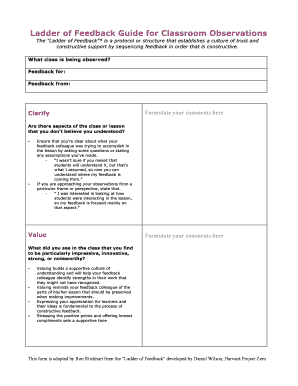
Ladder of Feedback Guide for Classroom Observations The "Ladder of Feedback* is a protocol or structure that establishes a culture of trust and constructive support by sequencing feedback in.

How it works
  • Open form

    Open form follow the instructions

  • Easily sign form

    Easily sign the form with your finger

  • Share form

    Send filled & signed form or save

How to fill out the Ladder of Feedback Guide for Classroom Observations online

The Ladder of Feedback Guide for Classroom Observations is a structured tool designed to facilitate constructive feedback in an educational setting. This guide aims to provide clear instructions for completing the form online, ensuring a supportive and effective feedback process.

Follow the steps to successfully complete the Ladder of Feedback Guide.

  1. Press the ‘Get Form’ button to access the form and open it in your online editor.
  2. Identify the class being observed by entering the appropriate information in the 'What class is being observed?' section.
  3. Provide your feedback in the designated 'Feedback for:' section, naming the individual receiving the feedback.
  4. Fill in the 'Feedback from:' section by noting your name or the name of the person providing the feedback.
  5. In the 'Clarify' section, formulate comments addressing aspects of the class or lesson that were unclear to you. Use prompts to articulate your understanding and any assumptions.
  6. In the 'Value' section, identify and describe what you found impressive or innovative during the observation, using clear and positive language.
  7. Move to the 'Raise Questions & Concerns' section and express any questions or concerns that arose during the observation, framing them as constructive inquiries.
  8. Go to the 'Suggest' section to offer suggestions for refining the observed lesson, noting any potential areas for improvement.
  9. Finally, complete the 'Thank' section by reflecting on what you learned through the observation and how it may inform your teaching practice.
  10. Once you have filled out all sections of the form, save your changes, and if needed, download, print, or share the completed form.

Complete the Ladder of Feedback Guide for Classroom Observations online to enhance your feedback process.

Get form

Experience a faster way to fill out and sign forms on the web. Access the most extensive library of templates available.

Related content

Guidelines for Uniform Performance Standards and...

Sample: Informal Classroom Observation Form Page 1 of 2 ... and through this focus and...

Learn more
Ladder of Feedback Guide for Classroom...

The "Ladder of Feedback”* is a protocol or structure that establishes a culture of trust...

Learn more
Student Handbook - Technical College of the...

Nov 3, 2011 — The student is responsible for obtaining the missed classroom ... Visual...

Learn more
Questions & Answers

Get answers to your most pressing questions about US Legal Forms API.

Contact support

What is the feedback ladder?

The feedback ladder is a structured approach to giving feedback that emphasizes progressive steps in communication. It guides educators through a process that begins with positive reinforcement, followed by constructive criticism, and ends with actionable suggestions. Using the Ladder Of Feedback Guide For Classroom Observations can help you effectively navigate this process. This method ensures that feedback is not only received but also understood and actionable.

To write effective observation feedback, start by being specific about what you observed. Use clear examples to illustrate points and focus on both strengths and areas for improvement. The Ladder Of Feedback Guide For Classroom Observations provides a framework that helps you structure your feedback constructively. By utilizing this guide, you can enhance the quality of your observations and support meaningful dialogue.

The 5 R's of feedback include Respect, Relevance, Rigor, Responsiveness, and Reflection. These principles guide educators in delivering constructive feedback that promotes growth and improvement. By following the Ladder Of Feedback Guide For Classroom Observations, you can ensure your feedback is thoughtful and effective. This approach fosters a positive learning environment where students feel valued and motivated.

The 4 C's of feedback are clarity, consistency, compassion, and constructive critique. These principles ensure that feedback is clear, reliable, empathetic, and aimed at improvement. Educators can utilize the 4 C's within the Ladder Of Feedback Guide For Classroom Observations to foster a supportive learning atmosphere that encourages student growth.

The 4 levels of feedback consist of praise, recommendations, corrections, and questions. These levels categorize feedback based on its purpose and depth. Understanding these levels is essential for effective observations, and the Ladder Of Feedback Guide For Classroom Observations provides practical strategies for implementing them in the classroom.

The 3 R's of feedback are relevance, respect, and reflection. These principles encourage feedback to be meaningful, considerate, and thought-provoking. Incorporating the 3 R's within the Ladder Of Feedback Guide For Classroom Observations helps educators create an environment where students feel valued and motivated to improve.

The ladder of feedback framework is a model that outlines the steps for providing feedback in a clear and supportive manner. It includes specific techniques for educators to engage with students during observations. By utilizing the Ladder Of Feedback Guide For Classroom Observations, teachers can implement this framework to create a positive feedback culture in their classrooms.

The ladder of feedback strategy is a structured approach to giving and receiving feedback effectively. It encourages open communication and promotes a growth mindset among students. This strategy is a core component of the Ladder Of Feedback Guide For Classroom Observations, as it helps teachers facilitate meaningful discussions that lead to actionable insights.

The 5 stages of feedback include setting objectives, gathering information, analyzing data, providing feedback, and reflecting on the process. Each stage plays a crucial role in enhancing the learning experience. By following the Ladder Of Feedback Guide For Classroom Observations, educators can ensure that feedback is constructive and targets specific areas for improvement.

To provide effective feedback after a classroom observation, start by discussing your observations with the teacher. Use the Ladder Of Feedback Guide For Classroom Observations to structure your conversation, focusing on specific examples. This framework encourages a balance between positive comments and constructive criticism, ensuring the feedback is both supportive and actionable. Remember, the goal is to foster improvement and enhance teaching practices.

Get This Form Now!

Use professional pre-built templates to fill in and sign documents online faster. Get access to thousands of forms.

If you believe that this page should be taken down, please follow our DMCA take down process here.

Get Ladder Of Feedback Guide For Classroom Observations