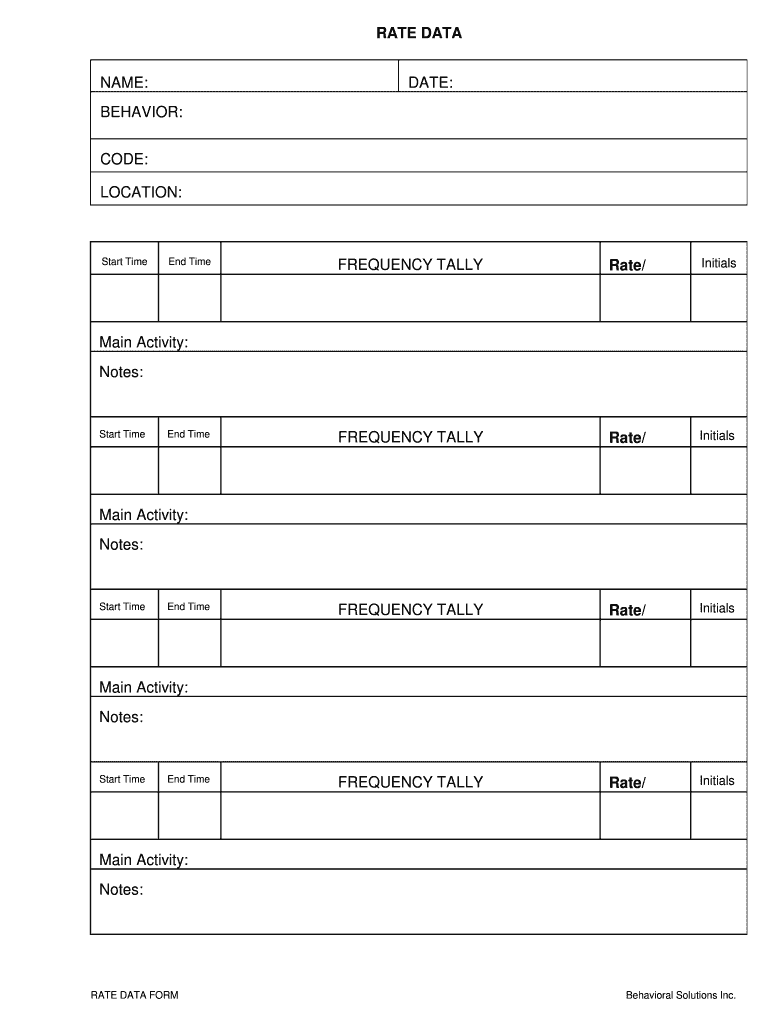
RATE DATA NAME: DATE: BEHAVIOR: CODE: LOCATION: Start Time End Time FREQUENCY TALLY Rate/ Initials FREQUENCY TALLY Rate/ Initials FREQUENCY TALLY Rate/ Initials FREQUENCY TALLY Rate/ Initials Main.
Loading

Open form follow the instructions

Easily sign the form with your finger

Send filled & signed form or save
How to fill out the Event Frequency Data Sheet online
This guide provides a clear and comprehensive overview of how to accurately complete the Event Frequency Data Sheet online. Follow these steps to ensure all required information is filled out correctly and efficiently.
Follow the steps to complete the Event Frequency Data Sheet online with ease.
- Click the ‘Get Form’ button to access the Event Frequency Data Sheet and open it in the editor.
- In the 'NAME' field, enter the name of the person or entity for whom the event is being tracked.
- Fill in the 'DATE' field with the relevant date of the event occurrence.
- Specify the 'BEHAVIOR' being observed by entering a brief description of the behavior.
- Record the 'CODE' associated with the behavior, which may refer to a specific identifier for categorizing behaviors.
- Indicate the 'LOCATION' where the event took place.
- For the 'Start Time' and 'End Time', input the times corresponding to when the behavior was first observed and when it ended.
- In the 'FREQUENCY TALLY' section, fill out the rate and initials for each observed behavior event, repeating as necessary to document multiple observations.
- Include main activities and notes related to each event in the respective sections, ensuring all information is accurately detailed.
- After completing the form, review all entries for accuracy, then choose to save changes, download, print, or share the completed Event Frequency Data Sheet.
Complete your documents online today for a streamlined experience.
Experience a faster way to fill out and sign forms on the web. Access the most extensive library of templates available.
Related content
Aug 20, 2020 — Frequency, Rate and Event Recording. Zoom Meeting ... Data: Frequency...
Examples of ways to collect Frequency/Event Data. Date: Dec 1. Student: ... Observations...
MC68HC05L25 Data Sheet, Rev. 3.1. Freescale ... Event Counter Status/Control Register...
Get answers to your most pressing questions about US Legal Forms API.
What is a radio frequency data sheet?
A radio frequency data sheet is a document that outlines specifications and performance metrics related to radio frequency components or systems. It typically includes details such as frequency ranges, power levels, and operational parameters. By incorporating an Event Frequency Data Sheet, you can analyze how often different radio frequencies are utilized, leading to more effective system designs and optimizations.
What is an example of frequency data in ABA?
In Applied Behavior Analysis (ABA), frequency data tracks the number of times a specific behavior occurs within a set time frame. This data is crucial for assessing behavior patterns and determining the effectiveness of interventions. An Event Frequency Data Sheet can simplify this process, allowing practitioners to visualize data trends and make informed adjustments to treatment plans.
What is the purpose of a data sheet?
The purpose of a data sheet is to provide clear and concise information about specific data points, methodologies, or products. It serves as a reference guide, helping users understand essential details without confusion. When utilizing an Event Frequency Data Sheet, you can easily access information about event occurrences, which aids in decision-making and planning.
What is radio frequency data?
Radio frequency data refers to information collected from signals transmitted over radio waves. This type of data is essential for various applications, including telecommunications and broadcasting. An Event Frequency Data Sheet can be instrumental in analyzing how often these signals are used, providing valuable insights for optimizing communication strategies.
What is a data frequency table?
A data frequency table is a tool that helps you organize and display data points according to their frequency of occurrence. It allows you to see patterns and trends within the data effectively. For those interested in event tracking, using an Event Frequency Data Sheet can enhance your understanding of how often specific events take place, making it easier to draw insights.
What is frequency data in ABA?
The term “frequency” in applied behavior analysis and behavior measurement generally refers to cycles per unit time, or a count (usually of behavior) divided by the time during which it occurred. In statistics, however, the term refers to a count of items in a data set.
What is event or frequency recording in ABA?
Frequency (or event) recording is a way to measure the number of times a behavior occurs within a given period. Frequency recording is best for behaviors with a distinct beginning and end.
What is frequency of event recording?
Event/Frequency Recording - An exact count of how many times a specific behavior occurs (i. Event/Frequency Recording - An exact count of how many times a specific behavior occurs (i.e. Mary gets out of her seat five times without permission during math seat work).
What is frequency recording in ABA example?
However, in Applied Behavior Analysis (ABA), frequency is simply how many times a behavior occurs. He raised his hand ten times is an example of frequency. However, he raised his hands an average of five times an hour is an example of rate. Rate and frequency have both advantages and disadvantages.
What is the difference between event recording and frequency recording?
Event recording is best for behaviors that occur with enough in between to distinguish between the end of one response and the onset of another. Special Considerations: A frequency measure should be used only when the length of observation time is consistent from day to day (e.g., always 2 hours).
Use professional pre-built templates to fill in and sign documents online faster. Get access to thousands of forms.
If you believe that this page should be taken down, please follow our DMCA take down process here.