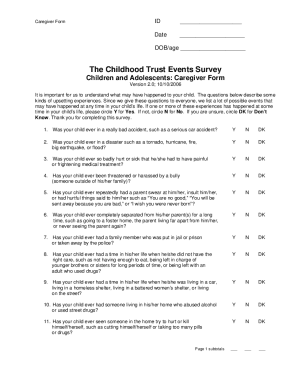
ID Date Caregiver Form DOB/age The Childhood Trust Events Survey Children and Adolescents: Caregiver Form Version 2.0; 10/10/2006 It is important for us to understand what may have happened to your.
Open form follow the instructions
Easily sign the form with your finger
Send filled & signed form or save
How to fill out the Childhood Trust Events Survey online
Completing the Childhood Trust Events Survey is an essential step in understanding your child's experiences. This guide provides detailed, step-by-step instructions to help you fill out the survey accurately and efficiently.
Follow the steps to complete the survey with ease.
- Click the ‘Get Form’ button to access the Childhood Trust Events Survey. This will open the form in your selected editor, allowing you to begin filling it out.
- Fill in the initial fields, including your child's ID, the date, and their date of birth or age. Ensure that all information is accurate to reflect your child's current status.
- Carefully read each question related to potential events in your child's life. For each question, consider if it applies to your child’s experiences.
- For each event listed in the survey, circle 'Y' for Yes if it has happened, 'N' for No if it has not, or 'DK' for Don’t Know if you are unsure.
- Continue responding to each question in the same manner, ensuring you circle the appropriate response clearly.
- After completing all questions, review your responses to ensure nothing has been missed and that all information is correct.
- Once you are satisfied with your answers, save your changes, and use the options available to download, print, or share the completed form as needed.
Complete the Childhood Trust Events Survey online today to support your child's well-being.
Experience a faster way to fill out and sign forms on the web. Access the most extensive library of templates available.
Related content
The National Survey of Children's Health (NSCH) now measures ACEs for children, ... about...
The Childhood Trust Events Survey. Children and Adolescents: Caregiver Form. Version 2.0;...
Child abuse or child maltreatment is physical, sexual, and/or psychological maltreatment...
Get answers to your most pressing questions about US Legal Forms API.
What does childhood trust do?
Childhood Trust works to support children and families affected by trauma by providing resources, awareness, and advocacy. Through initiatives like the Childhood Trust Events Survey, they gather critical data to inform policy and improve services for vulnerable youth. Their commitment to enhancing the well-being of children ensures that every child has the opportunity to thrive despite past challenges.
What is the childhood trust events survey?
The Childhood Trust Events Survey is a systematic tool designed to assess and analyze the impact of childhood experiences on individuals. By collecting data on various traumatic events, the survey aims to highlight the importance of early intervention and support. Utilizing this survey can help organizations and professionals better understand childhood trauma and develop effective strategies for recovery.
What is the 70-item childhood trauma questionnaire?
The 70-item childhood trauma questionnaire is a comprehensive assessment that evaluates various types of childhood trauma. It covers multiple domains, including physical, emotional, and sexual abuse, as well as household dysfunction. This extensive approach allows for a detailed analysis, which can be integrated into a Childhood Trust Events Survey for deeper insights into trauma-related issues.
What is the childhood trauma questionnaire used for?
The childhood trauma questionnaire serves as a valuable tool for identifying and measuring experiences of trauma during childhood. By gathering insights on traumatic events, it helps mental health professionals provide appropriate interventions and support. Additionally, the results can be incorporated into a Childhood Trust Events Survey to better understand the prevalence of trauma and its effects.
What events are considered childhood trauma?
Childhood trauma includes a variety of distressing events that can impact a child's emotional and psychological development. Examples include physical, emotional, or sexual abuse, neglect, parental separation, witnessing violence, and experiencing a major loss. Understanding these events is crucial for assessing their long-term effects, especially in the context of a Childhood Trust Events Survey.
What is the 70 item childhood trauma questionnaire?
The 70-item Childhood Trauma Questionnaire is a comprehensive assessment tool designed to measure various types of childhood trauma. It covers different experiences, including emotional, physical, and sexual abuse, as well as neglect. This questionnaire is often used in conjunction with the Childhood Trust Events Survey to provide a deeper understanding of an individual's experiences.
What are the 5 biggest childhood traumas?
The five biggest childhood traumas typically include physical abuse, sexual abuse, emotional abuse, neglect, and household dysfunction. Each of these traumas can lead to long-term emotional and psychological consequences. The Childhood Trust Events Survey helps in recognizing these traumas to promote healing and recovery.
What is a high CTQ score?
A high Childhood Trust Events Survey score indicates a significant level of childhood trauma experienced by an individual. This score helps mental health professionals identify the need for targeted support and intervention. The higher the score, the more likely the individual may face challenges related to their early experiences.
What questionnaire is used to measure childhood trauma?
The Childhood Trust Events Survey is one effective questionnaire used to measure childhood trauma. It assesses a range of experiences that individuals may have faced during their formative years. Through this survey, users can identify specific events that may have had lasting effects on their lives. This data is crucial for professionals looking to provide targeted support and interventions.
How do I classify in Google Sheets?
Sort data in alphabetical or numerical order On your computer, open a spreadsheet in Google Sheets. Highlight the group of cells you'd like to sort. If your sheet includes a header row, freeze the first row. Click Data Sort range. ... If your columns have titles, click Data has header row.
Use professional pre-built templates to fill in and sign documents online faster. Get access to thousands of forms.
If you believe that this page should be taken down, please follow our DMCA take down process here.