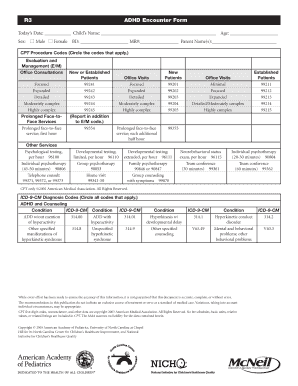
R3 ADHD Encounter Form Today s Date Child s Name Age Sex I Male I Female BD MR Parent Name s CPT Procedure Codes Circle the codes that apply.

How it works
  • Open form

    Open form follow the instructions

  • Easily sign form

    Easily sign the form with your finger

  • Share form

    Send filled & signed form or save

How to fill out the ADHD medical forms online

Filling out the ADHD medical forms accurately is a crucial step in obtaining the appropriate support and resources. This guide provides clear, step-by-step instructions to help you fill out the form correctly, ensuring all necessary information is included to facilitate a thorough assessment.

Follow the steps to complete your ADHD medical forms online.

  1. Press the ‘Get Form’ button to access the ADHD medical forms. This will open the form, allowing you to edit and fill it out.
  2. Begin by entering the today's date in the designated field. This helps establish the context for the appointment and the information being recorded.
  3. Fill in the child's name, age, and sex. This personal information is essential for identification purposes and ensures that the form is linked to the correct patient.
  4. Specify the date of birth (BD) and medical record number (MR#) if applicable. Make sure to check for accuracy to avoid any mix-ups in the healthcare system.
  5. Input the parent or guardian's name(s) in the appropriate section. This information can be important for correspondence and understanding the patient's environment.
  6. Review the CPT procedure codes section and encircle the applicable codes that apply to the evaluation and management of ADHD-related services. This may include various levels of office visits or psychological testing.
  7. Move to the ICD-9-CM diagnosis codes section where you should circle all relevant diagnosis codes that apply to the patient's condition. This step is important for accurate diagnosis and treatment planning.
  8. Refer to the sections on adverse environmental circumstances and any coexisting conditions. Circle any relevant conditions that apply, as this information can provide insight into the patient’s overall health and challenges.
  9. If applicable, completing the internalizing and externalizing disorders section is next. Check all criteria and boxes that apply to ensure the clinician has a comprehensive view of potential issues.
  10. Finally, sign the form at the bottom with the physician's signature and date. This validates the content of the form and the assessments made.
  11. Once you have completed and reviewed all sections, make sure to save your changes. You can then choose to download the form, print it for your records, or share it as needed.

Ensure you complete your ADHD medical forms online today for a smoother healthcare experience.

Get form

Experience a faster way to fill out and sign forms on the web. Access the most extensive library of templates available.

Related content

NIMH » Attention-Deficit/Hyperactivity Disorder

Avoid or dislike tasks that require sustained mental effort, such as schoolwork or...

Learn more
ADD and ADHD Exception Form | Middlebury

NCAA Medical Exception Documentation Reporting Form. to Support the Diagnosis of Attention...

Learn more
Major depressive disorder - Wikipedia

Differential diagnosis · Bipolar disorder, ADHD, sadness. Treatment, Counseling...

Learn more
Questions & Answers

Get answers to your most pressing questions about US Legal Forms API.

Contact support

How to fill in an ADHD form?

To fill in an ADHD form accurately, start by carefully reading each section to understand what information is needed. Provide honest and clear details about your symptoms, daily routines, and any past diagnoses. It can be helpful to gather supporting documents or notes from teachers or family members. Completing each section of ADHD medical forms thoughtfully ensures you receive the best possible guidance for managing your condition.

When filling out an ADHD form, it is vital to provide accurate and detailed information about symptoms and behaviors. Describe specific challenges you face in daily life, such as difficulties with focus, impulsivity, or organization. Moreover, including recent observations and relevant medical history can lead to a better understanding of your situation. Remember, thoroughness in ADHD medical forms contributes to more effective treatment plans.

The 30% rule in ADHD refers to a guideline used in evaluating treatment effectiveness. This rule suggests that if a person experiences a 30% reduction in symptoms, it may indicate a positive response to ADHD medical forms and treatments. Such evaluations help both patients and healthcare providers make informed decisions about the next steps in managing ADHD. Therefore, utilizing ADHD medical forms effectively can enhance this assessment process.

Yes, an ADHD diagnosis generally becomes part of your medical record. This medical record contains important information, including your ADHD medical forms, symptoms, and treatments. Having this diagnosis documented is crucial for receiving ongoing support and services. Furthermore, it helps you and your healthcare team to monitor your treatment progress effectively.

Proving an ADHD diagnosis typically involves providing documentation from a qualified healthcare provider. This documentation may include completed ADHD medical forms detailing your symptoms and their effects on daily life. Additionally, assessments and evaluations conducted by professionals play a critical role in this process. Gathering these materials can support your case for accommodations and services.

To obtain proof of your ADHD diagnosis, you should contact the healthcare provider who assessed you. They can provide you with the necessary documentation or ADHD medical forms that confirm your condition. These forms are essential for educational accommodations or workplace support. Furthermore, ensuring that you have the correct paperwork can facilitate access to resources you may need.

To obtain proof of your ADHD diagnosis, request a copy of your evaluation report from your healthcare provider. They may also supply you with ADHD Medical Forms that outline your diagnosis and treatment recommendations. Keeping these documents handy can be beneficial for seeking accommodations in various settings.

Yes, you can prove that you have ADHD through a formal diagnosis from a healthcare professional. This often involves an evaluation process and the completion of ADHD Medical Forms that detail your symptoms and functional difficulties. These documents are essential for ensuring you receive the appropriate support and accommodations.

Typically, a comprehensive evaluation is required to diagnose ADHD. This evaluation may include interviews, behavioral assessments, and standardized ADHD Medical Forms. These forms are crucial for gathering relevant history and symptoms, helping healthcare providers make accurate diagnoses.

The 10-3 rule for ADHD suggests that for every ten minutes of focused work, an individual may need a break of three minutes. This technique helps maintain productivity without leading to burnout. Using ADHD Medical Forms to track your focus and breaks can provide proof of your strategies and their effectiveness.

Get This Form Now!

Use professional pre-built templates to fill in and sign documents online faster. Get access to thousands of forms.

If you believe that this page should be taken down, please follow our DMCA take down process here.

Get Adhd Medical Forms