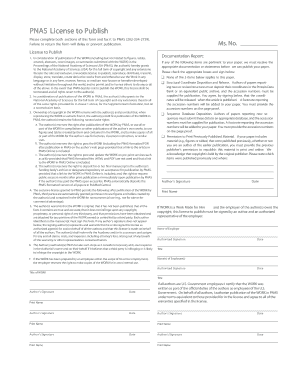
PNAS License to Publish Please complete both sections of this form and e-mail it to PNASauthorlicense nas. Edu or fax it to PNAS 202-334-2739. Failure to return the form will delay or prevent publication. License to Publish 1. In the event that PNAS decides not to publish the WORK this license shall be terminated and all rights revert to the author s. These policies conflict with the PNAS exclusive license to publish. Authors employed by an insti.

How it works
  • Open form

    Open form follow the instructions

  • Easily sign form

    Easily sign the form with your finger

  • Share form

    Send filled & signed form or save

How to fill out the PNAS License To Publish online

The PNAS License To Publish form is an essential document required for the publication of your work in the Proceedings of the National Academy of Sciences. This guide provides comprehensive, step-by-step instructions on how to complete the form accurately, ensuring a smooth publication process.

Follow the steps to successfully complete the form

  1. Press the ‘Get Form’ button to obtain the PNAS License To Publish and access it for editing.
  2. Fill in the title of your work accurately. This should reflect the content of what you are submitting.
  3. In the next section, indicate the authors of the work. Ensure that all individuals who have contributed significantly to the manuscript are listed.
  4. Carefully read and understand the rights being granted to PNAS. These include the sole and exclusive license to publish and distribute your work.
  5. If applicable, check any boxes related to additional documentation, such as depositions or permissions for previously published material.
  6. Sign the form, ensuring that all authors add their signatures where required. If necessary, include a representative signature for institutions if the work is a 'work made for hire'.
  7. Review all entered information for accuracy. Once everything is complete, save your changes, and prepare the document for submission.
  8. Finally, print the form if a physical copy is required, or proceed to share it with PNAS as per the submission guidelines.

Complete your PNAS License To Publish form online today for a seamless publication experience.

Get form

Experience a faster way to fill out and sign forms on the web. Access the most extensive library of templates available.

Related content

Simplifying the Direct Submission process - NCBI...

Sep 22, 2014 — Author information Copyright and License information Disclaimer...

Learn more
PNAS Information for Authors - Brandeis

... member should include a brief statement endorsing publication in PNAS. ... online...

Learn more
Citation impact - Wikipedia

Citation impact is a measure of how many times an academic journal article or book or...

Learn more
Questions & Answers

Get answers to your most pressing questions about US Legal Forms API.

Contact support

Can anyone publish in PNAS?

Yes, anyone can publish in PNAS, provided they have original research that adds to scientific understanding. The PNAS License To Publish allows a wide range of authors to submit articles that are rigorously examined. However, your submission must be well-researched and articulate. By using platforms like uslegalforms, you can prepare the required documentation and navigate the publication procedure with ease.

To obtain permission from PNAS, you must follow their official process outlined on their website. Requesting a PNAS License To Publish typically means you need to submit the necessary forms and provide details about your intended use of the published work. Moreover, it's essential to be clear and precise when communicating your requests. This ensures a smooth and efficient approval process.

Anyone who conducts significant research can submit their work to PNAS. The PNAS License To Publish opens its doors to authors worldwide, including scientists, researchers, and scholars from various disciplines. While there are no strict restrictions, your research should contribute valuable knowledge to your field. PNAS encourages diverse viewpoints and innovative studies.

Publishing in PNAS can be competitive and challenging. The PNAS License To Publish involves a thorough review process, ensuring that submitted articles meet high standards. Many authors find it beneficial to have strong research findings and clear writing to enhance their chances of acceptance. With dedication and the right focus, you can navigate the publication process successfully.

The desk rejection rate at PNAS is relatively high due to the quality of submissions. Many manuscripts do not meet the necessary criteria outlined in the PNAS License To Publish. Potential authors should be aware that only well-prepared and innovative research is likely to progress through the review stages. Preparing your manuscript carefully can significantly improve your chances.

The publication timeline for PNAS can vary significantly, typically ranging from a few months to over a year. Factors influencing this timeline include the complexity of the peer review process and the volume of submissions. To better manage your expectations, familiarize yourself with the PNAS license to publish, as it outlines components that can impact the speed of publication. Patience is key in the world of academic publishing.

A license to publish is an agreement that grants you the rights to reproduce and distribute content you create. In the context of PNAS, this license allows authors to share their findings widely while adhering to the journal's policies. Understanding the PNAS license to publish is vital for protecting your work and ensuring its accessibility to other researchers and the public. This enables broader impact and visibility for your research.

Relevant Science PNAS makes all content free within 6 months of publication and immediately free in 125 lower-income countries. Authors who choose the PNAS open access option pay a surcharge to make their papers immediately free.

Requesting permission Your full name, affiliation, and title. Your complete mailing address, phone number, and email. PNAS volume number, issue number, and issue date. PNAS article title. PNAS authors' names. Page numbers of items to be reprinted. Figure/table number or portion of text to be reprinted.

There are no requirements that an author needs to have an academic title or education. Neither does one have to be affiliated to a university or other form or research institute.

Get This Form Now!

Use professional pre-built templates to fill in and sign documents online faster. Get access to thousands of forms.

If you believe that this page should be taken down, please follow our DMCA take down process here.

Get Pnas License To Publish