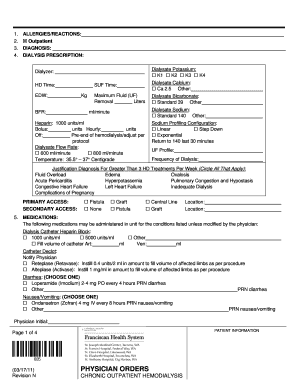
Um Fluid (UF) Removal Liters Dialysate Bicarbonate: Standard 39 Other Dialysate Sodium: Standard 140 Other: ml/minute : 1000 units/ml Bolus: units Hourly: units Off: Pre-end of hemodialysis/adjust per protocol Dialysate Flow Rate: 600 ml/minute 800 ml/minute Temperature: 35.5 37 Centigrade Sodium Profiling Configuration: Linear Step Down Exponential Return to 140 last 30 minutes UF Profile: Frequency of Dialysis: Justification Diagnosis For Greater Than 3 HD Treatments Per We.

How it works
  • Open form

    Open form follow the instructions

  • Easily sign form

    Easily sign the form with your finger

  • Share form

    Send filled & signed form or save

How to fill out the How I Do K4 Dialysis Form online

Filling out the How I Do K4 Dialysis Form online is a straightforward process that requires attention to detail. This guide will walk you through each section of the form, ensuring you capture all necessary information accurately and efficiently.

Follow the steps to complete the form successfully

  1. Press the 'Get Form' button to access the How I Do K4 Dialysis Form in your preferred digital editor.
  2. Begin by entering your allergy information in the designated section. Be sure to list any known allergies or adverse reactions to medications.
  3. Provide your diagnosis in the corresponding area. This should clearly state your medical condition related to dialysis.
  4. Fill out the dialysis prescription section thoroughly. Include details such as dialysate potassium levels (K1, K2, K3, K4), type of dialyzer, the time allocated for HD, dry weight, and blood flow rate.
  5. Complete the medication section that outlines all medications you may need. Indicate dosages, frequency, and any other specifics required for management during dialysis.
  6. In the diagnostics section, list any required lab tests or evaluations, noting the frequency of each test.
  7. Fill out the nutrition and other necessary sections to personalize your care plan according to your medical needs.
  8. Review all the entered information for accuracy. Make any necessary edits to ensure everything is complete and correct.
  9. Once you have confirmed that every section is completed, save your changes. You can then download, print, or share the form as needed.

Start filling out your How I Do K4 Dialysis Form online today!

Get form

Experience a faster way to fill out and sign forms on the web. Access the most extensive library of templates available.

Related content

Basics of base in hemodialysis solution: Dialysate...

Dialysate buffers are found in the form of bicarbonate or bicarbonate ... activities, can...

Learn more
CKiD Study Forms by Visit - statepi

CKiD Form 01: Symptoms List – 01/01/06b ... Do any of the people, adults or children...

Learn more
K4B2R-USA TELEMETRY UNIT User Manual ... - FCC ID

Resting Metabolic Rate Test Metabolism Metabolism can be understood as ... Renal failure...

Learn more
Questions & Answers

Get answers to your most pressing questions about US Legal Forms API.

Contact support

How to chart on a dialysis patient?

Charting on a dialysis patient involves recording vital information during and after each treatment session. Document the patient's vitals, fluid intake, and any complications encountered. Consistent and accurate charting aids in tracking progress over time. Consider using the How I Do K4 Dialysis Form to ensure that your charts are comprehensive and in adherence to best practices.

When writing dialysis instructions, ensure clarity and precision in your documentation. State the type of dialysis, the schedule, and any other pertinent treatment details. This documentation should be accessible for all healthcare professionals involved in the patient's care. Utilizing resources like the How I Do K4 Dialysis Form can make this writing process more straightforward and effective.

The rule of 7 in dialysis patients refers to monitoring and managing specific levels of potassium and phosphorus. Patients should maintain potassium levels below 5.0 mg/dL and phosphorus levels below 5.5 mg/dL to avoid complications. Regular blood tests are essential to ensure these levels remain within a safe range. The How I Do K4 Dialysis Form offers guidance on tracking these vital statistics effectively.

Calculating the ultrafiltration (UF) goal in dialysis involves assessing the patient's weight before and after treatment. First, determine the target weight, which should reflect the patient's dry weight. Then, subtract the post-dialysis weight from the pre-dialysis weight to compute the UF goal. This helps manage fluid balance, and utilizing the How I Do K4 Dialysis Form simplifies your calculations and record-keeping.

To write a dialysis order, include essential patient information, treatment frequency, and specific details about the type of dialysis therapy required. Clearly state lab tests and parameters to monitor during treatment. Proper documentation ensures that healthcare providers maintain a consistent approach to patient care. Using the How I Do K4 Dialysis Form can help streamline this process and ensure all necessary details are included.

The process of dialysis involves several key steps. First, medical staff prepare the patient by placing them on the dialysis machine. Then, the machine filters the blood to remove waste and excess fluid. Finally, the cleaned blood is returned to the patient, and this entire process can vary in duration depending on individual needs. To ensure a smooth experience with this procedure, consider using resources like the How I Do K4 Dialysis Form from US Legal Forms.

To manually calculate KT-V, you need to gather your total dialysate volume and urea concentration, alongside your body weight. The formula incorporates these variables to determine the effectiveness of your dialysis session. Ensuring you have accurate measurements and using the How I Do K4 Dialysis Form can help you maintain precise records and optimize your dialysis care.

Calculating K in dialysis involves measuring the total clearance of urea and factoring in the duration and frequency of treatments. The formula takes into account the volume of blood processed and the concentration of waste being cleared. Be sure to track these calculations in the How I Do K4 Dialysis Form to optimize your treatment.

The rule of 7 suggests that potassium levels should ideally be monitored and maintained at a target of about 7 mEq/L for safety during dialysis. This guideline helps prevent complications related to high potassium levels, which can be dangerous. Utilizing the How I Do K4 Dialysis Form can assist you in managing your potassium levels effectively while undergoing treatment.

The K value, specifically referring to the clearances achieved during dialysis, varies among patients but generally falls between 0.8 to 1.2, reflecting the effectiveness of the treatment. This value plays a crucial role in determining the adequacy of the dialysis process. As you complete the How I Do K4 Dialysis Form, consider your K value to maximize the effectiveness of your treatment.

Get This Form Now!

Use professional pre-built templates to fill in and sign documents online faster. Get access to thousands of forms.

If you believe that this page should be taken down, please follow our DMCA take down process here.

Get How I Do K4 Dialysis Form