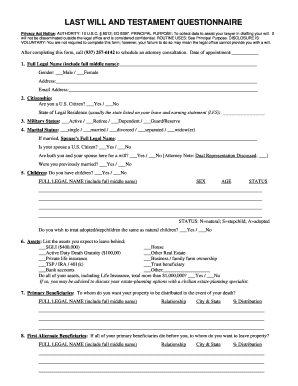
LAST WILL AND TESTAMENT QUESTIONNAIRE Privacy Act Notice: AUTHORITY: 10 U.S.C. 8012; EO 9397. PRINCIPAL PURPOSE: To collect data to assist your lawyer in drafting your will. It will not be disseminated.
Open form follow the instructions
Easily sign the form with your finger
Send filled & signed form or save
How to fill out the LAST WILL AND TESTAMENT QUESTIONNAIRE - Wpafb Af online
Completing the LAST WILL AND TESTAMENT QUESTIONNAIRE is an essential step in ensuring your wishes are honored after your passing. This guide will walk you through each section of the form, providing clear and supportive instructions for filling it out online.
Follow the steps to complete your will questionnaire online.
- Click the ‘Get Form’ button to access the LAST WILL AND TESTAMENT QUESTIONNAIRE. This will open the form in your editing tool of choice, allowing you to begin completing your responses.
- Begin by entering your full legal name, including your middle name, in the designated field. Provide your gender and full address, followed by your email address for future correspondence.
- Indicate your citizenship status by selecting 'Yes' or 'No' for being a U.S. Citizen. Next, fill in your state of legal residence, which is typically the state listed on your leave and earnings statement.
- Next, identify your military status by selecting from the options provided—Active, Retiree, Dependent, or Guard/Reserve. Following this, denote your marital status. If married, include your spouse's full legal name and their citizenship status.
- Provide information about your children. If you have children, list their full legal names, sex, age, and status (natural, stepchild, or adopted) in the appropriate fields. Indicate whether you wish to treat adopted or stepchildren the same as natural children.
- List the assets you plan to leave behind by marking the applicable boxes, which include options such as real estate, life insurance, and bank accounts. State whether the total value of your assets exceeds $1,000,000 for additional estate planning considerations.
- Identify your primary beneficiaries by entering their full legal names, relationships to you, locations, and the percentage of your estate each should receive.
- In case all primary beneficiaries predecease you, list your first alternate beneficiaries in the same manner as the primary list.
- Similarly, provide details for second alternate beneficiaries, detailing their full legal names and the intended distribution of your estate.
- Decide whether you want your child's share to pass to their children if they predecease you by selecting 'Yes' or 'No.'
- Indicate if any of your beneficiaries have a physical or mental disability, allowing for necessary considerations in your will.
- Select an executor or personal representative, providing their full legal name and relationship to you. You may also choose an alternate executor.
- If applicable, specify details regarding trusts for minor children, including the age at which they will receive their share of the estate.
- Nominate a guardian for your children, including their full legal name and relationship to you.
- Indicate if you are interested in establishing a financial power of attorney, giving someone authority to make financial decisions on your behalf.
- Determine if you are interested in healthcare directives, such as a living will or durable health care power of attorney.
- After filling out all relevant sections, make sure to review your entries for accuracy. Save your changes, and if needed, download or print the form to have a physical copy. Share the completed questionnaire with the legal office to schedule an attorney consultation.
Start your preparation for a secure future by filling out your LAST WILL AND TESTAMENT QUESTIONNAIRE online today.
Experience a faster way to fill out and sign forms on the web. Access the most extensive library of templates available.
Related content
May 18, 2020 — March 27, at Holloman Air Force Base, N.M. The individuals in the picture...
By means of a will, you can appoint a person or institution (executor) to ... If one dies...
The Conference Committee hopes that a subsequent volume will emerge to ... 153 G. K...
Get answers to your most pressing questions about US Legal Forms API.
What is required for a will to be valid in Colorado?
For a will to be valid in Colorado, it must be in writing, signed by the testator, and witnessed by at least two individuals. Additionally, the testator must be at least 18 years old and of sound mind at the time of signing. Utilizing a LAST WILL AND TESTAMENT QUESTIONNAIRE - Wpafb Af can simplify compliance with these requirements and help ensure your will is legally viable.
How to fill out a last will and testament form?
To fill out a Last Will and Testament form, start by clearly stating your name and identifying your relationship to the beneficiaries. Be sure to itemize your assets and designate who will receive each item. Using a LAST WILL AND TESTAMENT QUESTIONNAIRE - Wpafb Af provides a helpful template that can streamline this process while ensuring all necessary legal language is included.
How to fill out the last will and testament?
Filling out a Last Will and Testament involves several important steps. First, you should gather information about your assets and beneficiaries. Then, use a LAST WILL AND TESTAMENT QUESTIONNAIRE - Wpafb Af to systematically fill in your details, ensuring you address guardianship, executor selection, and any specific wishes regarding your estate.
Can I write my last will and testament in my own words?
Yes, you can write your Last Will and Testament in your own words, but it's important to follow certain legal guidelines. To avoid confusion and ensure validity, consider using a LAST WILL AND TESTAMENT QUESTIONNAIRE - Wpafb Af which provides a structured format. This can help you express your wishes clearly while adhering to legal requirements.
What is the sample wording for the Last Will and Testament?
A sample wording for a Last Will and Testament typically starts with an introduction stating your full name and a declaration that you are of sound mind. You would then specify how you wish to distribute your property and name an executor to carry out your wishes. Using a LAST WILL AND TESTAMENT QUESTIONNAIRE - Wpafb Af can guide you through this process to ensure clarity and compliance with legal standards.
What is required for a will to be valid in Kentucky?
For a will to be valid in Kentucky, it must be in writing and signed by the testator, or the person making the will. Additionally, the act of signing must be witnessed by at least two people who are present at the same time. The LAST WILL AND TESTAMENT QUESTIONNAIRE - Wpafb Af simplifies these requirements, guiding you through each necessary step to ensure your will is legally binding.
Do wills in Colorado need to be notarized?
In Colorado, a last will and testament does not necessarily need to be notarized, but having it notarized can add an extra layer of validation. A notarized will might help reduce disputes over its authenticity, giving your loved ones peace of mind. Utilizing the LAST WILL AND TESTAMENT QUESTIONNAIRE - Wpafb Af can clarify these legal nuances and assist in preparing a document that meets state guidelines.
What documents do I need to bring to prepare a last will and testament?
To prepare a last will and testament, you should gather important documents that reflect your current financial and familial situation. This includes identification such as your driver's license or passport, a list of your assets, and any existing legal documents concerning your estate. By using the LAST WILL AND TESTAMENT QUESTIONNAIRE - Wpafb Af, you can ensure that you have all necessary information organized, making the process smoother.
Are wills public record in the USA?
Yes, in the USA, wills typically become public records after the testator's death once they are submitted to probate court. This means that, once filed, anyone can view the will and see how the deceased chose to distribute their assets. However, the process and accessibility of these records may vary by state. Utilizing a LAST WILL AND TESTAMENT QUESTIONNAIRE - Wpafb Af allows you to consider privacy issues while drafting your will.
What is the meaning of certified copy?
A certified copy of a document is a copy of an original document which is certified as a true copy by an authorised person. Certification must appear on the front of each page of the submitted document.
Use professional pre-built templates to fill in and sign documents online faster. Get access to thousands of forms.
If you believe that this page should be taken down, please follow our DMCA take down process here.