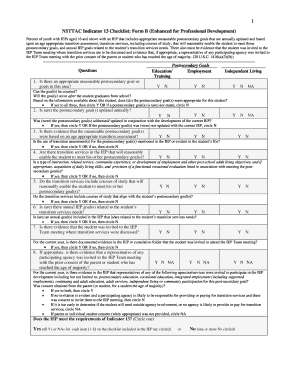
1 NSTTAC Indicator 13 Checklist: Form B (Enhanced for Professional Development) Percent of youth with IEPs aged 16 and above with an IEP that includes appropriate measurable postsecondary goals that.
Open form follow the instructions
Easily sign the form with your finger
Send filled & signed form or save
How to fill out the NSTTAC Indicator 13 Checklist: Form B (Enhanced for Professional Development) online
The NSTTAC Indicator 13 Checklist: Form B is a vital tool for ensuring that youth with Individualized Education Programs (IEPs) have appropriate measurable postsecondary goals. This guide provides step-by-step instructions for successfully completing the checklist online.
Follow the steps to complete the NSTTAC Indicator 13 Checklist.
- Click the ‘Get Form’ button to access the NSTTAC Indicator 13 Checklist: Form B. Once the form is opened, review the initial instructions provided.
- Begin by identifying appropriate measurable postsecondary goals for the student in three key areas: education or training, employment, and independent living. Circle 'Y' or 'N' accordingly based on the presence and appropriateness of these goals.
- Check if the postsecondary goals were updated annually. If the goals align with the current IEP, circle 'Y', if not, circle 'N'.
- Look for evidence that the postsecondary goals are based on an age-appropriate transition assessment. Mark 'Y' if evidence is available.
- Review the transition services listed in the IEP. Confirm that these services support the measurable postsecondary goals. Circle 'Y' or 'N' based on their presence and adequacy.
- Verify that the transition services include a course of study suitable for reaching the student’s postsecondary goals. Circle 'Y' for alignment and 'N' otherwise.
- Check for annual IEP goals that relate to the student’s transition service needs. Circle 'Y' for inclusion and 'N' if absent.
- Determine if there is documented evidence that the student was invited to the IEP team meeting discussing transition services, circling 'Y' or 'N' based on the findings.
- If applicable, verify whether a representative from a participating agency was invited to the IEP meeting with appropriate consent and circle 'Y' or 'N' accordingly.
- Finally, assess if the IEP meets the requirements of Indicator 13. Circle 'Yes' if all necessary items are marked 'Y' or 'NA', and 'No' if any items are marked 'N'.
Complete your documents online by following these steps to ensure thorough compliance and planning for youth’s transition.
Experience a faster way to fill out and sign forms on the web. Access the most extensive library of templates available.
Related content
NSTTAC Indicator 13 Checklist: Form B (Enhanced for Professional Development) ... Based on...
garding Indicator 13 Checklist for Reviewing IEP Pretest and Posttest. 56. Sample...
Get answers to your most pressing questions about US Legal Forms API.
What is indicator 13 and 14?
Indicator 13 focuses on transition planning for students with disabilities, while Indicator 14 evaluates the post-school outcomes of these individuals. Both indicators are crucial for understanding how well schools implement transition services. Using the NSTTAC Indicator 13 Checklist: Form B (Enhanced For Professional ... - Doe Sd helps educators bridge these two indicators effectively. This ultimately supports improved planning and outcomes for students as they move into adulthood.
What is SPP 13?
SPP 13 refers to the State Performance Plan indicator that assesses the transition services provided to students with disabilities. It focuses on the effectiveness of transition planning and the outcomes that schools achieve. The NSTTAC Indicator 13 Checklist: Form B (Enhanced For Professional ... - Doe Sd is integral to this process, allowing schools to evaluate and enhance their services continually. A strong SPP 13 ensures that students receive the support they need for a successful transition.
What is the oldest age you can attend high school in South Dakota?
In South Dakota, students can attend high school until they reach 21 years of age. This includes individuals who are eligible for special education services and require additional time to complete their education. The NSTTAC Indicator 13 Checklist: Form B (Enhanced For Professional ... - Doe Sd can be instrumental in planning for students who may need to extend their schooling. It's essential for creating effective transition plans that address their specific needs.
What is included in IDEA 2004's indicator 13 of the state performance plan?
IDEA 2004's Indicator 13 focuses on the transition services required for students with disabilities. It includes criteria to evaluate whether schools are providing appropriate plans that meet students' unique needs. The NSTTAC Indicator 13 Checklist: Form B (Enhanced For Professional ... - Doe Sd is essential for helping educators understand and implement these criteria effectively. This comprehensive approach leads to better preparation for students as they enter adulthood.
What is the indicator 13 checklist?
The indicator 13 checklist is designed to evaluate the transition planning process for students with disabilities. It includes necessary components such as present levels of performance, measurable goals, and transition services needed for students. Using the NSTTAC Indicator 13 Checklist: Form B (Enhanced For Professional ... - Doe Sd ensures that every aspect of the transition is addressed effectively. This creates a more inclusive environment and facilitates successful outcomes for students.
What is an indicator 13 checklist?
The NSTTAC Indicator 13 Checklist: Form B (Enhanced For Professional ... - Doe Sd serves as a crucial tool for assessing compliance with IDEA regulations. It helps educators ensure that transition plans are meaningful and measurable. This checklist guides schools in creating robust plans that prepare students for life after high school. Ultimately, it supports students in achieving their educational and personal goals.
What should teachers do to document the progress of students with disabilities?
To document the progress of students with disabilities, teachers should maintain clear and consistent records that highlight individual achievements and challenges. Regularly assessing student performance and updating IEPs is crucial for effective monitoring. Resources like the NSTTAC Indicator 13 Checklist: Form B (Enhanced For Professional ... - Doe Sd provide frameworks for teachers to document and enhance student outcomes systematically.
What does 'checklist' mean in education?
In education, a checklist is a detailed list of items or tasks that educators use to ensure all necessary components are addressed. It serves as a guide for teachers and administrators to follow established procedures. A checklist promotes consistency and thoroughness when implementing educational programs like the NSTTAC Indicator 13 Checklist: Form B (Enhanced For Professional ... - Doe Sd.
Is there evidence that the student was invited to the IEP team meeting where transition services were discussed?
Evidence of a student’s invitation to the IEP team meeting is crucial for compliance with the NSTTAC Indicator 13 Checklist: Form B (Enhanced For Professional ... - Doe Sd. The checklist emphasizes the importance of student involvement in discussions related to their future plans. Documenting this invitation helps to validate the student’s role in the transition planning process and ensures their voice is heard.
What is the goal for indicator 13?
Indicator 13 measures “the percentage of youth aged 16 and above with an IEP that includes coordinated, measurable, annual goals and transition services that will reasonably enable the students to meet postsecondary goals.”
Use professional pre-built templates to fill in and sign documents online faster. Get access to thousands of forms.
If you believe that this page should be taken down, please follow our DMCA take down process here.