Loading
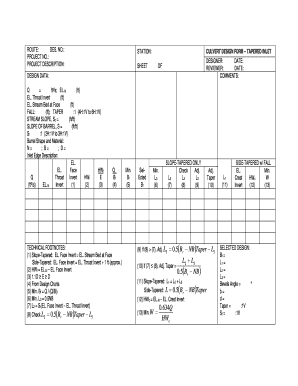
Get Culvert Design Form -- Tapered Inlet - In
How it works
-

Open form follow the instructions
-

Easily sign the form with your finger
-

Send filled & signed form or save
How to fill out the Culvert Design Form – Tapered Inlet - In online
Filling out the Culvert Design Form – Tapered Inlet - In is essential for the proper design and installation of culverts. This guide will provide you with a comprehensive, step-by-step process to ensure accuracy in your submissions.
Follow the steps to fill out the culvert design form effectively.
- Click 'Get Form' button to obtain the form and open it in the appropriate editor.
- Provide project details in the designated fields at the top of the form, including the route, design number, project number, and project description.
- Enter relevant data under the DESIGNER and REVIEWER fields, ensuring that you include the respective dates for tracking purposes.
- In the DESIGN DATA section, accurately input the flow rate (Q), elevation of throat invert (EL.hl), elevation of stream bed at face, and other measurements relevant to your design.
- Specify the taper dimensions and slope parameters, including TAPER and STREAM SLOPE in the given fields. Pay attention to the prescribed ratios (e.g., 4H:1V to 6H:1V).
- Select the barrel shape and material by filling in the respective fields with information regarding the dimensions (N, B, D) of the proposed design.
- Provide details about inlet edge description, ensuring you accurately fill out each elevation measurement (EL. Face, EL. Throat Invert, etc.).
- Refer to the technical footnotes for any specific calculations needed. Ensure that all minimum required values for Bf and L3 are listed, as stipulated in the footnotes.
- Complete the selected design attributes by filling out Bf, L1, L2, L3, bevels angle, taper values, and slope information as required.
- Finally, review your entries for completeness and accuracy. Once verified, save changes, download, print or share the filled-out form as needed.
Complete your documents online now for streamlined processing.
To determine if a culvert is inlet or outlet control, examine the flow conditions and the influence of upstream and downstream water levels. If the inlet is submerged, it typically indicates inlet control, while outlet control occurs when downstream conditions restrict flow. A well-structured Culvert Design Form -- Tapered Inlet - In can assist in assessing these controls accurately.