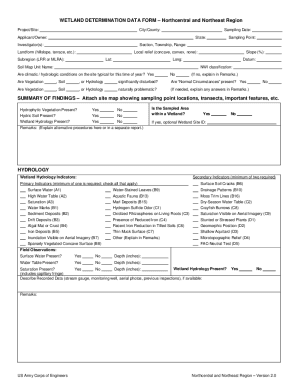
WETLAND DETERMINATION DATA FORM Northcentral and Northeast Region Project/Site: Applicant/Owner: Investigator(s): Landform (hillslope, terrace, etc.): Subregion (LRR or MLRA): Soil Map Unit Name:.

How it works
  • Open form

    Open form follow the instructions

  • Easily sign form

    Easily sign the form with your finger

  • Share form

    Send filled & signed form or save

How to fill out the Wetland Determination Data Form Northcentral Northeast Region online

This guide provides step-by-step instructions on how to complete the Wetland Determination Data Form for the Northcentral and Northeast Regions. Designed for users of all experience levels, this resource aims to assist individuals in accurately filling out the form to meet necessary environmental requirements.

Follow the steps to complete the form accurately.

  1. Press the ‘Get Form’ button to access the Wetland Determination Data Form and open it in your preferred editing tool.
  2. Begin by entering the project or site name, followed by the city or county where the project is located.
  3. Fill in the applicant or owner’s name, including the state and sampling point for clarity.
  4. Document the investigator(s) involved in the wetland determination, along with the section, township, and range information.
  5. Indicate the landform type, such as hillslope or terrace, and specify the local relief and slope percentage.
  6. Select the subregion from the list provided and input the latitude and longitude coordinates, as well as the datum used.
  7. In the climatic/hydrologic conditions section, answer whether conditions are typical for this time of year and provide additional explanations if necessary.
  8. Address whether vegetation, soil, or hydrology has been significantly disturbed and if 'Normal Circumstances' are present.
  9. Complete the summary of findings section, including attaching a site map that indicates sampling points and relevant features.
  10. Answer the hydrological indicators section by checking all applicable primary and secondary indicators observed.
  11. Document your field observations regarding surface water, water table, and saturation present, including depths.
  12. Move on to the vegetation section, using scientific names for plants and detailing the various strata with cover percentages.
  13. Complete the soil section, detailing the profile description and documenting any hydric soil indicators that apply.
  14. If necessary, provide any remarks for clarification in the remarks section throughout the form.
  15. Once all sections are filled out, save changes to your form, and choose to download, print, or share the completed document as needed.

Complete your Wetland Determination Data Form online today to ensure accurate documentation.

Get form

Experience a faster way to fill out and sign forms on the web. Access the most extensive library of templates available.

Related content

WETLAND DETERMINATION DATA FORM – Northcentral...

Sep 15, 2017 — WETLAND DETERMINATION DATA FORM – Northcentral and Northeast Region...

Learn more
WETLAND DETERMINATION DATA FORM – Northcentral...

Northcentral and Northeast Region – Version 2.0. WETLAND DETERMINATION DATA FORM –...

Learn more
Wadeable Streams Assessment: A Collaborative ......

approach, as well as regional meetings to evaluate and refine the results ... The data...

Learn more
Questions & Answers

Get answers to your most pressing questions about US Legal Forms API.

Contact support

What are the parameters for wetland delineation?

Wetland delineation parameters include assessing vegetation types, evaluating soil characteristics, and analyzing hydrology. Each of these parameters provides key insights into the wetland's status and health. The Wetland Determination Data Form Northcentral Northeast Region includes detailed guidelines to ensure accuracy in your delineation efforts. Using this form not only helps in proper classification but also supports environmental stewardship.

While wetland delineation is not always mandatory, it is essential for many projects that may impact wetland areas. This process provides precise information needed for compliance with federal and state regulations. The Wetland Determination Data Form Northcentral Northeast Region can streamline this evaluation, helping you understand when delineation is required. Knowing these requirements can guide your project to meet legal standards effectively.

The three criteria for classifying an area as a wetland include the presence of hydrophytic vegetation, hydric soils, and sufficient saturation during the growing season. Each of these criteria plays a crucial role in determining the ecological status of the area. Utilizing the Wetland Determination Data Form Northcentral Northeast Region can help in systematically assessing these factors. This form provides clarity and structure, ensuring you make informed decisions.

Wetland determination identifies whether an area qualifies as a wetland, while delineation specifies the exact boundaries of that wetland. The Wetland Determination Data Form Northcentral Northeast Region assists in this process by providing standardized guidelines. Understanding both processes is vital for compliance with environmental regulations. By using reliable resources, you ensure that you have accurate information for your project.

Getting a wetland delineation certification typically involves completing a relevant training course and passing an examination. Once certified, professionals can accurately conduct wetland delineations using the Wetland Determination Data Form Northcentral Northeast Region. This certification is crucial for anyone looking to establish a credible career in environmental consulting.

To obtain a wetlands determination, it’s essential to contact a qualified professional who can guide you through the necessary steps. They will employ the Wetland Determination Data Form Northcentral Northeast Region to assess your land and provide a detailed report. Timely and thorough completion of this form ensures that you fulfill all regulatory requirements.

Wetland classification involves recognizing various characteristics, including vegetation, soil types, and hydrology. Utilizing the Wetland Determination Data Form Northcentral Northeast Region can help to document these factors systematically. Doing so allows for accurate classification, aiding in land management decisions and regulatory compliance.

A wetland must meet three criteria: hydrology, hydric soils, and wetland vegetation. Hydrology refers to the presence of water, while hydric soils indicate a specific type of soil that retains moisture. Lastly, wetland vegetation comprises plants adapted to wet conditions. Each of these elements is essential for properly completing the Wetland Determination Data Form Northcentral Northeast Region.

Wetland delineation can be performed by a trained professional, typically a certified wetland scientist or environmental consultant. These experts understand local regulations and the necessary procedures for wetlands assessment. They ensure accurate data collection through the Wetland Determination Data Form Northcentral Northeast Region, which streamlines the entire process.

To obtain a wetland delineation certificate, you must conduct a thorough analysis of the wetland area according to established protocols. After documenting your findings with the Wetland Determination Data Form Northcentral Northeast Region, submit your materials to the relevant local authorities for review. Once approved, you will receive your delineation certificate, confirming the wetland's boundaries and classifications.

Get This Form Now!

Use professional pre-built templates to fill in and sign documents online faster. Get access to thousands of forms.

If you believe that this page should be taken down, please follow our DMCA take down process here.

Get Wetland Determination Data Form Northcentral Northeast Region