Loading
Form preview
  • US Legal Forms
  • Other Templates
  • More Forms
  • More Uncategorized Forms
  • Idph Involuntary Petition

Get Idph Involuntary Petition

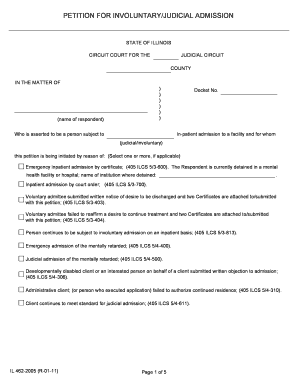
Ubject to Docket No. In-patient admission to a facility and for whom (judicial/involuntary) this petition is being initiated by reason of: (Select one or more, if applicable) Emergency inpatient admission by certificate; (405 ILCS 5/3-600). The Respondent is currently detained in a mental health facility or hospital; name of institution where detained: . Inpatient admission by court order; (405 ILCS 5/3-700). Voluntary admittee submitted written notice of desire to be discharged and two Cer.

How it works

  1. Open form

    Open form follow the instructions

  2. Easily sign form

    Easily sign the form with your finger

  3. Share form

    Send filled & signed form or save

How to fill out the Idph involuntary petition online

Filling out the Idph Involuntary Petition online can be a straightforward process when guided correctly. This guide will help you navigate each section of the petition, ensuring that all necessary information is provided clearly and accurately.

Follow the steps to complete the Idph involuntary petition online successfully.

  1. Press the ‘Get Form’ button to access the Idph Involuntary Petition and open it in your editor.
  2. Begin by entering the name of the respondent at the top of the form. Make sure to double-check the spelling for accuracy.
  3. Provide the docket number relevant to the case, if known.
  4. Select the reason for initiating the petition. You can check one or more options relevant to the respondent’s circumstances. Be thorough in ensuring that you meet the selected criteria.
  5. In the next section, you will assert the relevant mental health conditions of the respondent. Carefully outline the nature of the mental illness and its impact on their behavior and ability to function.
  6. Document any signs or symptoms exhibited by the respondent, including previous diagnoses and treatment history. Be specific and include relevant observations.
  7. List all witnesses who can support the assertions made in the petition. Include their contact information for follow-up.
  8. Identify any legal or financial interests you might have in this matter by selecting the appropriate options.
  9. If no certificate is attached, explain why and detail any efforts made to obtain one.
  10. If a peace officer was involved, provide their name, badge number, and employer information.
  11. Indicate your preferences regarding notification about the respondent's status during their admission process.
  12. Acknowledge that you have made a good faith attempt to ascertain if the respondent has any legal documentation regarding health care.
  13. Sign and date the petition, confirming that the statements made are true to the best of your knowledge. Validate your understanding of the implications of false statements.
  14. Once all sections are filled out, you have the option to save your progress, download the completed petition, print it out, or share it as needed.

Complete the Idph Involuntary Petition online to ensure that all necessary information is submitted effectively.

Get form

Experience a faster way to fill out and sign forms on the web. Access the most extensive library of templates available.
Get form

Related content

Notice of Involuntary Transfer or Discharge and...
FEDERAL PROCEEDING. This facility admits private-pay and Medicare or Medicaid residents...
Learn more
GUARDIANSHIP vs. AGENCY
After the decision is made to file a petition to appoint a guardian, the Illinois Probate...
Learn more

Related links form

Donate-Liquidate-ebay-it.com Consignment Agreement 2006 OK Kids Roster Form 2012 IL DOC 0135 2016 VA Medicaid/Famis Client Appeal Request Form 2021

Questions & Answers

Get answers to your most pressing questions about US Legal Forms API.

Contact support

The criteria for involuntary hospitalization primarily focus on whether the individual poses a substantial risk of harm to themselves or others. Each state has specific regulations, often outlined in legislation related to the Idph Involuntary Petition. Common factors include a diagnosed mental illness, inability to care for themselves, and lack of insight into their condition. Understanding these criteria is crucial, and enlisting a knowledgeable legal team can help clarify the requirements in your jurisdiction.

In Illinois, you can start the process of an Idph Involuntary Petition by filing with the local court, stating the reasons for your concern about the individual’s mental health. You need to provide evidence that the person is a danger to themselves or others. It often helps to have testimonials or evaluations from mental health practitioners to substantiate your claim. Working with a qualified attorney can make the process smoother and more effective.

If someone refuses help but needs it, you can consider filing an Idph Involuntary Petition. This legal action allows you to seek court-ordered treatment for the individual if they pose a risk to themselves or others. It is important to document any concerning behavior and involve health professionals who can provide their assessments. A legal professional can guide you through the process to ensure proper adherence to the law.

To initiate an Idph Involuntary Petition in Michigan, you must file a petition with the appropriate court. This process typically requires you to demonstrate that the person poses a danger to themselves or others due to mental illness. It is advisable to gather supporting documentation from mental health professionals to strengthen your case. Consider consulting with a legal expert to navigate this complex process effectively.

The criteria for initiating an Idph Involuntary Petition typically include evidence that the individual presents a clear danger to themselves or others, and may lack the ability to care for themselves due to mental illness. In many states, the individual must also show signs of severe mental disorder that impairs their judgment or functioning. It is crucial to collect comprehensive documentation and evaluations to meet these legal standards. Utilizing platforms like uslegalforms can assist in preparing the necessary paperwork accurately.

There are generally three types of involuntary commitment: emergency commitment, regular commitment, and judicial commitment. Emergency commitment typically occurs when immediate action is needed to prevent harm. Regular commitment involves a more thorough court process to evaluate an individual’s mental state over an extended period. Judicial commitment occurs after a detailed court hearing and often includes a structured treatment plan, ensuring that the person receives necessary care while respecting their rights.

In Michigan, you begin the process of an Idph Involuntary Petition by filing a petition with the probate court if someone is a danger to themselves or others due to a mental health condition. This petition needs to include specific information about the individual and the reasons for the request. Following the petition, a hearing will be scheduled, allowing the court to determine whether involuntary commitment is necessary. Engaging a legal expert can be advantageous to navigate the state’s procedures effectively.

In Illinois, the Idph Involuntary Petition can be completed by a variety of individuals, including family members, friends, or licensed mental health professionals. Each petition must assert that the individual poses a danger to themselves or others due to mental illness. Thorough documentation and supportive statements enhance the petition’s chances of acceptance.

Typically, family members, guardians, or mental health professionals can file an Idph Involuntary Petition for someone's commitment. This process allows those who care about an individual’s well-being to take action when that person’s safety is at risk due to mental health issues. It is essential to provide clear evidence and reasoning for the petition.

Obtaining an involuntary commitment starts with filing an Idph Involuntary Petition. Next, a mental health evaluation is conducted, followed by a hearing where the evidence is presented. Finally, if the court agrees with the findings, the individual may be committed to a facility for treatment.

Get This Form Now!

Use professional pre-built templates to fill in and sign documents online faster. Get access to thousands of forms.
Get form
If you believe that this page should be taken down, please follow our DMCA take down processhere.
Get Idph Involuntary Petition
Get form
  • Adoption
  • Bankruptcy
  • Contractors
  • Divorce
  • Home Sales
  • Employment
  • Identity Theft
  • Incorporation
  • Landlord Tenant
  • Living Trust
  • Name Change
  • Personal Planning
  • Small Business
  • Wills & Estates
  • Packages A-Z
  • Affidavits
  • Bankruptcy
  • Bill of Sale
  • Corporate - LLC
  • Divorce
  • Employment
  • Identity Theft
  • Internet Technology
  • Landlord Tenant
  • Living Wills
  • Name Change
  • Power of Attorney
  • Real Estate
  • Small Estates
  • Wills
  • All Forms
  • Forms A-Z
  • Other Templates
  • Legal Hub
  • About Us
  • Help Portal
  • Legal Resources
  • Blog
  • Affiliates
  • Contact Us
  • Delete My Account
  • Site Map
  • Industries
  • Forms in Spanish
  • Localized Forms
  • State-specific Forms
  • Forms Kit
  • Real Estate Handbook
  • All Guides
  • Notarize
  • Incorporation services
  • For Consumers
  • For Small Business
  • For Attorneys
  • USLegal
  • FormsPass
  • pdfFiller
  • signNow
  • altaFlow
  • DocHub
  • Instapage
Form Packages
  • Adoption
  • Bankruptcy
  • Contractors
  • Divorce
  • Home Sales
  • Employment
  • Identity Theft
  • Incorporation
  • Landlord Tenant
  • Living Trust
  • Name Change
  • Personal Planning
  • Small Business
  • Wills & Estates
  • Packages A-Z
Form Categories
  • Affidavits
  • Bankruptcy
  • Bill of Sale
  • Corporate - LLC
  • Divorce
  • Employment
  • Identity Theft
  • Internet Technology
  • Landlord Tenant
  • Living Wills
  • Name Change
  • Power of Attorney
  • Real Estate
  • Small Estates
  • Wills
  • All Forms
  • Forms A-Z
  • Other Templates
Customer Service
  • Legal Hub
  • About Us
  • Help Portal
  • Legal Resources
  • Blog
  • Affiliates
  • Contact Us
  • Delete My Account
  • Site Map
  • Industries
  • Forms in Spanish
  • Localized Forms
  • State-specific Forms
  • Forms Kit
Legal Guides
  • Real Estate Handbook
  • All Guides
Prepared for you
  • Notarize
  • Incorporation services
Our Customers
  • For Consumers
  • For Small Business
  • For Attorneys
Our Sites
  • USLegal
  • FormsPass
  • pdfFiller
  • signNow
  • altaFlow
  • DocHub
  • Instapage
Social Media
Call us now toll free:
+1 833 426 79 33
As seen in:
© Copyright 1999-2026 airSlate Legal Forms, Inc. 17 Station Street, Suite 303, Brookline, MA 02445
  • Your Privacy Choices
  • Terms of Service
  • Privacy Notice
  • Content Takedown Policy
  • Bug Bounty Program