TAX TABLE using the Amount on Line 19, Column B:. ..........................20 2 . 23 00 1. Personal Tax Credit:...................................................................................................... 21 2 00 2. Other State Tax Credit:.................................................................................................. 22 2 00 3. Business and Incentive Tax Credit................................................................................ 23 2 2000 00 00.

How it works
  • Open form

    Open form follow the instructions

  • Easily sign form

    Easily sign the form with your finger

  • Share form

    Send filled & signed form or save

How to fill out the AR1002 Fiduciary Tax online

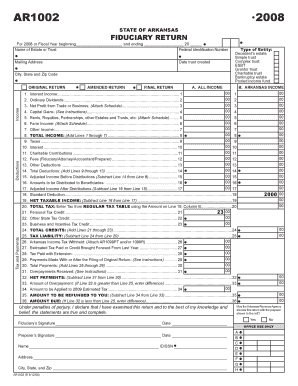
The AR1002 Fiduciary Tax form is essential for reporting the income and deductions of estates and trusts. This guide provides a comprehensive walkthrough to help users navigate the form step-by-step, ensuring accurate completion and filing.

Follow the steps to fill out the AR1002 Fiduciary Tax.

  1. Click ‘Get Form’ button to obtain the form and open it in your selected editor.
  2. Enter the federal identification number of the estate or trust on the respective line. It is crucial for identifying the tax entity accurately.
  3. Provide the name of the estate or trust clearly as it appears in official documents.
  4. Fill out the mailing address, including city, state, and zip code, to ensure any correspondence from the taxation authority is received.
  5. Indicate the date the trust was created. This information helps establish the tax year for reporting.
  6. Select the type of entity by checking the appropriate box, choosing from options like decedent’s estate, simple trust, or charitable trust.
  7. Report all income in Section A, including interest income and dividends. Be sure to attach any necessary schedules for income sources that require additional documentation.
  8. Calculate total deductions in Section B. Include taxes, contributions, and other expenses, adding it all together to derive the total deduction amount.
  9. Compute the adjusted income and amounts to be distributed to beneficiaries in the following fields. It's important to do the math correctly to ensure accurate reporting.
  10. After completing the form, review all entries for accuracy. Users can save changes, download the completed form, print it, or share it as needed.

Ensure you complete your AR1002 Fiduciary Tax form online accurately for timely filing.

Get form

Experience a faster way to fill out and sign forms on the web. Access the most extensive library of templates available.

Related content

Fiduciary and Estate Income Tax Forms | Department...

AR1002NR Non-Resident Fiduciary Income Tax Return, 01/07/2020. AR1002-TC Fiduciary...

Learn more
Planning to Minimize or Eliminate Virginia and...

Nov 11, 2016 — It is not designed or intended to provide financial, tax, legal...

Learn more
Questions & Answers

Get answers to your most pressing questions about US Legal Forms API.

Contact support

Where to file tax form 1041?

You should file tax form 1041 with the IRS, either electronically or by mail. The specific mailing address depends on your location and whether you are enclosing a payment. Ensure you comply with AR1002 Fiduciary Tax requirements when preparing your return. For additional help, uslegalforms can assist you in finding the correct filing address.

To submit a trust tax return, you need to complete Form 1041 accurately, reporting all income and deductions related to the trust. Make sure to follow the guidelines set by AR1002 Fiduciary Tax for proper submission. You can file electronically or via mail, depending on your preference. If necessary, uslegalforms provides tools to simplify the process.

Failing to file Form 1041 can lead to penalties and interest on any unpaid taxes associated with the fiduciary income. The IRS may also initiate further scrutiny into the trust or estate's finances. It is essential to stay compliant to avoid complications under AR1002 Fiduciary Tax regulations. For detailed filing guidance, uslegalforms can be a useful resource.

Fiduciary fees can be subject to tax, but they may also be deductible depending on your tax situation. Generally, the income derived from these fees must be reported as part of the fiduciary's taxable income. Understanding the AR1002 Fiduciary Tax regulations can help you navigate these complexities. For assistance, consider using platforms like uslegalforms.

You should report fiduciary fees on Schedule A of your Form 1040 if you are itemizing deductions. Ensure to categorize these fees correctly to comply with AR1002 Fiduciary Tax. Accurate reporting helps prevent issues with the IRS. If you need help, uslegalforms can guide you through the process.

Yes, fiduciary income is generally taxable. As a fiduciary, you must report the income generated by the trust or estate on Form 1041. This income is subject to tax under the AR1002 Fiduciary Tax guidelines. If you're uncertain about your responsibilities, consider using uslegalforms for personalized assistance.

Fiduciary fees can be deductible on your Form 1040, but certain conditions apply. You must ensure that these fees are necessary and directly related to the management of the trust or estate. It is essential to consult IRS guidelines regarding the AR1002 Fiduciary Tax to maximize your potential deductions. If you have further questions, platforms like uslegalforms can provide valuable resources.

You are required to file a 1041 if the estate or trust has any income, including interest, dividends, and rental income, that totals $600 or more. Additionally, if the estate has a non-resident alien beneficiary, filing is also necessary. Understanding the nuances of income requirements is crucial, and utilizing AR1002 Fiduciary Tax resources can help clarify this for you.

To file a 1041 for an estate, you will need the decedent's final tax return, documentation of all income received by the estate, and records of any expenses or deductions. Additionally, gather any relevant information about assets and liabilities. Our platform provides tools and checklists for managing these documents efficiently using AR1002 Fiduciary Tax.

You need to fill out Form 1041 if the estate or trust generated gross income of $600 or more during the tax year or has a beneficiary who is a non-resident alien. This filing helps the IRS track income for fiduciaries effectively. Make sure to consult our AR1002 Fiduciary Tax resources for a clearer understanding of your obligations.

Get This Form Now!

Use professional pre-built templates to fill in and sign documents online faster. Get access to thousands of forms.

If you believe that this page should be taken down, please follow our DMCA take down process here.

Get AR1002 Fiduciary Tax