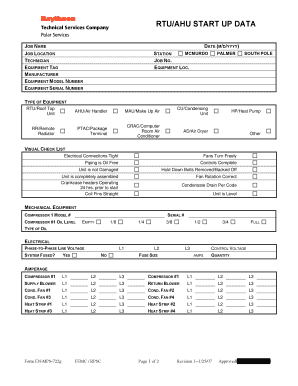
RTU/AHU START UP DATA. Form EN-MPS-722g. FEMC / RPSC. Page 1 of 2. Revision 1-1/25/07 Approved by Jorgen Capener. JOB NAME. DATE (M/D/YYYY) .
Open form follow the instructions
Easily sign the form with your finger
Send filled & signed form or save
How to fill out the RTU/AHU START UP DATA - Nsf online
This guide provides a comprehensive overview of how to accurately fill out the RTU/AHU START UP DATA - Nsf form online. By following these instructions, users can ensure that all required information is correctly submitted for efficient processing.
Follow the steps to complete the form accurately.
- Press the ‘Get Form’ button to access the form and open it in the online editing interface.
- Fill in the job name by providing the specific name associated with the project at hand.
- Enter the date in the format M/D/YYYY to document when the form is filled out.
- Provide the job location, specifying where the equipment is situated.
- List the technician's name responsible for the equipment startup, ensuring clarity in contacts.
- Input the equipment tag, which helps identify the equipment in the maintenance system.
- Specify the manufacturer's name to highlight the equipment's origin.
- Enter the equipment model number as indicated on the equipment label.
- Document the equipment serial number for tracking and warranty purposes.
- Select the type of equipment from the predefined options such as RTU, AHU, or others listed, depending on the specific machinery being referenced.
- Conduct a visual checklist, confirming items such as electrical connections and fan operation, noting any discrepancies.
- For each compressor, list the model and serial number, alongside oil levels and type of oil used.
- Fill in the electrical parameters, including phase-to-phase voltage and whether the system is fused.
- Document the pressures, temperatures, and any other relevant performance metrics for each system component.
- Provide any additional comments or observations that may assist in the startup process.
- Finally, save your changes, and proceed to download, print, or share the completed form as required.
Complete your RTU/AHU START UP DATA - Nsf form efficiently online today.
Experience a faster way to fill out and sign forms on the web. Access the most extensive library of templates available.
Related content
Additional start-up and testing requirements are as specified throughout the technical...
On phased construction projects the aforementioned equipment start-up ... number and the...
Jan 24, 2015 — before starting the installation, to familiarize yourself with. all steps...
Get answers to your most pressing questions about US Legal Forms API.
What does RTU mean on a roof top unit?
What is an RTU Unit? RTU stands for roof-top unit. All the components, including the coils, compressor, and fan, are packaged into a single unit on the roof. Traditionally, most HVAC systems have some components that exist outside, and some that exist inside.
What is the difference between an AHU and RTU?
In conclusion, AHU and RTU are two types of HVAC systems that are used for air conditioning and ventilation in commercial and industrial buildings. AHUs are interior units that circulate and condition air throughout the building, whereas RTUs are outdoor units that offer heating and cooling.
What is the difference between MUA & RTU?
A traditional design utilizes both Make-up Air (MUA) and HVAC Rooftop Units (RTU). MUA is typically used to 'make up' around 80% of air exhausted through the hood. The RTU over the kitchen is used to make up the rest and condition the kitchen space.
Is air handling unit the same as rooftop unit?
AHU stands for Air Handling Unit while RTU is an acronym for Rooftop Unit. An RTU is a type of AHU and as such is there any difference between the twoAHU vs RT? There are no differences between an AHU and an RTU except for the fact that an RTU is placed on the rooftop.
How do you troubleshoot an RTU?
If the RTU doesn't turn on, and the power isn't working, check the fuse. If it's missing or blown, replace it. And, if the fuse is fine but the RTU still won't work, it may have suffered lightning or other serious damage. This RTU will need to be replaced, or brought into the shop for more extensive repairs.
What is the difference between RTU and HVAC?
Traditionally, most HVAC systems have some components that exist outside, and some that exist inside. With an air-cooled split HVAC system, for example, the evaporator and fan are installed inside. But, with an RTU, everything is located outside on the roof. It uses ductwork to circulate air throughout the building.
What is a Mau unit in HVAC?
A makeup air unit, or MAU, is a large handler that provides a building with conditioned fresh air. In particular, it produces both heated and cooled air. Considering this, MAUs are typically used in applications that need high indoor air quality (IAQ).
What is the difference between RTU and Mau?
A larger air handler that conditions 100% outside air, and no recirculated air, is known as a makeup air unit (MAU) or fresh air handling unit (FAHU). An air handler designed for outdoor use, typically on roofs, is known as a packaged unit (PU), heating and air conditioning unit (HCU), or rooftop unit (RTU).
Use professional pre-built templates to fill in and sign documents online faster. Get access to thousands of forms.
If you believe that this page should be taken down, please follow our DMCA take down process here.