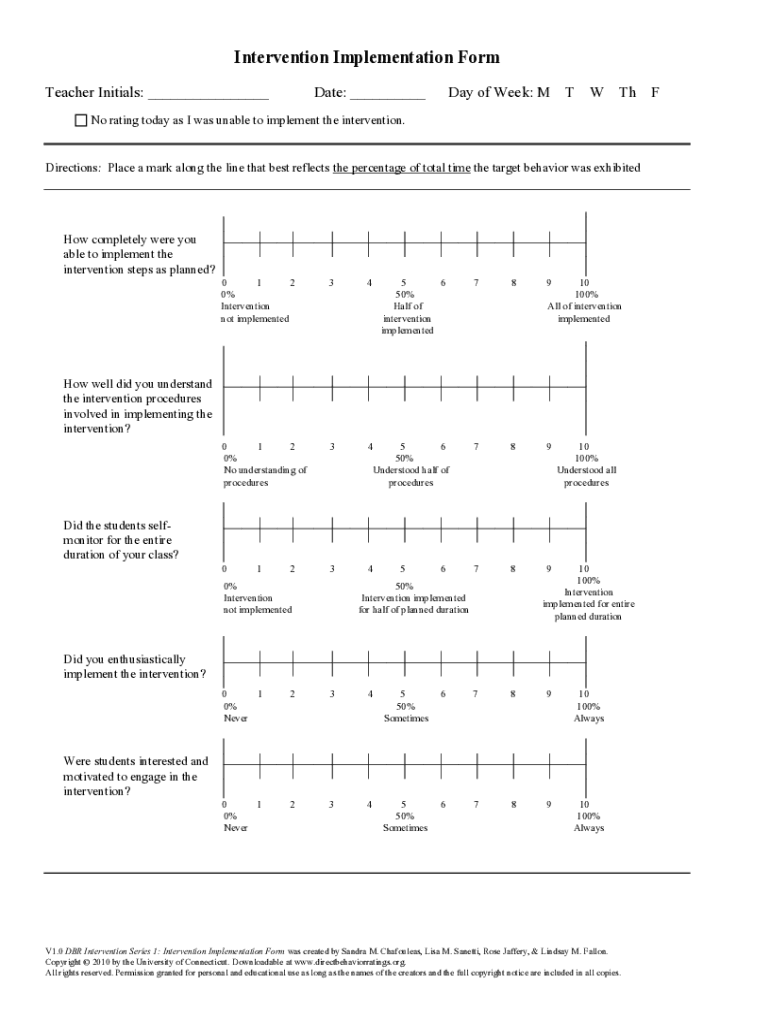
Ntervention. Directions: Place a mark along the line that best reflects the percentage of total time the target behavior was exhibited How completely were you able to implement the intervention steps as planned? 0 1 2 0% Intervention not implemented 3 4 5 6 50% Half of intervention implemented 7 8 9 0 1 2 0% No understanding of procedures 3 4 0 3 4 10 100% All of intervention implemented 5 6 50% Understood half of procedures 7 8 9 7 8 9 How well did you understand the inte.
Loading

Open form follow the instructions

Easily sign the form with your finger

Send filled & signed form or save
How to fill out the Direct Behavior Rating online
The Direct Behavior Rating is a valuable tool for educators to assess the implementation of interventions in a classroom setting. This guide will provide you with clear, step-by-step instructions to effectively complete the form online.
Follow the steps to accurately complete the form
- Press the ‘Get Form’ button to retrieve the form and open it in your chosen editor.
- Begin by entering the teacher's initials in the designated field at the top of the form.
- Fill out the date field by selecting the current date from the calendar option or typing it in manually.
- Indicate the day of the week by marking the appropriate box for Monday, Tuesday, Wednesday, Thursday, or Friday.
- If the intervention was not implemented, select the option 'No rating today as I was unable to implement the intervention.' This step is crucial for accuracy.
- For the first question about implementation, place a mark along the line corresponding to the percentage of time the target behavior was exhibited. Ensure to reflect on how completely the intervention steps were implemented.
- For the next question about understanding the procedures, similarly mark the line to indicate how well you understood the intervention procedures.
- Next, address whether the students self-monitored during the entire duration of your class. Mark the line to reflect the duration of intervention implementation.
- Evaluate your enthusiasm while implementing the intervention. Select the corresponding mark along the line that represents your level of enthusiasm.
- Finally, assess the students' interest and motivation to engage in the intervention. Again, place a mark along the line that best reflects their engagement.
- After completing the form, make sure to save your changes, and if needed, you can download, print, or share the completed form.
Complete your Direct Behavior Rating form online today for accurate tracking and implementation!
Experience a faster way to fill out and sign forms on the web. Access the most extensive library of templates available.
Related content
N This article reviews applications for an assessment tool called Direct Behavior...
If you have used DBR, we would love to hear from you! Click here to give us your feedback...
Direct Behavior Rating ( DBR ) is een gedrag assessment methode die het onderwijs...
Get answers to your most pressing questions about US Legal Forms API.
What is direct behavior rating?
Direct behavior rating is a method used to observe and evaluate specific behaviors as they occur. It allows for immediate assessment and helps track the effectiveness of behavioral interventions. By implementing direct behavior rating systems, educators and professionals can develop targeted strategies that meet individual needs more effectively.
What is a direct measure of behavior?
A direct measure of behavior involves collecting data through real-time observation rather than relying on secondhand reports. This method ensures that the information gathered reflects actual actions and reactions, making it highly reliable. Utilizing direct measures of behavior can significantly improve evaluation accuracy, which is key to effective interventions.
How to rate behavior on a scale?
To rate behavior on a scale, first identify the specific behaviors you want to measure. Next, establish clear criteria that outline what different ratings represent. Then, consistently observe and record behaviors using the defined scale, enabling you to capture accurate data for analysis and future reference.
What is a behavioral rating scale?
A behavioral rating scale is a tool used to evaluate and quantify behavior through various criteria. This scale can include ratings based on frequency, intensity, and quality of observed actions. By using a behavioral rating scale, educators and professionals can gather consistent data to inform interventions and track improvements effectively.
What is DBR data?
DBR data refers to the information collected through direct behavior rating assessments. This data typically includes frequency counts, intensity scores, and duration measures of specific behaviors. By utilizing DBR data, you can analyze patterns and track progress over time, ultimately enhancing behavior management strategies.
What is a direct behavior rating?
A direct behavior rating, often abbreviated as DBR, involves assessing a person's behaviors through direct observation. This method allows educators and parents to gain insights into an individual's actions in real-time. With direct behavior rating, you collect data that is reliable and can help in making informed decisions about interventions and support.
What is direct rating?
Direct rating is a straightforward assessment method that allows individuals to evaluate specific behaviors directly. This technique provides immediate feedback and helps in measuring performance based on observable actions. By focusing on clear criteria, direct rating simplifies the evaluation process, ensuring more accurate outcomes.
How to make a behavior report?
Creating a behavior report involves collecting data using Direct Behavior Rating methods. Begin by documenting observed behaviors, then organize this information into clear sections, such as strengths and areas needing improvement. This structured approach provides a comprehensive view that is beneficial for teachers, parents, and support staff.
How to record student behavior?
To record student behavior effectively, utilize a structured approach like Direct Behavior Rating. Focus on specific behaviors you want to measure, and observe the student during different activities. Consistently logging these observations helps identify trends and informs better behavioral strategies.
What is an example of a rating scale?
An example of a rating scale is the Likert scale, which measures attitudes or feelings on a specific topic. It allows respondents to express their level of agreement or disagreement on a statement, providing useful insights. When integrated with Direct Behavior Rating, such scales can provide a deeper understanding of behavioral trends.
Use professional pre-built templates to fill in and sign documents online faster. Get access to thousands of forms.
If you believe that this page should be taken down, please follow our DMCA take down process here.