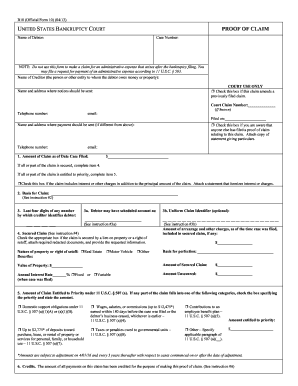
Djustment on 4/01/16 and every 3 years thereafter with respect to cases commenced on or after the date of adjustment. 6. Credits. The amount of all payments on this claim has been credited for the purpose of making this proof of claim. (See instruction #6) B10 (Official Form 10) (04/13) 2 7. Documents: Attached are redacted copies of any documents that support the claim, such as promissory notes, purchase orders, invoices, itemized statements of running accounts, contracts, judgments, mortgage.
Open form follow the instructions
Easily sign the form with your finger
Send filled & signed form or save
How to fill out the Bankruptcy B10 online
The Bankruptcy B10 form, also known as the Proof of Claim, is a crucial document for creditors seeking to recover debts from a debtor in bankruptcy. This guide will provide you with clear steps to effectively complete the form online.
Follow the steps to accurately complete the Bankruptcy B10 form.
- Click ‘Get Form’ button to access the Bankruptcy B10 form and open it in your online editor.
- In the 'Court' section, provide the name of the judicial district, the full name of the debtor, and the bankruptcy case number as indicated at the top of the notice you received.
- Fill in the name and address of the creditor to whom the debtor owes money, ensuring to complete the notice address. If different, use the space provided for the payment address.
- Enter the telephone number and email address where further communications regarding the claim can be sent.
- Indicate if this claim amends a previously filed claim by checking the appropriate box.
- State the total amount of the claim as of the date the case was filed. If applicable, indicate if the claim includes interest or additional charges.
- Complete the 'Basis for Claim' section by specifying how the debt was incurred, such as through goods sold or services performed.
- Provide the last four digits of any number that the creditor uses to identify the debtor, and fill in any information regarding the debtor's scheduled account as applicable.
- If applicable, complete the secured claim section by checking whether the claim is secured, describing the nature of the property, and detailing the amount secured.
- If part of the claim is entitled to priority, check the appropriate box and provide the amount entitled to priority under the relevant U.S. Code sections.
- Attach redacted copies of supporting documents for the claim, ensuring to avoid sending original documents.
- Sign and date the form, confirming that the information provided is accurate to the best of your knowledge. Check the appropriate box regarding your role in the claim.
- Finally, review all the information for accuracy, and then you may save, download, print, or share the completed form as required.
Complete your Bankruptcy B10 form online today to ensure your claim is filed correctly.
Experience a faster way to fill out and sign forms on the web. Access the most extensive library of templates available.
Related content
A proof of claim is a form used by the creditor to indicate the amount of the debt owed by...
Dec 13, 2005 — A proof of claim (Bankruptcy Form B 10) generally must be filed within 90...
This Reporting and Disclosure Guide for Employee Benefit Plans has been prepared by the...
Get answers to your most pressing questions about US Legal Forms API.
What are three requirements to file Chapter 7 bankruptcy?
When considering Chapter 7 bankruptcy B10, you'll encounter three primary requirements. First, you must pass the means test to determine your eligibility based on income. Second, you are required to disclose all your debts and assets, providing a full picture of your financial situation. Third, completing credit counseling before filing is often mandatory, helping you assess your options before pursuing bankruptcy.
What disqualifies you from filing Chapter 7?
Several factors can lead to disqualification from Chapter 7 bankruptcy B10. If you have previously filed for Chapter 7 and received a discharge within the past eight years, you may not qualify. Additionally, failing the means test, or having specific types of debts not eligible for discharge can also prevent you from filing. It's vital to assess your individual circumstances carefully.
What makes you qualify for Chapter 7?
Qualifying for Chapter 7 bankruptcy B10 hinges on your financial situation. Generally, you must demonstrate your inability to repay your debts, which often involves passing the means test based on your income. Factors like your monthly expenses and family size also play a critical role. Understanding these elements can help you determine if Chapter 7 is the right option for you.
What are the main requirements for a Chapter 7 bankruptcy filing?
To file for Chapter 7 bankruptcy B10, you must meet specific requirements. First, you need to pass a means test, which evaluates your income and expenses. Additionally, you must provide comprehensive financial information, including a list of your debts and assets. Certain clients may also need to complete credit counseling before filing, ensuring you have considered all options.
What cannot be forgiven when filing bankruptcy?
When filing for bankruptcy B10, certain debts typically cannot be discharged. This includes most student loans, child support, and recent tax debts. Furthermore, any debt arising from fraud or malicious injury also remains your responsibility. It is crucial to identify these non-dischargeable debts early on in your filing process.
What disqualifies you from filing bankruptcies?
Several factors can disqualify you from filing for bankruptcy B10. If you have previously filed for bankruptcy and dismissed it, or if you have had a bankruptcy denied in the past, you may face restrictions. Additionally, if you have files under certain previous bankruptcy filings within a certain time frame, those can also affect your eligibility. Understanding your specific situation can help you navigate these disqualification factors.
How long does Chapter 10 bankruptcy stay on your credit report?
Generally, Chapter 10 bankruptcy remains on your credit report for about seven years. This can impact your credit score during that time. However, understanding Bankruptcy B10 and how to manage your credit afterward can help you rebuild your financial reputation more effectively.
What is Chapter 10 bankruptcy?
Chapter 10 bankruptcy, also referred to as Bankruptcy B10, involves a business reorganization plan. It enables companies to keep operating while repaying creditors over time. This process can help businesses survive financial difficulty and emerge stronger on the other side.
Which bankruptcy clears all debt?
Chapter 7 bankruptcy is often known for clearing most unsecured debts like credit cards and medical bills. This process allows individuals to eliminate their debts quickly, providing a fresh financial start. However, keep in mind that Bankruptcy B10 serves a different purpose, focusing on reorganization rather than complete debt discharge.
What's the difference between Chapter 7 and Chapter 10?
Chapter 7 bankruptcy offers a fresh start by discharging most unsecured debts, while Chapter 10 bankruptcy is a more complex option that allows for the reorganization of debt. With Bankruptcy B10, businesses can propose a plan to repay creditors over time. Understanding these differences is crucial to choosing the right path for financial relief.
Use professional pre-built templates to fill in and sign documents online faster. Get access to thousands of forms.
If you believe that this page should be taken down, please follow our DMCA take down process here.