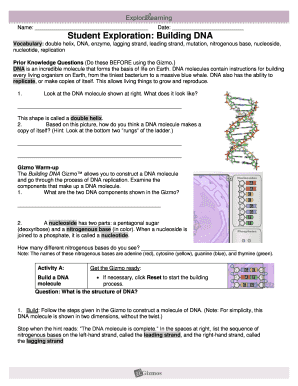
Name: Date: Student Exploration: Building DNA Vocabulary: double helix, DNA, enzyme, lagging strand, leading strand, mutation, nitrogenous base, nucleoside, nucleotide, replication Prior Knowledge.

How it works
  • Open form

    Open form follow the instructions

  • Easily sign form

    Easily sign the form with your finger

  • Share form

    Send filled & signed form or save

How to fill out the Building Dna Gizmo Answers online

This guide provides clear, step-by-step instructions for filling out the Building DNA Gizmo Answers form online. By following these guidelines, users can efficiently complete the form and engage with the exciting content on DNA education.

Follow the steps to successfully complete the Building Dna Gizmo Answers form.

  1. Click the ‘Get Form’ button to access the Building Dna Gizmo Answers form and open it for editing.
  2. Begin by entering your name in the designated field to identify your submission.
  3. Record the date of completion in the appropriate date field.
  4. Proceed to the 'Prior Knowledge Questions' section. Answer each question thoughtfully, reflecting on your understanding of DNA and its structure.
  5. In the 'Gizmo Warm-up' section, specify the two components of DNA as understood from your exploration.
  6. Follow the activity instructions to build a DNA molecule, noting the sequence of nitrogenous bases for both the leading and lagging strands.
  7. Complete the fill-in-the-blank questions regarding the nitrogenous bases and their pairings.
  8. Participate in the practice and challenge questions, providing diagrams and thorough explanations as required.
  9. Finish with the 'Activity B' section, which includes observing the role of enzymes during DNA replication and sketching your findings.
  10. After completing all sections, review your answers for accuracy, and ensure all necessary fields are filled.
  11. Once satisfied with your entries, save your changes, and download, print, or share the form as needed.

Start filling out your Building Dna Gizmo Answers form online today!

Get form

Experience a faster way to fill out and sign forms on the web. Access the most extensive library of templates available.

Related content

Student Exploration Building Dna Gizmos Answer Key

Student exploration building DNA gizmos answer key is an essential resource for educators...

Learn more
Student Exploration Building Dna Gizmos Answer Key

Student exploration building DNA gizmos answer key is an essential resource for educators...

Learn more
Avid 3D User Guide

The software described in this document is furnished under a license agreement. You can...

Learn more
Questions & Answers

Get answers to your most pressing questions about US Legal Forms API.

Contact support

How do the building blocks make up DNA?

The building blocks of DNA, or nucleotides, connect in long chains to create the double helix structure. Each base pairs with a complementary base, forming the rungs of the helix, which holds genetic information. To delve deeper into this topic, Building Dna Gizmo Answers offers a comprehensive look at the assembly and significance of these building blocks.

The 'DNA question' often refers to the inquiry about how genetic information is stored and transmitted. Understanding this concept is vital for anyone interested in genetics. The Building Dna Gizmo Answers provides valuable information on how DNA functions as the blueprint of life.

The primary building block of DNA is the nucleotide. Each nucleotide plays a crucial role in encoding genetic information. Exploring Building Dna Gizmo Answers allows you to learn how these components work together to form the structure of DNA.

DNA is copied through a process called replication. During replication, enzymes unwind the DNA strand, and new nucleotides are added to form a complementary strand. If you are looking for more detailed insights, Building Dna Gizmo Answers can guide you through the various steps involved in this fascinating process.

The building blocks of DNA are known as nucleotides. Each nucleotide consists of a sugar, a phosphate group, and a nitrogenous base. In the context of Building Dna Gizmo Answers, understanding nucleotides is essential for grasping DNA structure and function.

DNA can be described simply as the molecule that contains the genetic instructions for all living things. It helps control activities within cells and is essential for reproduction and hereditary characteristics. To break down these ideas even further, check out Building Dna Gizmo Answers, which simplifies complex topics related to DNA.

A question about DNA could relate to its role in heredity, such as 'How is genetic information passed from parents to offspring?' This type of inquiry often leads to discussions about chromosomes and genes. Platforms like Building Dna Gizmo Answers equip users with clear explanations and resources to explore such questions.

DNA, or deoxyribonucleic acid, is the genetic material that carries the information necessary for the creation and functioning of living beings. It is structured as a double helix, composed of nucleotides that store genetic codes. By exploring Building Dna Gizmo Answers, you can gain deeper insights into this vital molecule.

DNA acts as the fundamental blueprint for life by providing the instructions needed for growth, development, and functioning of all living organisms. Each DNA strand contains sequences that dictate everything from physical traits to biological processes. Understanding this concept is crucial, and resources like Building Dna Gizmo Answers can guide you through these essential principles.

The sides of the ladder are made of alternating sugar and phosphate molecules. The sugar is deoxyribose. The rungs of the ladder are pairs of 4 types of nitrogen bases. Two of the bases are purines- adenine and guanine.

Get This Form Now!

Use professional pre-built templates to fill in and sign documents online faster. Get access to thousands of forms.

If you believe that this page should be taken down, please follow our DMCA take down process here.

Get Building Dna Gizmo Answers