Loading
Form preview
  • US Legal Forms
  • Other Templates
  • More Forms
  • More Multi-State Forms
  • Section 9 2 The Krebs Cycle And Electron Transport Answer Key

Get Section 9 2 The Krebs Cycle And Electron Transport Answer Key

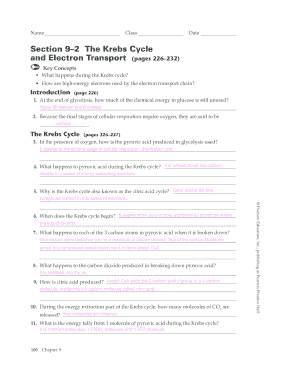
18. Is the following sentence true or false? Hydrogen serves as the final electron acceptor of the electron transport chain. false 19. What is the energy of the high-energy electrons used for every time 2 high-energy electrons move down the electron transport chain? Their energy is used to transport hydrogen ions across the membrane. 20. What causes the H+ ions in the intermembrane space to move through the channels in + the membrane and out into the matrix? During electron transport, H ions.

How it works

  1. Open form

    Open form follow the instructions

  2. Easily sign form

    Easily sign the form with your finger

  3. Share form

    Send filled & signed form or save

How to fill out the Section 9 2 The Krebs Cycle And Electron Transport Answer Key online

Filling out the Section 9 2 The Krebs Cycle And Electron Transport Answer Key online can be a straightforward process. This guide will help you navigate through each section and field of the form, ensuring you provide all necessary information accurately.

Follow the steps to complete the answer key effectively.

  1. Press the ‘Get Form’ button to access the document and open it in your preferred online editor.
  2. Begin by entering your name in the designated field. Ensure it is clearly written for identification purposes.
  3. Next, fill in your class information in the specified section, as this will help contextualize your responses.
  4. Date the document by writing the current date in the provided space. This adds a timestamp to your submission.
  5. Proceed to answer the questions regarding the Krebs cycle. Read each question carefully and provide your answers based on the relevant study material.
  6. For the questions related to electron transport, make sure your responses reflect the key concepts discussed in the textbook sections indicated.
  7. Once all questions are answered, review your responses for accuracy and completeness. Making sure all sections are filled out is crucial.
  8. Finally, you can save any changes made to the document. Options to download, print, or share the form should be used as necessary to finalize your submissions.

Start filling out your document online today for a seamless experience.

Get form

Experience a faster way to fill out and sign forms on the web. Access the most extensive library of templates available.
Get form

Related content

Cellular Respiration Virtual Lab Answer Key
the stages of glycolysis, the Krebs cycle, and the electron transport chain. The cellular...
Learn more
Chapter 9 Cellular Respiration Chemical Pathways...
Krebs cycle electron transport chain ATP NADH FADH2 pyruvate citric acid cycle oxidative...
Learn more
Monitored Natural Attenuation of Inorganic...
in most microorganisms by an electron transport chain to an electron acceptor which, in...
Learn more

Related links form

Vehicle Movement Record Sample TELANGANA STATE WAQF BOARD The Hong Kong University Of Science And Technology Academic Records And Registration, Academic BIRTHDAY INVITATION CARD

Questions & Answers

Get answers to your most pressing questions about US Legal Forms API.

Contact support

To easily memorize the Krebs cycle, try visualizing the cycle as a circular pathway and use color-coded diagrams to highlight different components. Interactive learning tools or apps that visualize the cycle in motion may also help reinforce your memory. For structured guidance and strategies, you can consult Section 9 2 The Krebs Cycle And Electron Transport Answer Key for effective memorization tips.

The energy from high-energy electrons moving through the electron transport chain (ETC) is harnessed to pump protons across the mitochondrial membrane, creating a proton gradient. This gradient ultimately drives the synthesis of ATP via ATP synthase, a process known as oxidative phosphorylation. Understanding this dynamic is crucial, and you can find detailed explanations in Section 9 2 The Krebs Cycle And Electron Transport Answer Key.

The products of the Krebs cycle include carbon dioxide, ATP, NADH, and FADH2, among others. Specifically, every turn of the cycle generates 2 molecules of ATP, 8 molecules of NADH, 2 molecules of FADH2, and releases 6 molecules of CO2. Water is also produced in small amounts during these biochemical reactions. For clarity on these products, be sure to check Section 9 2 The Krebs Cycle And Electron Transport Answer Key.

The correct sequence of the Krebs cycle starts with citrate formation, followed by multiple transformations that lead to isocitrate, alpha-ketoglutarate, succinyl-CoA, succinate, fumarate, and malate. Finally, the cycle concludes with the regeneration of oxaloacetate. This sequence is essential for energy production, and understanding it fully can be facilitated by referring to Section 9 2 The Krebs Cycle And Electron Transport Answer Key.

To effectively remember the enzymes involved in the Krebs cycle, you can use mnemonic devices or memory aids that associate each enzyme with a visual cue or a simple phrase. Creating flashcards with the enzyme names, their order, and corresponding functions may also enhance retention. For an organized summary, consider reviewing Section 9 2 The Krebs Cycle And Electron Transport Answer Key for additional tips on this topic.

The key steps of the Krebs cycle include the formation of citrate, its transformation through several intermediates, and the regeneration of oxaloacetate. Key enzymes participate in these steps, facilitating the conversion of citrate into various forms while releasing high-energy carriers and carbon dioxide. Understanding these steps is crucial; therefore, you may want to check Section 9 2 The Krebs Cycle And Electron Transport Answer Key for comprehensive information.

The Krebs cycle, also known as the citric acid cycle, is comprised of eight key steps that facilitate the conversion of acetyl-CoA into carbon dioxide and energy. It begins with the combination of acetyl-CoA with oxaloacetate to form citrate. Through a series of transformations, citrate is converted back to oxaloacetate, producing NADH, FADH2, and ATP along the way. For more details, refer to Section 9 2 The Krebs Cycle And Electron Transport Answer Key.

The eight steps of the cycle are a series of redox, dehydration, hydration, and decarboxylation reactions that produce two carbon dioxide molecules, one GTP/ATP, and reduced forms of NADH and FADH2.

Step 7: Fumarate is converted to malate (another four-carbon molecule). Step 8: Malate is then converted into oxaloacetate. The third molecule of NADH is also produced.

Krebs cycle Steps Oxidative Decarboxylation of pyruvate to Acetyl CoA. Step 1: Condensation of acetyl CoA with oxaloacetate. Step 2: Isomerization of citrate into isocitrate. Step 3: Oxidative decarboxylations of isocitrate. Step 4: Oxidative decarboxylation of α-ketoglutarate.

Get This Form Now!

Use professional pre-built templates to fill in and sign documents online faster. Get access to thousands of forms.
Get form
If you believe that this page should be taken down, please follow our DMCA take down processhere.
Get Section 9 2 The Krebs Cycle And Electron Transport Answer Key
Get form
  • Adoption
  • Bankruptcy
  • Contractors
  • Divorce
  • Home Sales
  • Employment
  • Identity Theft
  • Incorporation
  • Landlord Tenant
  • Living Trust
  • Name Change
  • Personal Planning
  • Small Business
  • Wills & Estates
  • Packages A-Z
  • Affidavits
  • Bankruptcy
  • Bill of Sale
  • Corporate - LLC
  • Divorce
  • Employment
  • Identity Theft
  • Internet Technology
  • Landlord Tenant
  • Living Wills
  • Name Change
  • Power of Attorney
  • Real Estate
  • Small Estates
  • Wills
  • All Forms
  • Forms A-Z
  • Other Templates
  • Legal Hub
  • About Us
  • Help Portal
  • Legal Resources
  • Blog
  • Affiliates
  • Contact Us
  • Delete My Account
  • Site Map
  • Industries
  • Forms in Spanish
  • Localized Forms
  • State-specific Forms
  • Forms Kit
  • Real Estate Handbook
  • All Guides
  • Notarize
  • Incorporation services
  • For Consumers
  • For Small Business
  • For Attorneys
  • USLegal
  • FormsPass
  • pdfFiller
  • signNow
  • altaFlow
  • DocHub
  • Instapage
Form Packages
  • Adoption
  • Bankruptcy
  • Contractors
  • Divorce
  • Home Sales
  • Employment
  • Identity Theft
  • Incorporation
  • Landlord Tenant
  • Living Trust
  • Name Change
  • Personal Planning
  • Small Business
  • Wills & Estates
  • Packages A-Z
Form Categories
  • Affidavits
  • Bankruptcy
  • Bill of Sale
  • Corporate - LLC
  • Divorce
  • Employment
  • Identity Theft
  • Internet Technology
  • Landlord Tenant
  • Living Wills
  • Name Change
  • Power of Attorney
  • Real Estate
  • Small Estates
  • Wills
  • All Forms
  • Forms A-Z
  • Other Templates
Customer Service
  • Legal Hub
  • About Us
  • Help Portal
  • Legal Resources
  • Blog
  • Affiliates
  • Contact Us
  • Delete My Account
  • Site Map
  • Industries
  • Forms in Spanish
  • Localized Forms
  • State-specific Forms
  • Forms Kit
Legal Guides
  • Real Estate Handbook
  • All Guides
Prepared for you
  • Notarize
  • Incorporation services
Our Customers
  • For Consumers
  • For Small Business
  • For Attorneys
Our Sites
  • USLegal
  • FormsPass
  • pdfFiller
  • signNow
  • altaFlow
  • DocHub
  • Instapage
Social Media
Call us now toll free:
+1 833 426 79 33
As seen in:
© Copyright 1999-2026 airSlate Legal Forms, Inc. 17 Station Street, Ste. 203, Brookline, MA 02445
  • Your Privacy Choices
  • Terms of Service
  • Privacy Notice
  • Content Takedown Policy
  • Bug Bounty Program