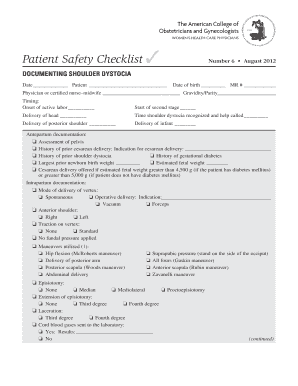
Patient Safety Checklist Number 6 August 2012DOCUMENTING SHOULDER DYSTOCIA Date Patient Date of birth MR # Physician or certified nursemidwife Gravidity/Parity Timing: Onset of active labor Start.
Open form follow the instructions
Easily sign the form with your finger
Send filled & signed form or save
How to fill out the Safety Checklist For Shoulder Dystocia online
Filling out the Safety Checklist For Shoulder Dystocia is essential for documenting the care provided during a shoulder dystocia event. This guide offers clear instructions to help users effectively complete the form online.
Follow the steps to complete the checklist accurately
- Press the ‘Get Form’ button to access the form and open it in your preferred digital editing platform.
- Enter the date and fill in the patient's name and date of birth, ensuring accuracy for proper record-keeping.
- Input the medical record number and the names of the physician or certified nurse-midwife overseeing the case.
- Document gravidity and parity, reflecting the patient's obstetric history accurately.
- Record relevant timing information such as the onset of active labor, start of the second stage, and delivery times.
- Complete the antepartum documentation by checking the appropriate boxes and providing any necessary details regarding past medical history.
- Fill in the intrapartum documentation including the mode of delivery, maneuvers utilized, and any episiotomy details if applicable.
- Document the status of the neonate before leaving the delivery room, including Apgar scores, injury evidence, and birth weight.
- Finalize postoperative documentation, ensuring that follow-up care, counseling, and assessments are recorded thoroughly.
- After completing all sections, save the form, download it, print it, or share it with relevant parties as needed.
Complete the Safety Checklist For Shoulder Dystocia online today to ensure comprehensive documentation and improve patient safety.
Experience a faster way to fill out and sign forms on the web. Access the most extensive library of templates available.
Related content
JavaScript is disabled. In order to continue, we need to verify that you're not a robot...
Shoulder Dystocia. SHOULDER DYSTOCIA CHECKLIST. Shoulder Dystocia checklist ...Read more
Get answers to your most pressing questions about US Legal Forms API.
Why is careful, comprehensive, and precise documentation following a shoulder dystocia delivery important?
Careful documentation following a shoulder dystocia delivery plays a pivotal role in patient safety and quality care. It enables healthcare providers to review the effectiveness of interventions and informs future protocols. Additionally, precise records protect against legal implications and are essential for meeting compliance standards, making it a cornerstone of the Safety Checklist For Shoulder Dystocia.
What must be documented during a shoulder dystocia?
Documentation during a shoulder dystocia must include a detailed account of the events leading to the incident, the interventions performed, and any maternal or fetal status updates. It’s essential to note the time frames of each action taken to provide a complete picture of care quality. This comprehensive documentation is crucial for future reference and aligns with the Safety Checklist For Shoulder Dystocia.
What are the first two steps that should be taken once shoulder dystocia is diagnosed?
Once shoulder dystocia is diagnosed, the first crucial step is to call for help, ensuring that additional assistance is on the way. Next, healthcare providers should employ the McRoberts maneuver to maximize pelvic opening. These initial actions are vital components of the Safety Checklist For Shoulder Dystocia, enabling the healthcare team to respond efficiently and effectively.
What is the protocol for shoulder dystocia?
The protocol for managing shoulder dystocia involves several critical steps. First, healthcare providers should perform an immediate assessment to confirm the diagnosis and call for assistance. Following that, the appropriate maneuvers, such as utilizing the McRoberts maneuver and suprapubic pressure, should be executed swiftly. The Safety Checklist For Shoulder Dystocia provides a structured outline to ensure that all team members follow these vital steps effectively.
What should be documented after a shoulder dystocia delivery?
After a shoulder dystocia delivery, it is essential to document the time of diagnosis, the maneuvers used, and the outcome of the delivery. Additionally, you should record any maternal or fetal complications that arose during the process. Proper documentation serves not only to inform future care but also aligns with the Safety Checklist For Shoulder Dystocia, ensuring all critical steps are tracked.
What are three crucial nursing interventions during a shoulder dystocia?
During a shoulder dystocia, nurses should focus on three key interventions: first, they must call for additional help to ensure proper support. Secondly, they should implement the McRoberts maneuver, which involves flexing the mother's legs towards her chest to widen the pelvis. Lastly, applying suprapubic pressure can help dislodge the impacted shoulder, significantly enhancing delivery success. These steps should be part of a comprehensive Safety Checklist For Shoulder Dystocia.
How to check for shoulder dystocia?
Checking for shoulder dystocia involves careful observation during delivery. Medical professionals should look for signs like a prolonged second stage of labor or difficulty delivering the fetal shoulders. Utilizing a Safety Checklist For Shoulder Dystocia can greatly assist in early identification and prompt response, helping to prevent complications during childbirth.
What should a nurse do for shoulder dystocia?
When dealing with shoulder dystocia, a nurse plays a crucial role in the response team. Nurses should be trained to recognize the signs, provide support to the mother, and assist in implementing the Safety Checklist For Shoulder Dystocia. This includes preparing necessary equipment and ensuring that emergency protocols are followed to facilitate a safe delivery.
What is the Rubin 1 and 2 maneuver?
The Rubin 1 and 2 maneuvers are techniques used to relieve shoulder dystocia during childbirth. The Rubin 1 maneuver involves rotating the fetal shoulders, while the Rubin 2 maneuver focuses on pushing the posterior shoulder downward. Both maneuvers are important components of the Safety Checklist For Shoulder Dystocia, helping medical staff to act confidently in critical delivery situations.
What does the nurse do for shoulder dystocia?
Nurses play a vital role in obtaining assistance during a shoulder dystocia, keeping time, assisting with maneuvers such as suprapubic pressure, and documenting the dystocia management.
Use professional pre-built templates to fill in and sign documents online faster. Get access to thousands of forms.
If you believe that this page should be taken down, please follow our DMCA take down process here.