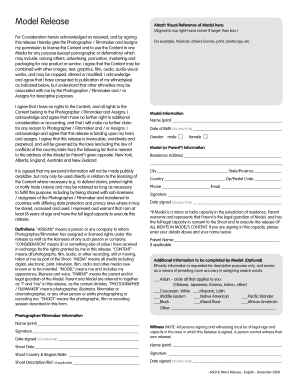
By give the Photographer / Filmmaker and Assigns my permission to license the Content and to use the Content in any Media for any purpose (except pornographic or defamatory) which may include, among others, advertising, promotion, marketing and packaging for any product or service. I agree that the Content may be combined with other images, text, graphics, film, audio, audio-visual works; and may be cropped, altered or modified. I acknowledge and agree that I have consented to publication of my.

How it works
  • Open form

    Open form follow the instructions

  • Easily sign form

    Easily sign the form with your finger

  • Share form

    Send filled & signed form or save

How to fill out the Alignment By Agreement - CS Stanford online

Filling out the Alignment By Agreement - CS Stanford form is an essential step in ensuring clarity and consent regarding the use of visual content. This comprehensive guide provides a clear and user-friendly approach to completing the form online.

Follow the steps to successfully complete the Alignment By Agreement - CS Stanford form.

  1. Click ‘Get Form’ button to acquire the form and open it in an online editor. This will allow you to view and fill out the necessary information.
  2. Begin by attaching a visual reference of the model in the designated area at the top right-hand corner of the form, especially if the image is larger than the provided box.
  3. Read the section regarding the permission granted to the photographer/filmmaker. Ensure you understand that the rights to the content will belong to them.
  4. Fill in the model information by providing your name, date of birth, and checking the appropriate gender option. Make sure to print clearly.
  5. Next, provide your residence address, including city, state or province, country, and zip or postal code.
  6. Enter your phone number and email address in the specified fields for effective communication.
  7. Sign and date the form in the designated areas, ensuring that the date format aligns with the required DD/MM/YEAR styling.
  8. If you are a minor or lack legal capacity, a parent or legal guardian must also sign the document. They should fill in their name and details as needed.
  9. Optionally, complete the additional information regarding ethnicity for descriptive purposes. Circle all that apply to you.
  10. Ensure that the photographer/filmmaker completes their section by providing their printed name, signature, and the date signed.
  11. Select a witness to sign the document. Note that all signers must be of legal age and capacity. The witness also needs to provide their printed name, signature, and date signed.
  12. Provide the shoot details, including the date, country, region/state, and any description if applicable.
  13. Once all fields are filled out and verified for accuracy, save your changes, download or print the completed form for your records.

Complete the Alignment By Agreement - CS Stanford form online today to ensure clarity and consent in your visual content usage.

Get form

Experience a faster way to fill out and sign forms on the web. Access the most extensive library of templates available.

Related content

Multiple alignment of protein sequences with...

by TM Phuong · 2006 · Cited by 60 — ProDA is a practical tool for automated alignment...

Learn more
Alignment by Agreement

by P Liang · Cited by 596 — We present an unsupervised approach to symmetric word...

Learn more
Evaluation of DeepSeek AI Models

Sep 16, 2025 — CAISI evaluated DeepSeek models and reference models on Cybench, a...

Learn more
Questions & Answers

Get answers to your most pressing questions about US Legal Forms API.

Contact support

What is the difference between alignment and agreement?

The primary distinction is that alignment focuses on shared understanding and intent, while agreement is about establishing formal consent. Alignment aims to create a cohesive direction among parties, while agreements can sometimes exist without complete alignment. Delving into Alignment By Agreement - CS Stanford can provide further insights into how to foster both alignment and agreement effectively.

Contract alignment refers to ensuring that all terms and conditions within a contract are in harmony with the intended goals and objectives of the parties involved. It helps prevent misunderstandings and promotes a smooth execution of agreements. Understanding contract alignment is essential, and utilizing tools like Alignment By Agreement - CS Stanford can support this process effectively.

A synonym for alignment is 'coordination.' This term reflects the idea of bringing different entities or ideas into agreement or harmony. When discussing Alignment By Agreement - CS Stanford, coordination plays a vital role in ensuring that all stakeholders are on the same page.

Arrangement denotes the organization of elements in a specific order, while alignment emphasizes the goal of harmonizing those elements to achieve a shared objective. In legal terms, arrangements can refer to contractual terms, whereas alignment may involve a broader strategic vision. Considering Alignment By Agreement - CS Stanford can help you understand these concepts in a more integrated manner.

In the context of Natural Language Processing (NLP), alignment refers to the process of matching textual elements to enhance understanding and interpretation. This technique enables systems to process human language more effectively by creating relationships between words and phrases. By utilizing Alignment By Agreement - CS Stanford, practitioners can improve the accuracy and relevance of NLP applications.

Alignment and agreement are closely related but not identical. Alignment focuses on ensuring that all parties share a common understanding and direction. Meanwhile, agreement often refers to a formal contract or consensus that may not encompass the shared vision. For better clarity on Alignment By Agreement - CS Stanford, understanding these nuances is crucial.

Alignment refers to the process of ensuring that various elements, such as goals and strategies, are consistent and supportive of one another. On the other hand, an agreement signifies a formal understanding between parties. While alignment can exist without a formal contract, agreements often create a framework for achieving alignment. Thus, grasping both concepts is vital for effective collaboration, especially when considering Alignment By Agreement - CS Stanford.

An arrangement refers to a mutual understanding or setup that may not have binding legal implications. In contrast, an agreement is a formal, enforceable contract between parties, designed to create legal obligations. Arrangements can be informal, while agreements signify a serious commitment to terms and conditions. Understanding this distinction is crucial for anyone exploring Alignment By Agreement - CS Stanford.

The four types of alignment include strategic alignment, organizational alignment, operational alignment, and cultural alignment. These categories reflect different aspects of how businesses and projects can be harmonized to achieve common goals. Strategic alignment focuses on long-term objectives, while organizational alignment deals with the structure and resources of a group. Operational alignment, on the other hand, addresses processes, and cultural alignment emphasizes shared values and behaviors, all of which are essential when considering Alignment By Agreement - CS Stanford.

Setting the alignment of a paragraph involves selecting the desired text alignment option, often through a word processor. For students in class 9, this typically includes options like left, right, center, or justified alignment. Just as clear paragraph alignment enhances readability, ensuring contract alignment through Alignment By Agreement - CS Stanford promotes clearer communication.

Get This Form Now!

Use professional pre-built templates to fill in and sign documents online faster. Get access to thousands of forms.

If you believe that this page should be taken down, please follow our DMCA take down process here.

Get Alignment By Agreement - CS Stanford