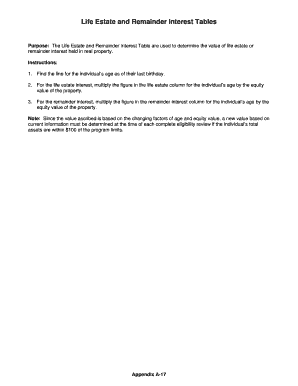
Life Estate and Remainder Interest Tables Purpose The Life Estate and Remainder Interest Table are used to determine the value of life estate or remainder interest held in real property. Instructions 1. Find the line for the individual s age as of their last birthday. 2. For the life estate interest multiply the figure in the life estate column for the individual s age by the equity value of the property. 3. For the remainder interest multiply the figure in the remainder interest column for the individual s age by the equity value of the property. Note Since the value ascribed is based on the changing factors of age and equity value a new value based on current information must be determined at the time of each complete eligibility review if the individual s total assets are within 100 of the program limits. Appendix A-17 LIFE ESTATE REMAINDER AGE. 02812. 01012. 00983. 00992. 01116. 01178. 01252. 01337. 01435. 01547. 01671. 01934. 02063. 02185. 02300. 02410. 02755. 02880. 03014. 03159.....
Open form follow the instructions
Easily sign the form with your finger
Send filled & signed form or save
How to fill out the Life Estate Tables 2020 online
The Life Estate Tables 2020 are crucial for determining the value of life estate or remainder interests in real property. This guide provides step-by-step instructions for completing the form online, ensuring clarity for all users, regardless of their legal experience.
Follow the steps to fill out the Life Estate Tables 2020 effectively.
- Click the ‘Get Form’ button to access the Life Estate Tables 2020. This will open the document in an online editor, allowing you to fill out the necessary information.
- Locate the line corresponding to the individual's age, using the last birthday to determine the correct line to reference in the tables.
- For the life estate interest, find the figure in the life estate column that aligns with the individual's age and multiply this by the equity value of the property.
- Next, for the remainder interest, identify the figure in the remainder interest column corresponding to the individual's age and multiply this by the equity value of the property.
- Keep in mind that values based on age and equity can change; conduct a review each time eligibility is assessed, especially if total assets fluctuate near the program limits.
- Once all calculations are complete, review your form for accuracy, then proceed to save your changes, download, print, or share the form as needed.
Begin completing your Life Estate Tables 2020 online today.
Experience a faster way to fill out and sign forms on the web. Access the most extensive library of templates available.
Related content
Aug 26, 2025 — The tax law requires that you use these actuarial tables to value...
This administrative regulation establishes the appropriate United States life mortality...
Apr 15, 1976 — Life tenant. Generally, if you hold business or investment property as a...
Get answers to your most pressing questions about US Legal Forms API.
How do I calculate the value of an estate?
To calculate the value of an estate, gather all assets and liabilities associated with the estate. Use current market values for all property owned and subtract any outstanding debts. Incorporating the Life Estate Tables 2020 in your analysis provides vital data on life expectancies, making your valuation process more precise and reliable.
How to calculate net estate?
Calculating the net estate requires you to subtract the total liabilities from the total assets. Begin by identifying all assets, including those that may be subject to life estates, and then deduct any debts or obligations. Reference the Life Estate Tables 2020 to factor in relevant life estate information, ensuring your calculations are thorough and accurate.
How to calculate life estate?
To calculate a life estate, determine the fair market value of the property and the life expectancy of the individual holding the estate. Use the Life Estate Tables 2020 to find the relevant mortality rates, which allow you to establish the present value of the life estate. This calculation ultimately helps in estate planning, ensuring that all parties understand their rights and values.
How to calculate the estate?
Calculating the estate involves summing up all assets and liabilities at the time of death. Start with the fair market value of your assets, including real estate, investments, and personal property, then subtract any debts or liabilities. By referring to the Life Estate Tables 2020, you can accurately assess life estates and other elements of your estate, leading to clearer valuations.
How to value an annuity for estate tax purposes?
Valuing an annuity for estate tax purposes involves determining its present value based on the remaining term and payment amounts. You can use actuarial tables like the Life Estate Tables 2020 to estimate the life expectancy of the annuitant and choose the appropriate interest rate. This approach ensures a fair valuation of the annuity, crucial for accurate estate tax assessments.
Who creates actuarial tables?
Actuarial tables are typically created by actuaries, who are professionals trained in mathematics, statistics, and financial theory. These tables are essential for estimating life expectancies and are updated periodically, reflecting changes in mortality rates and other relevant factors. The Life Estate Tables 2020 provide users with reliable data to inform their estate planning decisions.
How do I use the IRS life expectancy table?
To use the IRS life expectancy table, first identify the appropriate table that corresponds to your needs, such as the Life Estate Tables 2020. Locate your age on the table to find the estimated life expectancy. This estimate helps you make informed decisions related to taxation, retirement planning, and estate planning. Proper utilization of these tables can clarify your outlook on future financial matters.
Are actuarial tables public information?
Yes, actuarial tables, including the Life Estate Tables 2020, are typically available to the public. Many resources, including government agencies, publish these tables for transparency and accessibility. You can find them online through various platforms, such as U.S. Legal Forms, which offers easy access to these valuable resources. This public availability ensures that individuals can access the information they need without any barriers.
How often are actuarial tables updated?
Actuarial tables, including the Life Estate Tables 2020, are generally refreshed every few years, depending on data availability and research advancements. Regular updates are crucial to reflect the latest demographic trends and factors affecting longevity. This ensures that users can rely on the most accurate information for planning and analysis. Keeping abreast of these changes helps ensure that you’re making informed decisions.
What is a life estate table?
A life estate table is a specific type of actuarial table that outlines life expectancy for individuals based on their age and other demographic factors. The Life Estate Tables 2020 serve this purpose and help users gauge how long an individual may retain interest in an estate. This tool is crucial for estate planning and informs decisions regarding property distribution among heirs. Using these tables can provide clarity and direction in estate management.
Use professional pre-built templates to fill in and sign documents online faster. Get access to thousands of forms.
If you believe that this page should be taken down, please follow our DMCA take down process here.