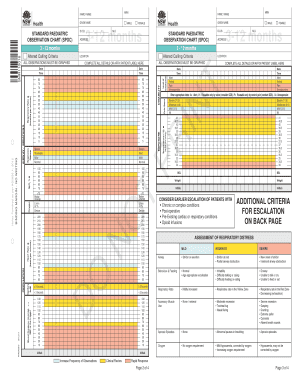
MRN FAMILY NAME GIVEN NAME Altered Calling Criteria 312 months D.O.B. / / M.O. STANDARD PAEDIATRIC OBSERVATION CHART (SPOC) ADDRESS COMPLETE ALL DETAILS OR AFFIX PATIENT LABEL HERE T N O 220 210 200.
Open form follow the instructions
Easily sign the form with your finger
Send filled & signed form or save
How to fill out the Paediatric Obs Chart online
Filling out the Paediatric Observation Chart (SPOC) online is an essential task for monitoring the health of pediatric patients. This guide provides comprehensive instructions on how to accurately fill out each section of the form to ensure effective tracking of vital signs and other critical observations.
Follow the steps to accurately complete the Paediatric Obs Chart
- Click the ‘Get Form’ button to access the Paediatric Obs Chart online and open it in your editor.
- Begin by entering the patient's family name and given name in the designated fields at the top of the chart.
- Fill in the medical record number (MRN) and the patient's date of birth, which are vital for accurate recordkeeping.
- Input the address of the patient to maintain proper identification and contact details.
- Note the altered calling criteria if applicable, and complete all other relevant patient details or affix a patient label.
- In the 'Observations' section, accurately record vital signs, including temperature, heart rate, respiratory rate, and oxygen saturation.
- Indicate the level of consciousness using the appropriate letters: A for alert, V for rousable by voice, P for rousable by pain, and U for unresponsive.
- Complete the pain score by selecting the severity level based on the unit policy outlined on the chart.
- Graph all observations as required, using the designated areas and scales provided in the chart for easy reference.
- Review all entered information for accuracy before finalizing your entries.
- Once completed, you can save changes, download, print, or share the form as needed for further processing.
Complete the Paediatric Obs Chart online now to ensure accurate and effective patient monitoring.
Experience a faster way to fill out and sign forms on the web. Access the most extensive library of templates available.
Related content
Apr 1, 2025 — Pediatric Vital Signs. Heart Rate (beats/min) 1. Respiratory rate...
This calculator can help to determine whether a child has a healthy blood pressure for...
To obtain accurate vital signs (Temperature, HR, RR, BP) in a pediatric patient in...
Get answers to your most pressing questions about US Legal Forms API.
What is the correct sequence of obtaining vital signs in an infant?
The correct sequence for obtaining vital signs in an infant starts with temperature, followed by heart rate, respiratory rate, and then blood pressure. This order ensures that the infant remains calm, as the temperature measurement can be less distressing. Record each finding on the Paediatric Obs Chart promptly. Consistency in this process can improve the accuracy of health assessments.
How to take vital signs for pediatric?
Taking vital signs for pediatric patients requires using child-friendly methods. Start with temperature, followed by pulse, respiration, and blood pressure using appropriately sized tools. Ensure you communicate with the child to reduce anxiety during the process. Document all measurements carefully in the Paediatric Obs Chart for thorough tracking over time.
How to obtain pediatric vital signs?
To obtain pediatric vital signs, begin with a gentle approach to make the child comfortable. Measure the temperature, pulse, respiration, and blood pressure using appropriate pediatric-sized equipment. Record all findings on the Paediatric Obs Chart to maintain accurate health records. This approach helps healthcare professionals provide better care tailored to the child’s needs.
How to calculate pediatric heart rate?
To calculate pediatric heart rate, count the number of heartbeats for a full minute at the chest or wrist. It's important to ensure the child is calm to obtain an accurate reading. Document this information on the Paediatric Obs Chart for ongoing monitoring. Consistent recording enables healthcare providers to assess heart rate trends effectively.
What are the normal vital signs for pediatrics?
Normal vital signs for pediatrics vary by age but generally include a heart rate of 70-160 beats per minute, a respiratory rate of 20-30 breaths per minute, and a blood pressure range appropriate for the child’s age and size. Utilizing a Paediatric Obs Chart can help ensure that these values are recorded accurately. Regularly updating this chart allows for quick identification of any deviations from normal ranges.
What is an OBS chart?
An OBS chart, or observation chart, is a tool used in healthcare to track vital signs and other clinical observations. This chart is crucial for assessing the condition of pediatric patients consistently. With the Paediatric Obs Chart, healthcare professionals can identify trends and changes in a child's health, facilitating timely interventions.
How to record vital signs on a chart?
To record vital signs on a Paediatric Obs Chart, start by measuring the child's temperature, pulse, respiration rate, and blood pressure. Clearly document each measurement in the appropriate section of the chart. This ensures a comprehensive view of the child's health status. This method allows healthcare providers to monitor changes over time effectively.
What are the observations on the paediatric PEWS?
Observations on the pediatric PEWS include measurements of heart rate, respiratory rate, temperature, and the child's level of consciousness. These indicators help healthcare professionals gauge the severity of a child's condition and make timely clinical decisions. When documented within a Paediatric Obs Chart, these observations create a clear visual representation of the child's health status. This context aids in prioritizing care and interventions appropriately.
How to fill out an RDR chart?
Filling out a RDR (Recognition, Decision, Response) chart involves documenting a child's vital signs and observations accurately. Ensure you record the time, the observed parameters, and any relevant changes in the child’s condition. Utilizing a Paediatric Obs Chart can streamline this process, making it easier to note observations systematically. This approach ensures that vital updates are communicated effectively within the healthcare team.
What are pediatric vital signs PEWS?
Pediatric vital signs PEWS refer to the vital measurements used in the PEWS system to evaluate a child's health status. They include heart rate, respiratory changes, blood pressure, and temperature, which help quantify clinical severity. Employing a Paediatric Obs Chart when recording these vital signs allows healthcare providers to spot trends and possible deterioration. This structured assessment enhances overall quality of care for pediatric patients.
Use professional pre-built templates to fill in and sign documents online faster. Get access to thousands of forms.
If you believe that this page should be taken down, please follow our DMCA take down process here.