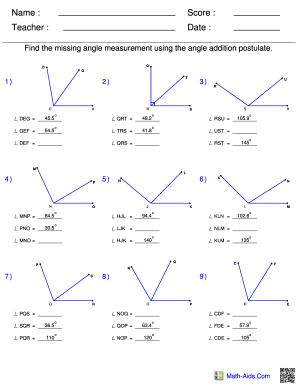
Name : Score : Teacher : Date : Find the missing angle measurement using the angle addition postulate. Q D G 1) T 2) E R F o 3) S S o 45.5 / DEG T o 48.2 / QRT o U R 105.9 / RSU o 54.5 / GEF 41.8.
Open form follow the instructions
Easily sign the form with your finger
Send filled & signed form or save
How to fill out the Find the missing angle measurement using the angle addition postulate online
This guide provides users with clear, step-by-step instructions on how to accurately fill out the Find the missing angle measurement using the angle addition postulate form. This online process will ensure that you complete the measurement activities efficiently.
Follow the steps to complete your angle measurement form.
- Use the ‘Get Form’ button to access the form and open it in the editing platform.
- Begin by entering your name in the appropriate field at the top of the form. This identifies who is completing the form.
- Next, input the current date in the designated section for the date. This helps track when the measurements were taken.
- Locate the measurement questions labeled 1 through 9. For each question, use the angle addition postulate to fill in the missing angle values.
- For question 1, find the missing measurement based on the provided angles, like the angle measuring 45.5 degrees. Calculate accordingly.
- Continue to the following questions, applying the same method for each missing angle by considering the angles in the same set.
- Once all questions are filled out, review each entry to ensure accuracy. Double-check calculations if necessary.
- After finalizing your entries, you can save changes to the form, download it for your records, print it out, or share it directly online if required.
Complete your angle measurement form online today and ensure that you have all necessary calculations recorded.
Experience a faster way to fill out and sign forms on the web. Access the most extensive library of templates available.
Related content
addition postulate to find a missing angle? To find a missing angle using the angle...
To find a missing angle using the angle addition postulate, add the measures of the...
Angles in a Triangle. Find the measure of each angle indicated. 1). 57 ... Find the...
Get answers to your most pressing questions about US Legal Forms API.
How do you find the measurement of the unknown angles?
Finding the measurement of unknown angles involves analyzing the relationships between known angles. Setting up equations based on these relationships allows you to isolate the unknown angle. By applying the angle addition postulate, you will successfully find the missing angle measurement in various geometrical contexts.
What is the formula to find the measure of an angle?
There isn't a single formula for angle measures, as it depends on angle relationships. Generally, for supplementary angles, the formula is: measure of angle A + measure of angle B = 180 degrees. Utilizing these relationships and the angle addition postulate will guide you in finding the missing angle measurement accurately.
How to calculate a missing angle measure?
Calculating a missing angle measure starts with identifying the type of angle relationships at play, whether they are complementary or supplementary. Use simple equations to set up your unknown angle based on the known angle information. This clear approach enables you to find the missing angle measurement using the angle addition postulate effectively.
How to calculate missing angle measures?
To calculate missing angle measures, identify known angles and their relationships. For example, if two angles are complementary, subtract the known angle from 90 degrees. By applying this technique, you can find the missing angle measurement using the angle addition postulate, enhancing your geometry skills.
What is the angle addition postulate?
The angle addition postulate states that if you have two adjacent angles, the sum of their measures is equal to the measure of the larger angle they form. This principle is crucial when calculating unknown angle measures. By using this postulate, you can efficiently find the missing angle measurement in many geometric situations.
How do you find the value of the missing angles?
Finding the value of missing angles requires an understanding of angle relationships, such as complementary, supplementary, and vertical angles. Use the relationships between angles to set up equations. This approach not only helps find the specific angle you need but also aids in grasping how to find the missing angle measurement using the angle addition postulate.
What is the angle angle postulate?
The angle angle postulate states that if two angles of one triangle are equal to two angles of another triangle, then the two triangles are similar. This means they have the same shape but not necessarily the same size. Understanding this concept helps you apply the angle addition postulate to find the missing angle measurement in various geometrical problems.
How to find missing angles in supplementary angles?
To find missing angles in supplementary angles, you need to remember that supplementary angles add up to 180 degrees. If you know one angle, subtract its measurement from 180. This method allows you to find the missing angle and effectively apply the concept of how to find the missing angle measurement using the angle addition postulate.
How do you find the missing value of an angle?
To find the missing value of an angle, observe the relationships between the angles presented. Use known measurements and apply rules like supplementary, complementary, or the angle addition postulate. By working through the calculations and isolating the missing angle variable, you can find its value confidently. This step-by-step process leads you to the correct angle measurement every time.
How do you find the missing angle of a figure?
Finding the missing angle of a figure typically involves analyzing the shapes’ properties. Start by determining how many degrees the full shape represents; for example, triangles have 180° and quadrilaterals have 360°. Apply the angle addition postulate to calculate the missing angle by subtracting the sum of the known angles from the total. This method provides a clear path to solving your angle problems.
Use professional pre-built templates to fill in and sign documents online faster. Get access to thousands of forms.
If you believe that this page should be taken down, please follow our DMCA take down process here.