Loading
Form preview
  • US Legal Forms
  • Other Templates
  • More Forms
  • More Multi-State Forms
  • Cpted Checklist

Get Cpted Checklist

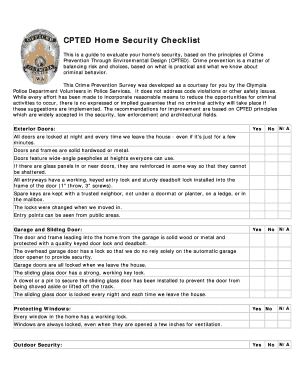
CPTED Home Security Checklist This is a guide to evaluate your homes security, based on the principles of Crime Prevention Through Environmental Design (CPTED). Crime prevention is a matter of balancing.

How it works

  1. Open form

    Open form follow the instructions

  2. Easily sign form

    Easily sign the form with your finger

  3. Share form

    Send filled & signed form or save

How to fill out the Cpted Checklist online

The Cpted Checklist is a valuable tool designed to evaluate your home’s security based on the principles of Crime Prevention Through Environmental Design. This guide will provide you with clear, step-by-step instructions to help you complete the checklist effectively and enhance your home security.

Follow the steps to fill out the Cpted Checklist online

  1. Click the ‘Get Form’ button to obtain the Cpted Checklist and open it for editing.
  2. Begin by evaluating your exterior doors. For each entry on the form, mark 'Yes', 'No', or 'N/A' as applicable. Pay attention to details like door locks, peepholes, and key storage practices.
  3. Proceed to the garage and sliding door section. Again, indicate the status of each item with 'Yes', 'No', or 'N/A'. Ensure you assess the quality of locks and security measures present.
  4. Next, fill out the protecting windows section. Confirm that all windows have functioning locks. Record whether they are secured even when slightly open.
  5. In the outdoor security section, evaluate the visibility around your home. Mark your assessment of lighting, landscaping, and other external security measures.
  6. Assess security measures when away from home. Mark the options that pertain to lighting timers, alarm systems, and arrangements made for mail or newspaper collection.
  7. Finally, review the outdoor valuables and personal property section. Indicate the security measures in place for items like bicycles or firearms. It's also beneficial to confirm that your home inventory is documented.
  8. Once you have filled out all sections of the Cpted Checklist, make sure to save your changes. You may then download, print, or share the completed form as needed.

Start completing your Cpted Checklist online today to enhance your home security!

Get form

Experience a faster way to fill out and sign forms on the web. Access the most extensive library of templates available.
Get form

Related content

CPTED Home Security Checklist
This is a guide to evaluate your home's security, based on the principles of Crime...
Learn more
Crime Prevention Through Environmental Design...
A streamlined version of the public transit checklist, more appropriate for use at bus...
Learn more
Incident Checklist - OperationsCommander (OPSCOM)
Accessing the Checklist. To access the checklist go into any incident and click on the...
Learn more

Related links form

The Use Of Event Data Recorders In The Analysis Of Real ... - NHTSA - Nhtsa Opnom Felician Health Clearance Form Quotation Form - Bank Of India

Questions & Answers

Get answers to your most pressing questions about US Legal Forms API.

Contact support

The 3 D's of CPTED are design, definition, and discipline. Design focuses on creating environments that deter crime; definition emphasizes clear boundaries and ownership; and discipline ensures consistent enforcement of security measures. By integrating these concepts into your CPTED checklist, you can effectively enhance safety and promote overall community well-being. Applying the 3 D's fosters a proactive approach to crime prevention.

The four elements of CPTED are natural surveillance, access control, territoriality, and maintenance. These elements work together to create an environment where potential criminal activity is discouraged. Incorporating each element into your CPTED checklist allows for a comprehensive approach to enhancing security. Understanding these elements helps you create spaces that community members feel safe in.

A CPTED assessment involves a thorough evaluation of a physical environment to identify strengths and weaknesses concerning crime prevention. By utilizing a structured CPTED checklist, experts assess factors such as visibility, accessibility, and maintenance. This assessment leads to actionable insights that can improve safety. Engaging in a CPTED assessment enables communities to proactively enhance their security measures.

The five principles of CPTED include natural surveillance, natural access control, territorial reinforcement, maintenance, and activity support. Each principle plays a vital role in creating environments that deter criminal behavior. When applied through a CPTED checklist, these principles guide you in designing spaces that enhance safety and foster a sense of community. Implementing them effectively requires careful consideration and strategic planning.

To assess CPTED, planners and security professionals use a detailed CPTED checklist as a guiding tool. This checklist evaluates the physical environment, looking for factors that can prevent crime. Observations on natural surveillance, access control, and maintenance are essential components of this assessment. Utilizing this information, you can develop effective strategies for enhancing safety in your area.

When utilizing a CPTED checklist, consider enhancing natural surveillance by ensuring clear sightlines and adequate lighting. Strengthening territorial reinforcement by defining property boundaries can also deter crime. Additionally, maintaining your environment through regular upkeep will promote a sense of community and safety. By combining these tips, you can significantly reduce potential risks.

CPTED stands for Crime Prevention Through Environmental Design. This approach focuses on the idea that proper design and effective use of physical space can reduce crime opportunities. By incorporating a CPTED checklist, you can create safer environments in residential and commercial areas. Understanding CPTED helps you to implement strategies that enhance security and improve community well-being.

The key principles of CPTED encompass natural surveillance, natural access control, territoriality, maintenance, and activity support. Each principle offers unique strategies for crime prevention through design and community involvement. By focusing on these principles, you can create environments that naturally deter crime. A well-structured CPTED checklist can guide you in integrating these principles into your projects.

The four pillars of CPTED are natural surveillance, natural access control, territorial reinforcement, and maintenance. Each pillar plays a crucial role in crime prevention through environmental design. By emphasizing these pillars, you can effectively deter criminal activity. Implementing a CPTED checklist will ensure that each pillar is consistently applied in your security assessments.

The five principles of security include confidentiality, integrity, availability, accountability, and assurance. These principles serve as a foundation for ensuring that environments remain safe and secure. When combined with CPTED strategies, they form a comprehensive security approach, guiding you in creating environments less attractive to potential criminals. You can find useful resources such as a CPTED checklist on the UsLegal platform.

Get This Form Now!

Use professional pre-built templates to fill in and sign documents online faster. Get access to thousands of forms.
Get form
If you believe that this page should be taken down, please follow our DMCA take down processhere.
Get Cpted Checklist
Get form
  • Adoption
  • Bankruptcy
  • Contractors
  • Divorce
  • Home Sales
  • Employment
  • Identity Theft
  • Incorporation
  • Landlord Tenant
  • Living Trust
  • Name Change
  • Personal Planning
  • Small Business
  • Wills & Estates
  • Packages A-Z
  • Affidavits
  • Bankruptcy
  • Bill of Sale
  • Corporate - LLC
  • Divorce
  • Employment
  • Identity Theft
  • Internet Technology
  • Landlord Tenant
  • Living Wills
  • Name Change
  • Power of Attorney
  • Real Estate
  • Small Estates
  • Wills
  • All Forms
  • Forms A-Z
  • Other Templates
  • Legal Hub
  • About Us
  • Help Portal
  • Legal Resources
  • Blog
  • Affiliates
  • Contact Us
  • Delete My Account
  • Site Map
  • Industries
  • Forms in Spanish
  • Localized Forms
  • State-specific Forms
  • Forms Kit
  • Real Estate Handbook
  • All Guides
  • Notarize
  • Incorporation services
  • For Consumers
  • For Small Business
  • For Attorneys
  • USLegal
  • FormsPass
  • pdfFiller
  • signNow
  • altaFlow
  • DocHub
  • Instapage
Form Packages
  • Adoption
  • Bankruptcy
  • Contractors
  • Divorce
  • Home Sales
  • Employment
  • Identity Theft
  • Incorporation
  • Landlord Tenant
  • Living Trust
  • Name Change
  • Personal Planning
  • Small Business
  • Wills & Estates
  • Packages A-Z
Form Categories
  • Affidavits
  • Bankruptcy
  • Bill of Sale
  • Corporate - LLC
  • Divorce
  • Employment
  • Identity Theft
  • Internet Technology
  • Landlord Tenant
  • Living Wills
  • Name Change
  • Power of Attorney
  • Real Estate
  • Small Estates
  • Wills
  • All Forms
  • Forms A-Z
  • Other Templates
Customer Service
  • Legal Hub
  • About Us
  • Help Portal
  • Legal Resources
  • Blog
  • Affiliates
  • Contact Us
  • Delete My Account
  • Site Map
  • Industries
  • Forms in Spanish
  • Localized Forms
  • State-specific Forms
  • Forms Kit
Legal Guides
  • Real Estate Handbook
  • All Guides
Prepared for you
  • Notarize
  • Incorporation services
Our Customers
  • For Consumers
  • For Small Business
  • For Attorneys
Our Sites
  • USLegal
  • FormsPass
  • pdfFiller
  • signNow
  • altaFlow
  • DocHub
  • Instapage
Social Media
Call us now toll free:
+1 833 426 79 33
As seen in:
© Copyright 1999-2026 airSlate Legal Forms, Inc. 17 Station Street, Ste. 203, Brookline, MA 02445
  • Your Privacy Choices
  • Terms of Service
  • Privacy Notice
  • Content Takedown Policy
  • Bug Bounty Program