Loading
Form preview
  • US Legal Forms
  • Other Templates
  • More Forms
  • More Multi-State Forms
  • Western District Of Texas Protective Order

Get Western District Of Texas Protective Order

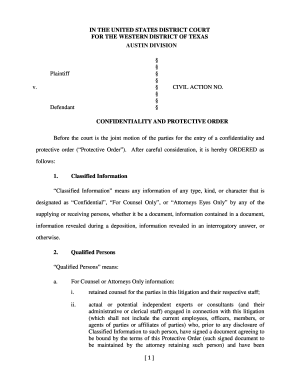
T to the time of disclosure from another source without restriction as to disclosure, provided such third party has the right to make the disclosure to the receiving party. Classified Information. A party shall designate as Classified Information only 2 such information that the party in good faith believes in fact is confidential. Information that is generally available to the public, such as public filings, catalogues, advertising materials, and the like, shall not be designated as C.

How it works

  1. Open form

    Open form follow the instructions

  2. Easily sign form

    Easily sign the form with your finger

  3. Share form

    Send filled & signed form or save

How to fill out the Western District Of Texas Protective Order online

Filling out the Western District Of Texas Protective Order online can seem daunting, but this guide aims to provide you with clear, step-by-step instructions to assist you through the process. Whether you have limited legal experience or are familiar with legal documents, you'll find this guide supportive and easy to follow.

Follow the steps to complete the Protective Order form online.

  1. Click the ‘Get Form’ button to access the Protective Order document and open it in an online editor.
  2. Begin by entering the case number in the designated field at the top of the form. This number is typically assigned by the court and is crucial for identification purposes.
  3. Fill in the names of the parties involved in the case, including the plaintiff and the defendant. Make sure to provide accurate spelling of names.
  4. In the section that asks for the nature of the disclosure, specifically describe what type of Confidential or Classified Information you are looking to protect. It's important to be precise.
  5. Review the criteria for different types of Classified Information carefully, and in the relevant section, mark the appropriate designation for your information (e.g., 'For Counsel Only', 'Confidential').
  6. Complete the section regarding Qualified Persons who will have access to this information. Specify who will be allowed to see the documents and ensure they have signed agreements in place.
  7. If applicable, fill out any additional fields requiring details about how you will handle the Classified Information during depositions or inspections.
  8. Finally, once all necessary sections are filled out, save your changes. You can also download, print, or share the document as needed.

Complete your Protective Order form online today and ensure that your important information is secured.

Get form

Experience a faster way to fill out and sign forms on the web. Access the most extensive library of templates available.
Get form

Related content

Western District of Texas Protective Order
Classified Information shall not be disclosed or made available by the receiving party to...
Learn more
WESTERN DISTRICT OF TEXAS AUSTIN DIVISION Case ...
May 7, 2020 — 10. Texas Public Information Act. Nothing in this Protective Order shall...
Learn more
adult correctional systems
This public document was published at a total cost of $369 ($3.69 per copy). 100 copies of...
Learn more

Related links form

One Source Background Check Form LX-140 Insulation Kit Instructions How To Retrieve Cgfns Id Number Corrado Malanga Wikipedia

Questions & Answers

Get answers to your most pressing questions about US Legal Forms API.

Contact support

To prove harassment in Texas, you need to present evidence showing a pattern of unwanted behavior that instills fear or causes emotional distress. This may include text messages, emails, or videos that illustrate the perpetrator's actions. Gathering this evidence is important for obtaining a Western District of Texas Protective Order effectively.

A protective order may be denied in Texas if the evidence does not sufficiently demonstrate a clear threat of harm or if the request lacks credibility. Additionally, previous violations of court orders or the absence of imminent danger can contribute to a denial. Understanding these factors can help you strengthen your application for a Western District of Texas Protective Order.

In the Western District of Texas, the page limit for motions often varies based on the type of motion. Generally, non-dispositive motions are limited to 15 pages. Adhering to these limits is crucial when submitting documents related to a Western District of Texas Protective Order to ensure compliance with court rules.

The Western District of Texas is a federal judicial district covering various regions, including cities like Austin, San Antonio, and Waco. It serves as a critical jurisdiction for cases, including those involving protective orders. If you're seeking a Western District of Texas Protective Order, understanding the district's jurisdiction can aid in navigating legal processes effectively.

The burden of proof for obtaining a protective order in Texas requires the petitioner to show evidence of a recent act of violence or a credible threat of violence. The standard is based on a preponderance of the evidence, meaning that the evidence must show it is more likely than not that the danger exists. This legal requirement is crucial for those seeking a Western District of Texas Protective Order.

The new law for protective orders in Texas, effective from September 2021, expands the definition of family violence. It allows courts to consider a broader array of behaviors when determining the necessity for a protective order. This legislative change helps more individuals seek relief through a Western District of Texas Protective Order, reflecting the evolving understanding of domestic violence.

In Texas, the code for protective orders is found under Title 4, Chapter 7 of the Texas Family Code. This section outlines the legal framework for obtaining a protective order in situations of family violence or stalking. Understanding this code is essential when navigating the process for a Western District of Texas Protective Order.

In Texas, individuals who have experienced abuse, threat of violence, or stalking can qualify for a protective order. This qualification typically applies to those who have had a relationship with the aggressor, such as family members, current or former partners, or those living together. It’s crucial to consult legal resources to understand the specific qualifications for obtaining a Western District of Texas protective order, and platforms like US Legal Forms can assist you in navigating these requirements.

In Texas, a protective order focuses on preventing domestic violence and ensuring the safety of individuals from specific threats, while a restraining order is more general and may be used to maintain the status quo in legal disputes. Protective orders typically involve a higher threshold for issuance, often requiring a showing of immediate danger. Understanding these distinctions is crucial when dealing with cases in the Western District of Texas protective order context.

Yes, you can look up protective orders in Texas. This process is facilitated through court records, either online or in person. The Western District of Texas provides avenues for individuals to find this information conveniently. Using resources like US Legal Forms can help make your search easier and more efficient.

Get This Form Now!

Use professional pre-built templates to fill in and sign documents online faster. Get access to thousands of forms.
Get form
If you believe that this page should be taken down, please follow our DMCA take down processhere.
Get Western District Of Texas Protective Order
Get form
  • Adoption
  • Bankruptcy
  • Contractors
  • Divorce
  • Home Sales
  • Employment
  • Identity Theft
  • Incorporation
  • Landlord Tenant
  • Living Trust
  • Name Change
  • Personal Planning
  • Small Business
  • Wills & Estates
  • Packages A-Z
  • Affidavits
  • Bankruptcy
  • Bill of Sale
  • Corporate - LLC
  • Divorce
  • Employment
  • Identity Theft
  • Internet Technology
  • Landlord Tenant
  • Living Wills
  • Name Change
  • Power of Attorney
  • Real Estate
  • Small Estates
  • Wills
  • All Forms
  • Forms A-Z
  • Other Templates
  • Legal Hub
  • About Us
  • Help Portal
  • Legal Resources
  • Blog
  • Affiliates
  • Contact Us
  • Delete My Account
  • Site Map
  • Industries
  • Forms in Spanish
  • Localized Forms
  • State-specific Forms
  • Forms Kit
  • Real Estate Handbook
  • All Guides
  • Notarize
  • Incorporation services
  • For Consumers
  • For Small Business
  • For Attorneys
  • USLegal
  • FormsPass
  • pdfFiller
  • signNow
  • altaFlow
  • DocHub
  • Instapage
Form Packages
  • Adoption
  • Bankruptcy
  • Contractors
  • Divorce
  • Home Sales
  • Employment
  • Identity Theft
  • Incorporation
  • Landlord Tenant
  • Living Trust
  • Name Change
  • Personal Planning
  • Small Business
  • Wills & Estates
  • Packages A-Z
Form Categories
  • Affidavits
  • Bankruptcy
  • Bill of Sale
  • Corporate - LLC
  • Divorce
  • Employment
  • Identity Theft
  • Internet Technology
  • Landlord Tenant
  • Living Wills
  • Name Change
  • Power of Attorney
  • Real Estate
  • Small Estates
  • Wills
  • All Forms
  • Forms A-Z
  • Other Templates
Customer Service
  • Legal Hub
  • About Us
  • Help Portal
  • Legal Resources
  • Blog
  • Affiliates
  • Contact Us
  • Delete My Account
  • Site Map
  • Industries
  • Forms in Spanish
  • Localized Forms
  • State-specific Forms
  • Forms Kit
Legal Guides
  • Real Estate Handbook
  • All Guides
Prepared for you
  • Notarize
  • Incorporation services
Our Customers
  • For Consumers
  • For Small Business
  • For Attorneys
Our Sites
  • USLegal
  • FormsPass
  • pdfFiller
  • signNow
  • altaFlow
  • DocHub
  • Instapage
Social Media
Call us now toll free:
+1 833 426 79 33
As seen in:
© Copyright 1999-2026 airSlate Legal Forms, Inc. 17 Station Street, Ste. 203, Brookline, MA 02445
  • Your Privacy Choices
  • Terms of Service
  • Privacy Notice
  • Content Takedown Policy
  • Bug Bounty Program