Loading
Form preview
  • US Legal Forms
  • Other Templates
  • More Forms
  • More Multi-State Forms
  • Punnett Square Practice Pages

Get Punnett Square Practice Pages

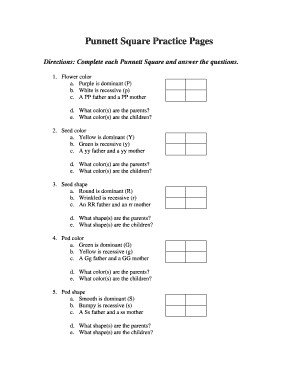
Punnett Square Practice Pages Directions: Complete each Punnett Square and answer the questions. 1. Flower color a. Purple is dominant (P) b. White is recessive (p) c. A PP father and a PP mother d.

How it works

  1. Open form

    Open form follow the instructions

  2. Easily sign form

    Easily sign the form with your finger

  3. Share form

    Send filled & signed form or save

How to fill out the Punnett Square Practice Pages online

The Punnett Square Practice Pages are designed to help users understand and apply the principles of genetics through various examples. This guide provides clear, step-by-step instructions to assist you in completing the form online effectively.

Follow the steps to fill out the Punnett Square Practice Pages with ease.

  1. Click the ‘Get Form’ button to obtain the Punnett Square Practice Pages and open it in your online editor.
  2. Begin with the first section labeled 'Flower color.' Input the genotype of the parents (PP for both) as indicated. Use the provided descriptors to determine the color of the parents and the resulting children.
  3. Proceed to the next section labeled 'Seed color.' Enter the genotypes (yy for both parents) and follow the prompts to identify the colors of both the parents and their children.
  4. Continue to 'Seed shape.' Here, you will document the genotypes of the parents (RR and rr) and deduce both the parents' and children's shapes.
  5. Next, fill out the 'Pod color' section. Use the given genotypes (Gg and GG) to complete the parent and child color queries.
  6. In the 'Pod shape' segment, note the genotype of the parents (Ss and ss) and answer based on the shapes of the parents and children.
  7. Move on to 'Flower position.' Enter the genotypes of the parents (Aa for both) and identify the positions of the flowers accordingly.
  8. For 'Plant height,' record the provided genotype for one parent and deduce the missing parent's genotype, as well as the phenotypes of both parents and children.
  9. In the 'Chin cleft in humans' section, analyze the genotypes and complete the questions regarding the missing parent genotype and associated phenotypes.
  10. Follow similar procedures for sections on 'Fur color in rabbits,' 'Dimples in humans,' 'Whiskers in seals,' and 'Purple people eater horns,' documenting the genotypes and phenotypes as prompted.
  11. For 'Incomplete dominance in snapdragons,' input the genotype of the parents and conclude with the resulting colors.
  12. Finally, address the last sections on 'Codominance in human blood' and 'Hair color in humans,' ensuring to cover all genotype, phenotype, and additional inquiries.
  13. Once all steps are completed, review your answers for accuracy. Finally, save your changes, and choose to download, print, or share the completed Punnett Square Practice Pages.

Start filling out the Punnett Square Practice Pages online to enhance your understanding of genetic principles.

Get form

Experience a faster way to fill out and sign forms on the web. Access the most extensive library of templates available.
Get form

Related content

Genetics And Punnett Square Practice Worksheet
Genetics and Punnett Square Practice Worksheet are essential tools for students and...
Learn more
Practice with Punnett Squares
This worksheet covers the basics of Mendelian inheritance and Punnett squares. Practice...
Learn more
Literally and Figuratively Wrestling With God...
Jan 9, 2025 — And the idea is- and this is sympathetic magic that he's doing here. C:...
Learn more

Related links form

Fillable Online REGISTRATION FORM - Guam Community College ... Bla Checklist DEX408 - Setup Sheet V1.0E - EDIT 2 - Team Durango Eligibility Form

Questions & Answers

Get answers to your most pressing questions about US Legal Forms API.

Contact support

Filling out a Punnett square involves several clear steps. First, determine the parents' genotypes and arrange them in the appropriate positions on the square. Next, fill in each cell by combining the alleles from the corresponding row and column. Step-by-step guidance can be found on Punnett Square Practice Pages, which are designed to simplify this process.

The Punnett square is typically addressed in chapters related to genetics within biology textbooks. This section often covers inheritance patterns, allele interactions, and genotype analysis. To reinforce your learning, consider engaging with Punnett Square Practice Pages that align with the chapters you study.

A heterozygous genotype contains two different alleles for a trait, represented as Aa. In contrast, aa and AA indicate homozygous recessive and homozygous dominant genotypes, respectively. When navigating these concepts, Punnett Square Practice Pages can be an excellent resource for differentiation and comprehension.

The 9-3-3-1 rule applies to dihybrid crosses, which evaluate the inheritance of two traits simultaneously. Specifically, it states that, when two heterozygous parents are crossed, the expected ratio of phenotypes among the offspring will be 9 exhibiting both dominant traits, 3 exhibiting one dominant and one recessive trait, 3 with the opposite combination, and 1 showing both recessive traits. Understanding this ratio can be facilitated by using Punnett Square Practice Pages.

The genotype AA AA AA represents a scenario where an organism has multiple contributions of the dominant allele A. This means that the organism is homozygous dominant for the trait in question. Knowing how to interpret genotypes correctly is essential, and practicing with Punnett Square Practice Pages can provide valuable insights.

In a Punnett square, it is conventional to place the father's alleles on the top and the mother's alleles on the side. However, this format is flexible; the main goal is to clearly present all potential combinations for the offspring. By using Punnett Square Practice Pages, learners can experiment with various setups to find what works best for their understanding.

To write in a Punnett square, first identify the alleles from each parent. You then place one parent's alleles along the top of the square and the other parent's along the left side. Each cell inside the square represents a potential genotype for the offspring, formed by combining the alleles from both parents. Utilizing Punnett Square Practice Pages can make this process easier and more intuitive.

Using a Punnett square involves several standard practices that can enhance your understanding of genetic combinations. Typically, you start by identifying the parent genotypes and placing them at the top and side of the square. This arrangement allows you to visualize the possible offspring combinations clearly. Engaging with Punnett Square Practice Pages can help solidify these concepts.

The study of Punnett squares falls under the broader field of genetics, focusing on how traits are inherited through generations. It involves analyzing genetic crosses and predicting probabilities of certain traits appearing in offspring. By utilizing Punnett Square Practice Pages, you can deepen your understanding of these concepts and apply them effectively in your studies.

To generate a Punnett square, start by determining the alleles for both parents involved in your genetic cross. Next, draw a two-by-two grid to represent the possible combinations of these alleles. By filling in the grid systematically, you can visually map out the potential genetic combinations. For hands-on practice, consider using Punnett Square Practice Pages that guide you through this process.

Get This Form Now!

Use professional pre-built templates to fill in and sign documents online faster. Get access to thousands of forms.
Get form
If you believe that this page should be taken down, please follow our DMCA take down processhere.
Get Punnett Square Practice Pages
Get form
  • Adoption
  • Bankruptcy
  • Contractors
  • Divorce
  • Home Sales
  • Employment
  • Identity Theft
  • Incorporation
  • Landlord Tenant
  • Living Trust
  • Name Change
  • Personal Planning
  • Small Business
  • Wills & Estates
  • Packages A-Z
  • Affidavits
  • Bankruptcy
  • Bill of Sale
  • Corporate - LLC
  • Divorce
  • Employment
  • Identity Theft
  • Internet Technology
  • Landlord Tenant
  • Living Wills
  • Name Change
  • Power of Attorney
  • Real Estate
  • Small Estates
  • Wills
  • All Forms
  • Forms A-Z
  • Other Templates
  • Legal Hub
  • About Us
  • Help Portal
  • Legal Resources
  • Blog
  • Affiliates
  • Contact Us
  • Delete My Account
  • Site Map
  • Industries
  • Forms in Spanish
  • Localized Forms
  • State-specific Forms
  • Forms Kit
  • Real Estate Handbook
  • All Guides
  • Notarize
  • Incorporation services
  • For Consumers
  • For Small Business
  • For Attorneys
  • USLegal
  • FormsPass
  • pdfFiller
  • signNow
  • altaFlow
  • DocHub
  • Instapage
Form Packages
  • Adoption
  • Bankruptcy
  • Contractors
  • Divorce
  • Home Sales
  • Employment
  • Identity Theft
  • Incorporation
  • Landlord Tenant
  • Living Trust
  • Name Change
  • Personal Planning
  • Small Business
  • Wills & Estates
  • Packages A-Z
Form Categories
  • Affidavits
  • Bankruptcy
  • Bill of Sale
  • Corporate - LLC
  • Divorce
  • Employment
  • Identity Theft
  • Internet Technology
  • Landlord Tenant
  • Living Wills
  • Name Change
  • Power of Attorney
  • Real Estate
  • Small Estates
  • Wills
  • All Forms
  • Forms A-Z
  • Other Templates
Customer Service
  • Legal Hub
  • About Us
  • Help Portal
  • Legal Resources
  • Blog
  • Affiliates
  • Contact Us
  • Delete My Account
  • Site Map
  • Industries
  • Forms in Spanish
  • Localized Forms
  • State-specific Forms
  • Forms Kit
Legal Guides
  • Real Estate Handbook
  • All Guides
Prepared for you
  • Notarize
  • Incorporation services
Our Customers
  • For Consumers
  • For Small Business
  • For Attorneys
Our Sites
  • USLegal
  • FormsPass
  • pdfFiller
  • signNow
  • altaFlow
  • DocHub
  • Instapage
Social Media
Call us now toll free:
+1 833 426 79 33
As seen in:
© Copyright 1999-2026 airSlate Legal Forms, Inc. 17 Station Street, Ste. 203, Brookline, MA 02445
  • Your Privacy Choices
  • Terms of Service
  • Privacy Notice
  • Content Takedown Policy
  • Bug Bounty Program