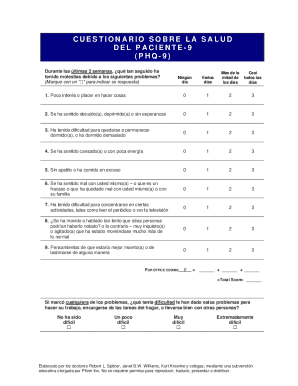
Get Phq 9 In Spanish
How it works
-

Open form follow the instructions
-

Easily sign the form with your finger
-

Send filled & signed form or save
How to fill out the Phq 9 In Spanish online
The Phq 9 In Spanish is a valuable tool designed to assess mental health over the past two weeks. This guide will provide you with a clear, step-by-step approach to filling out this important questionnaire online, ensuring you understand each section and can complete it effectively.
Follow the steps to fill out the Phq 9 In Spanish online.
- Press the ‘Get Form’ button to acquire the form and open it in your preferred digital environment.
- Begin with the first section, which asks about your interest or pleasure in activities. For each question, choose a response that best reflects your feelings over the past two weeks, using the following options: 'No del todo', 'Varios días', 'Casi todos los días', or 'Más de la mitad de todos los días'.
- Proceed to the second question about feeling down, depressed, or hopeless. Again, select the option that most closely aligns with your experience.
- Continue through the remaining questions, which address aspects such as sleep patterns, energy levels, appetite, feelings of worthlessness, concentration difficulties, and thoughts of self-harm. Make sure to read each question carefully and respond honestly.
- Once you have completed all nine questions, you will be asked how difficult these issues have made it for you to manage daily tasks. Select the option that best represents your experience.
- Confirm that the information you provided is correct by entering your initials in the designated space for the patient and recording the date.
- Finally, review your responses to ensure accuracy. Once satisfied, save the changes, download the form, or prepare to print or share it as needed.
Start completing the Phq 9 In Spanish online today to assess your mental health.
To report a PHQ-9 score, first, calculate the total from the responses, which ranges from 0 to 27. A score of 5 to 9 typically indicates mild depression, while higher scores suggest more severe levels. It's crucial to communicate these results clearly with healthcare providers for appropriate intervention. Our platform offers guidance on how to interpret and report these scores effectively.