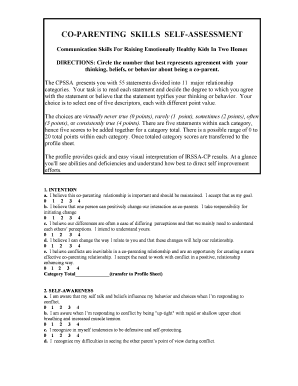
COPARENTING SKILLS SELFASSESSMENT Communication Skills For Raising Emotionally Healthy Kids In Two Homes DIRECTIONS: Circle the number that best represents agreement with your thinking, beliefs, or.

How it works
  • Open form

    Open form follow the instructions

  • Easily sign form

    Easily sign the form with your finger

  • Share form

    Send filled & signed form or save

How to use or fill out the CO-PARENTING SKILLS SELF-ASSESSMENT online

The CO-PARENTING SKILLS SELF-ASSESSMENT is a valuable tool designed to help users evaluate their co-parenting skills across various relational categories. This guide provides clear, step-by-step instructions to successfully complete the assessment online, ensuring a comprehensive understanding of your communication abilities as a co-parent.

Follow the steps to complete your co-parenting skills self-assessment.

  1. Press the ‘Get Form’ button to access the assessment document, which will open in an online editing interface.
  2. Read each of the 55 statements carefully. Each statement pertains to key co-parenting skills categorized under 11 major relationship themes, such as intention and self-awareness.
  3. For each statement, select the number that best represents your agreement from the following options: virtually never true (0 points), rarely true (1 point), sometimes true (2 points), often true (3 points), or consistently true (4 points). Circling the corresponding number will help you track your responses.
  4. Complete this process for all of the statements provided under each of the 11 categories, ensuring that you circle one number for each statement.
  5. After responding to all statements in each category, sum the points for the responses to acquire a total score for each section. Record these category totals in the designated areas.
  6. Transfer your category totals onto the profile sheet, where a visual interpretation of your co-parenting skills will be available.
  7. Finally, save any changes you made to the document, and download, print, or share the completed assessment as needed.

Start your co-parenting skills self-assessment online today to better understand and enhance your parenting abilities.

Get form

Experience a faster way to fill out and sign forms on the web. Access the most extensive library of templates available.

Related content

A Multi-Domain Self-Report Measure of Coparenting...

by ME Feinberg · 2012 · Cited by 837 — This study reports the psychometric properties...

Learn more
SKILLS FOR COOPERATIVE PARENTING POST- DIVORCE

BEING A SINGLE PARENT. • Developing self-esteem and skills as a single-parent and a...

Learn more
34: Zev Weinstein - On Parenting, Boys &...

Mar 2, 2025 — A) What is the proper approach to parenting a child whose learning...

Learn more
Questions & Answers

Get answers to your most pressing questions about US Legal Forms API.

Contact support

How to measure parenting skills?

Measuring parenting skills can be achieved through self-reflection and evaluation tools like a co-parenting skills self-assessment. This assessment allows parents to assess strengths and pinpoint areas for growth. By understanding your capabilities and limitations, you can actively work towards becoming a more effective and involved parent.

To successfully pass a parenting assessment, focus on demonstrating your understanding of your child's emotional needs, interests, and development milestones. Comprehensive preparation, including a co-parenting skills self-assessment, can help identify potential weaknesses to address beforehand. Furthermore, being open to feedback and showcasing your commitment to improvement can leave a positive impression.

The 30% rule in parenting indicates that children need at least 30% of their time to be spent with each parent in a co-parenting arrangement. This balance helps ensure that children form strong bonds with both parents. Utilizing a co-parenting skills self-assessment can help you evaluate whether you are meeting this critical requirement and making necessary adjustments.

The 7 7 7 rule suggests spending seven uninterrupted minutes daily with your child, seven hours a week in meaningful activities, and seven outings each year. This rule stresses the importance of quality time in nurturing your child's emotional development. A co-parenting skills self-assessment can help you determine how effectively you and your co-parent implement this rule in your daily lives.

The 5 C's of parenting include consistency, communication, cooperation, conflict resolution, and compassion. Focusing on these core principles can enhance your effectiveness as a parent and improve your co-parenting relationship. Utilizing a co-parenting skills self-assessment can help you track your progress in each of these areas, supporting better parenting practices.

Co-parenting can become easier over time as both parents develop effective communication strategies and learn to work together. Adjusting to new routines and addressing conflicts can take time, but maintaining a proactive approach can lead to a more harmonious environment. A regular co-parenting skills self-assessment helps identify areas for growth, making the process increasingly manageable.

Measuring parenting skills involves assessing various factors such as consistency, emotional support, and conflict resolution abilities. One effective method is through a co-parenting skills self-assessment, which can provide insights into strengths and areas needing improvement. By regularly analyzing these aspects, parents can foster better relationships and positively influence their children's well-being.

Red flags in co-parenting include poor communication, lack of respect for each other's parenting roles, and ongoing conflicts. If one parent frequently undermines decisions made by the other, it can create an unhealthy situation for children. Identifying these issues early can help families effectively assess their co-parenting skills and make necessary changes through self-assessment.

Good co-parenting questions focus on the child's emotional and developmental needs, such as asking about their feelings or preferences. Explore questions like, 'How can we support our child's education together?' or 'What activities can we do to foster a positive relationship?' Engaging in a CO-PARENTING SKILLS SELF-ASSESSMENT can also uncover additional effective dialogue.

The golden rules of co-parenting include focusing on the child's needs, maintaining clear boundaries, and communicating respectfully. Prioritize teamwork over individual desires, and always keep the child's best interests in mind. Implementing these principles can enhance trust and cooperation, especially when informed by insights from a CO-PARENTING SKILLS SELF-ASSESSMENT.

Get This Form Now!

Use professional pre-built templates to fill in and sign documents online faster. Get access to thousands of forms.

If you believe that this page should be taken down, please follow our DMCA take down process here.

Get CO-PARENTING SKILLS SELF-ASSESSMENT