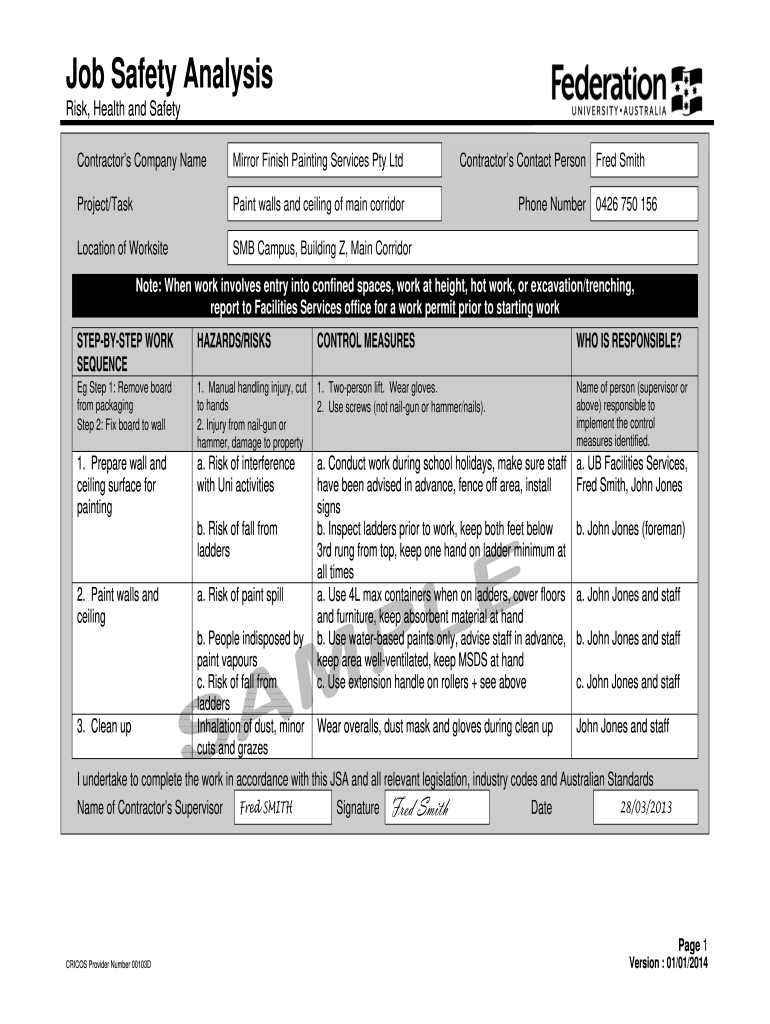
Tractor s Contact Person Fred Smith SMB Campus, Building Z, Main Corridor Phone Number 0426 750 156 Note: When work involves entry into confined spaces, work at height, hot work, or excavation/trenching, report to Facilities Services office for a work permit prior to starting work STEP-BY-STEP WORK SEQUENCE HAZARDS/RISKS CONTROL MEASURES WHO IS RESPONSIBLE? Eg Step 1: Remove board from packaging Step 2: Fix board to wall 1. Manual handling injury, cut to hands 2. Injury from nail-gun.
Loading

Open form follow the instructions

Easily sign the form with your finger

Send filled & signed form or save
How to fill out the How To Fill Out A Jsa Sample online
This guide provides clear instructions for users on how to effectively complete the How To Fill Out A Jsa Sample document online. Understanding each section will ensure proper completion and adherence to safety measures.
Follow the steps to successfully complete your JSA form.
- Click the ‘Get Form’ button to access the document and open it in your preferred editor.
- Start with the contractor's company name section. Clearly input the name of the contracting entity responsible for the job — in this case, Mirror Finish Painting Services Pty Ltd. Ensure that all spelling is accurate.
- Fill in the project/task field with a specific description of the job at hand, such as painting walls and ceiling of the main corridor.
- Provide the location of the worksite in detail. For example, include information that specifies SMB Campus, Building Z, Main Corridor.
- List the contractor’s contact person in the designated section. Use clear identification, such as Fred Smith, along with their phone number (e.g., 0426 750 156).
- Refer to the section that addresses special conditions under which a work permit must be obtained, such as when working in confined spaces or at heights.
- Proceed to the step-by-step work sequence table. Clearly detail each task and associated hazard or risk. For example, include tasks like removing boards from packaging and fixing them to the wall.
- For each identified risk, detail the control measures to be implemented, such as stating 'two-person lift' or 'wear gloves' for handling boards.
- Assign responsibility in the form by identifying who will be accountable for implementing the control measures, such as listing supervisors or foremen responsible for each task.
- Finalize the form by entering the name of the contractor’s supervisor. They should review and sign the document to confirm that the work aligns with safety standards and relevant legislation.
- Once all sections are complete, you can save your changes, download the document, print it, or share it as necessary.
Start filling out your document online to ensure a safe and effective job analysis.
Experience a faster way to fill out and sign forms on the web. Access the most extensive library of templates available.
Related content
Sample Job Hazard Analysis Form .................................. 46. Page 7. 1. Who...
Before filling out this form, consider the following: The purpose of the task - What has...
Know emergency procedures. • If you are on the drill, do not move. Remain on drilling...
Get answers to your most pressing questions about US Legal Forms API.
How to properly fill out a JSA?
To properly fill out a JSA, ensure you involve workers in the process for their insights. Identify all the steps of the job, potential hazards, and document safety measures to mitigate risks. Leveraging a reliable JSA sample can guide you in structuring your document properly. This collaborative approach fosters a strong safety culture.
What does a good JSA look like?
A good JSA is clear, detailed, and easily understandable. It outlines each job step, identifies hazards, and provides actionable safety measures. Reviewing a JSA sample can give you insights into formatting and content that works best for your team. By using effective examples, your JSAs will support a safer workplace.
What are the 5 steps of a JSA?
The five steps of a JSA typically include identifying the job, breaking it into steps, determining hazards, assessing risks, and outlining safety measures. Each step is vital in ensuring a comprehensive analysis that promotes worker safety. A JSA sample can help illustrate how to systematically approach each step. With careful attention, you can minimize risks effectively.
How to fill a hazard report form?
To fill a hazard report form, begin by documenting the specific hazard and its location. Include a description of the risk and any relevant details, such as time and date of occurrence. Using a hazard report sample can help ensure that you provide comprehensive information. This practice promotes a safer work environment, making your reports effective.
How to fill in a JHA?
Filling in a Job Hazard Analysis (JHA) follows similar principles to a JSA. Start by identifying tasks, potential hazards, and developing control measures. Use a JHA sample as a framework to ensure no detail gets missed. By implementing a structured approach, you can enhance safety in your work environment.
What are common JSA mistakes?
Common mistakes when filling out a JSA include skipping steps, failing to involve workers, and neglecting to update the JSA as tasks change. Additionally, overlooking hazards or not addressing safety measures adequately can lead to accidents. To avoid these pitfalls, refer to a JSA sample that highlights best practices. This ensures comprehensive coverage of safety concerns.
What is JSA with example?
A JSA, or Job Safety Analysis, outlines job tasks and related hazards. For instance, in a construction project, a JSA might detail steps like ladder use, identifying risks like falls and outlining safety measures. By using a JSA sample, you can see how to structure your analysis effectively. This not only aids in understanding but also enhances workplace safety.
How to fill out a JSA properly?
To fill out a Job Safety Analysis (JSA) properly, start by identifying the job tasks. Break the job down into steps, determine the hazards associated with each step, and propose safety measures to mitigate those hazards. Consider using a JSA sample as a guide, which can streamline the process. By following clear examples, you will create a thorough and effective JSA.
How to fill out a hazard form?
To fill out a hazard form, start by identifying the specific job and its steps. Next, assess potential hazards associated with each step and document them visibly. Finally, propose control measures to eliminate or reduce risks. Using a comprehensive guide, such as how to fill out a JSA sample, can simplify this process significantly.
Which steps are necessary steps when filling out a JSA?
Four basic stages in conducting a JSA are: selecting the job to be analyzed. breaking the job down into a sequence of steps. identifying potential hazards. determining preventive measures to overcome these hazards.
Use professional pre-built templates to fill in and sign documents online faster. Get access to thousands of forms.
If you believe that this page should be taken down, please follow our DMCA take down process here.