Loading
Form preview
  • US Legal Forms
  • Other Templates
  • More Forms
  • More Multi-State Forms
  • Dyssemia

Get Dyssemia

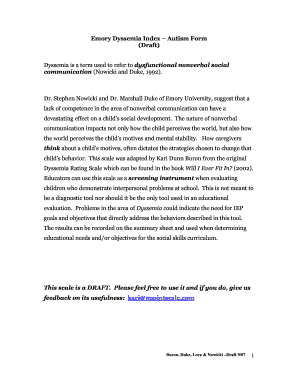
R other noncontributing phrases repetitively Doesn t seem to listen to what others are saying Choice of conversation topics is inappropriate to situation Does not inquire about or expand on the other person s topic Choses inappropriate topics given the situation Total # out of Section J: Chronemics and the Use of Time Observed Often arrives late for class Walks out of classes or goes on a personal errand at inappropriate times Moves slowly between classes Walks too fast for situat.

How it works

  1. Open form

    Open form follow the instructions

  2. Easily sign form

    Easily sign the form with your finger

  3. Share form

    Send filled & signed form or save

How to fill out the Dyssemia online

Filling out the Dyssemia form is an important step in evaluating nonverbal communication skills in children. This guide will provide you with a clear, step-by-step approach to completing the form effectively online.

Follow the steps to successfully complete the Dyssemia form.

  1. Click ‘Get Form’ button to obtain the Dyssemia form and open it for editing.
  2. Begin by entering the student name in the designated field. This information is essential for identifying the individual being assessed.
  3. Next, fill in the date completed. This helps track when the assessment took place.
  4. Indicate who completed the form by inputting the name of the person conducting the assessment. This could be a teacher, therapist, or caregiver.
  5. Proceed to Section A: Gaze and Eye Contact. Carefully review the observed behaviors and check all that apply based on interactions with the student.
  6. Continue to Section B: Space and Touch. Mark any observed behaviors in this section as well.
  7. Repeat this process for Sections C through J, ensuring that you check all relevant behaviors according to your observations.
  8. In the Areas of Concern section, summarize the total count of observations for each category. This provides a clear overview of the student's nonverbal communication skills.
  9. After completing all sections, outline the skills to be taught and the methods for teaching them based on the evaluation results.
  10. Finish by inputting annual goals and benchmarks for the teaching process before saving your completed form.
  11. Finally, save your changes, and if needed, download, print, or share the Dyssemia form as required.

Start completing the Dyssemia assessment form online today to better understand and support a child's nonverbal communication needs.

Get form

Experience a faster way to fill out and sign forms on the web. Access the most extensive library of templates available.
Get form

Related content

The Emory Dyssemia Index: a brief screening...
by EB Love · 1994 · Cited by 25 — The Emory Dyssemia Index: a brief screening...
Learn more
Emory University News Release - dyssemia
Dyssemia is a condition that does not require professional psychological help, but is one...
Learn more
이상증 - 요다위키
난독증은 수용적이고/또는 표현적인 비언어적 의사소통의...
Learn more

Related links form

Ahc2212 Sy14 15 Algebra Exit Exam Activity Notice Victorian Seniors Card Application Bformb - Seniors Bonlineb - Seniorsonline Vic Gov

Questions & Answers

Get answers to your most pressing questions about US Legal Forms API.

Contact support

An example of a nonverbal learning disorder is Nonverbal Learning Disorder (NVLD), which shares some traits with dyssemia. Individuals with NVLD may excel in verbal skills but struggle with spatial awareness and nonverbal communication. This mismatch can lead to difficulties in social situations and in understanding visual or physical cues. Learning about these conditions can help users navigate their challenges and find resources available through platforms like US Legal Forms for tailored support.

The dyssemia rating scale is a tool used to assess the severity of dyssemia in individuals. It evaluates various aspects of social comprehension and nonverbal communication skills. By using this scale, professionals can identify specific areas where an individual may struggle and tailor intervention strategies accordingly. This proactive approach makes it easier to address the challenges posed by dyssemia effectively.

An example of dyssemia is when someone fails to pick up on social signals during a conversation, leading to awkward or misunderstood interactions. For instance, a person with dyssemia may not notice when someone is uncomfortable or ready to change the topic. This lack of awareness can hinder the development of personal relationships. Understanding dyssemia is crucial for those affected, as it opens pathways to better communication support.

Dyssemia can manifest through various symptoms that primarily affect communication and social interactions. Individuals may struggle with reading nonverbal cues, such as body language or facial expressions. They might also find it challenging to interpret social contexts, which can lead to misunderstandings. Recognizing these symptoms early can help in seeking appropriate support and resources.

Dyssemia refers to a communication disorder that affects an individual's ability to interpret and convey social cues effectively. This condition can significantly hinder personal and professional relationships. Understanding dyssemia is essential for both individuals affected and those who interact with them. Utilizing resources like the US Legal Forms platform can help provide guidance and legal documentation related to seeking help for dyssemia.

While various scales assess schizophrenia, the best scale depends on individual needs; the dyssemia rating scale may also provide insights into communication issues faced by these individuals. Choosing the right scale involves understanding the specific symptoms and challenges a person encounters. Consulting a healthcare professional can clarify which assessment will offer the most benefit. This informed approach can significantly enhance the support provided for both dyssemia and schizophrenia.

A sensory rating scale measures an individual's perception and processing of sensory information, which can relate to dyssemia. This scale evaluates how well a person responds to sensory input, which often intersects with communication challenges. Understanding sensory processing can help address dyssemia by guiding treatment approaches. Using this information, professionals can create interventions that suit the individual’s specific needs.

The 11 point rating scale is a widely recognized measurement tool used to evaluate various conditions, including dyssemia. This scale allows individuals to express the severity of their symptoms on a clear numerical scale. By offering this feedback, clinicians can better understand the patient’s experience and tailor their interventions. As a result, this method proves beneficial in managing dyssemia effectively.

The Dssmed rating scale serves as a specialized assessment mechanism for understanding dyssemia across various contexts. It provides a standardized method for evaluating communication deficits related to dyssemia and other disorders. This scale aids clinicians in identifying specific areas needing attention and treatment. Through its use, patients can receive more focused and effective care.

Symptoms of being unable to speak properly can include slurred speech, difficulty finding words, or problems forming sentences. Individuals may feel frustrated when trying to communicate their thoughts or ideas clearly. It's crucial to understand these signs, as they may indicate an underlying condition, such as dyssemia, requiring professional evaluation and assistance.

Get This Form Now!

Use professional pre-built templates to fill in and sign documents online faster. Get access to thousands of forms.
Get form
If you believe that this page should be taken down, please follow our DMCA take down processhere.
Get Dyssemia
Get form
  • Adoption
  • Bankruptcy
  • Contractors
  • Divorce
  • Home Sales
  • Employment
  • Identity Theft
  • Incorporation
  • Landlord Tenant
  • Living Trust
  • Name Change
  • Personal Planning
  • Small Business
  • Wills & Estates
  • Packages A-Z
  • Affidavits
  • Bankruptcy
  • Bill of Sale
  • Corporate - LLC
  • Divorce
  • Employment
  • Identity Theft
  • Internet Technology
  • Landlord Tenant
  • Living Wills
  • Name Change
  • Power of Attorney
  • Real Estate
  • Small Estates
  • Wills
  • All Forms
  • Forms A-Z
  • Other Templates
  • Legal Hub
  • About Us
  • Help Portal
  • Legal Resources
  • Blog
  • Affiliates
  • Contact Us
  • Delete My Account
  • Site Map
  • Industries
  • Forms in Spanish
  • Localized Forms
  • State-specific Forms
  • Forms Kit
  • Real Estate Handbook
  • All Guides
  • Notarize
  • Incorporation services
  • For Consumers
  • For Small Business
  • For Attorneys
  • USLegal
  • FormsPass
  • pdfFiller
  • signNow
  • altaFlow
  • DocHub
  • Instapage
Form Packages
  • Adoption
  • Bankruptcy
  • Contractors
  • Divorce
  • Home Sales
  • Employment
  • Identity Theft
  • Incorporation
  • Landlord Tenant
  • Living Trust
  • Name Change
  • Personal Planning
  • Small Business
  • Wills & Estates
  • Packages A-Z
Form Categories
  • Affidavits
  • Bankruptcy
  • Bill of Sale
  • Corporate - LLC
  • Divorce
  • Employment
  • Identity Theft
  • Internet Technology
  • Landlord Tenant
  • Living Wills
  • Name Change
  • Power of Attorney
  • Real Estate
  • Small Estates
  • Wills
  • All Forms
  • Forms A-Z
  • Other Templates
Customer Service
  • Legal Hub
  • About Us
  • Help Portal
  • Legal Resources
  • Blog
  • Affiliates
  • Contact Us
  • Delete My Account
  • Site Map
  • Industries
  • Forms in Spanish
  • Localized Forms
  • State-specific Forms
  • Forms Kit
Legal Guides
  • Real Estate Handbook
  • All Guides
Prepared for you
  • Notarize
  • Incorporation services
Our Customers
  • For Consumers
  • For Small Business
  • For Attorneys
Our Sites
  • USLegal
  • FormsPass
  • pdfFiller
  • signNow
  • altaFlow
  • DocHub
  • Instapage
Social Media
Call us now toll free:
+1 833 426 79 33
As seen in:
© Copyright 1999-2026 airSlate Legal Forms, Inc. 17 Station Street, Suite 303, Brookline, MA 02445
  • Your Privacy Choices
  • Terms of Service
  • Privacy Notice
  • Content Takedown Policy
  • Bug Bounty Program