Loading
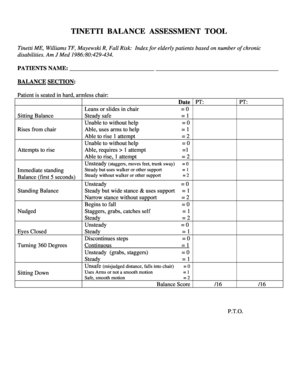
Get Tinetti Test
How it works
-

Open form follow the instructions
-

Easily sign the form with your finger
-

Send filled & signed form or save
How to fill out the Tinetti Test online
The Tinetti Test is a widely used assessment tool for evaluating an individual's balance and gait, primarily among elderly patients. This guide will provide you with clear and concise instructions on how to complete the Tinetti Test online, ensuring a smooth and efficient process.
Follow the steps to successfully complete the Tinetti Test online.
- Press the ‘Get Form’ button to access the Tinetti Test and open it in your preferred editor.
- Begin by entering the patient's name in the designated space at the top of the form. This is crucial for identifying the individual being assessed.
- Proceed to the balance section. Start with the sitting balance, noting whether the patient is able to rise from the chair and how they perform the standing balance tasks. Record observations regarding their steadiness and any aids required.
- Continue filling out the sitting and standing balance fields, evaluating and recording the patient's ability to remain steady and perform tasks without assistance.
- Next, move to the gait section. Observe the patient's gait by having them walk across the room at their usual pace and then at a rapid pace. Capture all relevant indicators such as step length and foot clearance.
- In the gait section, assess common gait indicators including step symmetry and trunk stability. Document any hesitation or deviations noted during the walking tests.
- Calculate the balance and gait scores by adding up the values from each respective section. Ensure these are recorded correctly for future reference.
- Finally, review the total score which combines both the balance and gait scores. This will help in determining the risk level of falls for the patient.
Complete the Tinetti Test online today to effectively assess balance and gait.
A good Tinetti Test score typically ranges from 25 to 28 points out of a possible 28. This range indicates that a person has good balance and low risk of falling. Lower scores signal a greater need for intervention, making early evaluation crucial for enhancing safety and mobility.