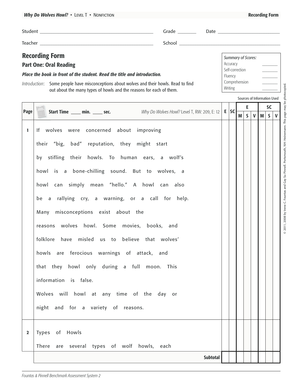
Why Do Wolves Howl? Level T Nonction Recording Form Grade Date Teacher School Recording Form Summary of Scores: Accuracy Selfcorrection Fluency Comprehension Writing Part One: Oral Reading Place the.
Open form follow the instructions
Easily sign the form with your finger
Send filled & signed form or save
How to fill out the Why Do Wolves Howl Fountas And Pinnell online
Filling out the Why Do Wolves Howl Fountas And Pinnell document requires careful attention to detail to ensure accurate recording of assessments. This guide provides step-by-step instructions for completing each section of the form efficiently and effectively, helping users navigate the process with confidence.
Follow the steps to complete your recording form
- Press the ‘Get Form’ button to acquire the form, which will open it in the document editor for your use.
- Fill in the grade level where indicated. This is essential to categorize the assessment accurately.
- Enter the current date in the specified field; this ensures that the documentation is time-stamped.
- Provide the teacher's name clearly in the designated space to identify who conducted the assessment.
- Complete the school name section. Proper identification is crucial for record-keeping.
- In the 'Summary of Scores' section, accurately record the scores for accuracy, self-correction, fluency, comprehension, and writing as the assessment progresses.
- During Part One: Oral Reading, ensure the book is in front of the student and instruct them to read the title and introduction aloud.
- After oral reading, note the start and end time for the reading, recording the fluency and accuracy scores.
- For Part Two: Comprehension Conversation, engage with the student through guided questions, documenting their comprehension levels and evidence of understanding.
- Finally, save the changes to the document once all sections are completed, and prepare to download, print, or share the form as needed.
Start completing your assessment forms online today!
Experience a faster way to fill out and sign forms on the web. Access the most extensive library of templates available.
Related content
Sorrel s-- Why do wolves howl / Gabriel Kidd -- Canyon mystery / Laura Shallop...
Get answers to your most pressing questions about US Legal Forms API.
Why do wolves howl?
Wolves howl for several reasons, including communication with their pack and territorial claims. This vocal behavior is crucial for maintaining social bonds and coordinating activities. To dive deeper into understanding why wolves howl, Fountas And Pinnell provides excellent resources on this topic.
What should you do if you hear a wolf howl?
If you hear a wolf howl, remain calm and observe from a safe distance. It's a sign that wolves are present, and it's best to respect their space. For guidance on how to safely enjoy wildlife encounters, check out what Fountas And Pinnell offers.
What happens if you howl at a wolf?
Howling at a wolf can elicit various responses; the wolf may either respond with its own howl or get curious. However, it's important to keep a respectful distance from wildlife. To learn more about safe interactions with animals, look into the Fountas And Pinnell platform for educational resources.
What triggers a wolf to howl?
Wolves typically howl in response to various stimuli, including the need to locate pack members, defend territory, or signal an impending hunt. These howls serve as a unifying call, promoting social cohesion. For an in-depth understanding of the triggers for wolf howling, consider the resources available through Fountas And Pinnell.
Do wolves howl when they're happy?
Wolves howl primarily to communicate, but they can also howl when they are excited or happy. This vocalization expresses their connection with the pack or celebrates successful hunts. By understanding why wolves howl, as highlighted in Fountas And Pinnell, you can appreciate their social behavior more fully.
Why do wolves howl on a full moon?
Wolves may howl more often during a full moon due to increased visibility and social activity among their pack. The moonlight can make hunting easier, leading to more vocalizations. If you're curious about the connection between wolves and lunar phases, consider looking into Fountas And Pinnell for further insights.
Do wolves howl to mark their territory?
Yes, wolves howl to communicate with their pack and mark their territory. This vocalization signals their presence to other wolves in the area. Understanding the reasons behind why wolves howl can deepen your appreciation for these majestic animals, and resources like Fountas And Pinnell can help you explore this fascinating behavior.
Do wolves howl because of grief?
Yes, wolves can howl in response to loss or grief within their pack. This emotional expression helps them cope with the absence of a member. Recognizing this behavior offers insight into the emotional depth of wolves, addressing the profound question, 'Why do wolves howl Fountas And Pinnell?' and reminding us of their intelligence and connections.
Why do wolves howl when the full moon is?
Wolves are often associated with the full moon due to increased visibility and activity during the night. However, their howling is not directly caused by the moon; it is more about social interaction. During this time, you might notice wolves vocalizing more. This connection to the full moon enhances our understanding of 'Why do wolves howl Fountas And Pinnell?' creating a link between folklore and natural behavior.
Why do you think the wolf is howling?
Wolves howl to communicate with other members of their pack. This vocalization serves as a way to locate each other when they are separated. Additionally, howling can strengthen social bonds within the pack. Understanding this behavior sheds light on the question, 'Why do wolves howl Fountas And Pinnell?'
Use professional pre-built templates to fill in and sign documents online faster. Get access to thousands of forms.
If you believe that this page should be taken down, please follow our DMCA take down process here.