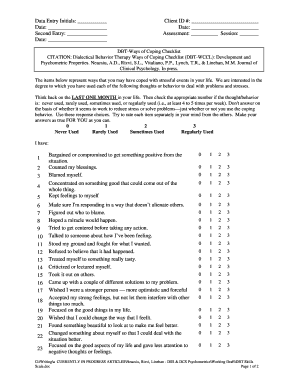
Data Entry Initials: Date: Second Entry: Date: Client ID #: Date: Assessment: Session: DBTWays of Coping Checklist CITATION: Dialectical Behavior Therapy Ways of Coping Checklist (DBTWCCL): Development.

How it works
  • Open form

    Open form follow the instructions

  • Easily sign form

    Easily sign the form with your finger

  • Share form

    Send filled & signed form or save

How to fill out the Dbt Wccl online

The Dialectical Behavior Therapy Ways of Coping Checklist (Dbt Wccl) is a valuable tool for individuals to reflect on their coping strategies during stressful events. This guide will provide clear, step-by-step instructions on how to complete the Dbt Wccl online, ensuring that users can easily navigate through each section of the form.

Follow the steps to complete your Dbt Wccl online

  1. Click the ‘Get Form’ button to access the Dbt Wccl and open it in your preferred editor.
  2. Enter your data entry initials and the date of completion at the top of the form.
  3. Complete the 'Client ID #' field with your unique identification number.
  4. Provide the assessment date relevant to your evaluation.
  5. In the section labeled 'DBT-Ways of Coping Checklist', reflect on the past month and indicate your coping behaviors by marking the corresponding numbers for each item. Use the response scale of 0 (never used) to 3 (regularly used) for each statement.
  6. Proceed through each item in the checklist, ensuring to rate each coping behavior based on your personal experiences.
  7. Once all items are filled out, review your responses for accuracy.
  8. After completing the checklist, you can choose to save your changes, download, print, or share the completed form as needed.

Start filling out your Dbt Wccl online today to better understand your coping mechanisms.

Get form

Experience a faster way to fill out and sign forms on the web. Access the most extensive library of templates available.

Related content

The dialectical behavior therapy ways of coping...

by AD Neacsiu · 2010 · Cited by 300 — We adapted the Revised Ways of Coping Checklist...

Learn more
Assessment Instruments | Behavioral Research &...

Citation: Neacsiu, A.D., Rizvi, S.L., Vitaliano, P. P., Lynch, T.R., & Linehan, M.M...

Learn more
Questions & Answers

Get answers to your most pressing questions about US Legal Forms API.

Contact support

What is the interpretation of the DBT WCCL score?

The DBT WCCL score reflects a client's progress within the framework of Dialectical Behavior Therapy. A higher score indicates a better alignment with personalized learning goals and DBT skills application. Professionals use this score to assess the effectiveness of the therapy and make necessary adjustments. By leveraging the DBT WCCL score, practitioners can provide tailored support that drives meaningful change.

DBT, or Dialectical Behavior Therapy, is a therapeutic approach designed to help individuals manage emotions and improve relationships. It combines cognitive-behavioral techniques with mindfulness practices, emphasizing acceptance and change. This approach has proven especially beneficial for those struggling with mood disorders and self-harm. Understanding the DBT WCCL can help deepen your knowledge of how therapy can adapt to individual needs.

DBT features four main modes: individual therapy, skills training groups, phone coaching, and consultation teams. Each mode serves a distinct purpose in supporting clients' progress. Individual therapy focuses on personal issues, while skills training fosters learning essential DBT skills. Incorporating DBT WCCL concepts into these modes can further enhance their effectiveness.

The DBT WCCL, which stands for Dialectical Behavior Therapy with a focus on Client-Centered Learning, enhances traditional DBT. It prioritizes adapting DBT to individual client experiences and learning styles. This approach aims to improve therapeutic outcomes by focusing on personalized strategies. By utilizing the DBT WCCL, practitioners can offer more effective support to clients.

DBT, or Dialectical Behavior Therapy, faces criticism mainly due to its complexity and the need for skilled practitioners. Some users feel that the structure of the program can be overwhelming. Others argue that it may not be as effective for certain individuals. However, understanding the DBT WCCL can help practitioners tailor the therapy to meet diverse needs.

The 24-hour rule in DBT therapy encourages you to wait at least 24 hours before making impulsive decisions during emotional distress. This pause allows you to consider your options with a clearer mindset. By implementing this rule, you can reduce emotional reactivity and make more thoughtful choices. Practicing this skill regularly can significantly improve emotional regulation.

Absolutely, you can work through a DBT workbook independently. These workbooks are designed to help you understand and apply DBT skills effectively. As you follow along, focus on completing exercises and reflecting on your experiences. Combining workbook exercises with external resources can create a comprehensive learning experience.

Yes, DBT can be done individually, typically through personalized therapy sessions with a trained professional. This approach allows for tailored guidance and support as you work through your unique challenges. Individual DBT therapy can address specific issues, making it a powerful tool for emotional growth. You can also supplement your sessions with self-help resources for a well-rounded experience.

While DBT can be practiced independently, having professional support can enhance your experience. You can explore various materials, such as books and online courses, to guide your learning. However, working with a therapist can provide essential feedback and accountability, helping you fully integrate DBT skills into your life. Consider the best approach that suits your learning style.

To practice DBT on your own, start by familiarizing yourself with the core skills of mindfulness, distress tolerance, emotion regulation, and interpersonal effectiveness. Utilize DBT workbooks and online resources to structure your practice. Regularly assess your progress and adjust your approach as necessary. Incorporating these skills into your daily routine can lead to meaningful change in managing emotions.

Get This Form Now!

Use professional pre-built templates to fill in and sign documents online faster. Get access to thousands of forms.

If you believe that this page should be taken down, please follow our DMCA take down process here.

Get Dbt Wccl