Loading
Form preview
  • US Legal Forms
  • Other Templates
  • More Forms
  • More Multi-State Forms
  • Literary Analysis Outline

Get Literary Analysis Outline

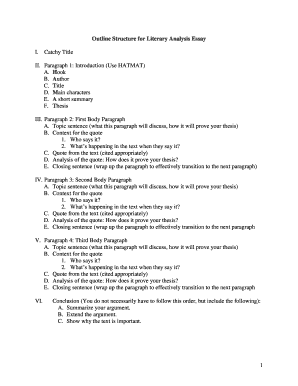
Outline Structure for Literary Analysis Essay I. Catchy Title II. Paragraph 1: Introduction (Use HATMAT) A. Hook B. Author C. Title D. Main characters E. A short summary F. Thesis III. Paragraph 2:.

How it works

  1. Open form

    Open form follow the instructions

  2. Easily sign form

    Easily sign the form with your finger

  3. Share form

    Send filled & signed form or save

How to fill out the Literary Analysis Outline online

Filling out the Literary Analysis Outline is a crucial step in crafting a well-organized and coherent analysis of literary works. This guide provides detailed, user-friendly instructions to help you navigate each component of the outline effectively.

Follow the steps to complete your Literary Analysis Outline successfully.

  1. Click ‘Get Form’ button to obtain the form and open it in the editor.
  2. Begin with section I, where you will enter a catchy title that captures the essence of your analysis. This title should be engaging and relevant to the work you are discussing.
  3. Move to section II, Paragraph 1: Introduction. Utilize the HATMAT framework, ensuring you include a hook, the author, the title, main characters, a brief summary, and your thesis statement.
  4. Proceed to section III, Paragraph 2: First Body Paragraph. Start with a topic sentence outlining the main point of this paragraph. Then, provide context for the quote, including details about who says it and the situation in the text when it occurs.
  5. Next, include the quote from the text, cited appropriately. Follow this with an analysis explaining how this quote supports your thesis, and conclude the paragraph with a closing sentence that transitions smoothly to the next.
  6. Repeat the process for section IV, Paragraph 3: Second Body Paragraph, ensuring the topic, context, quote, analysis, and closing sentence are appropriately addressed.
  7. Continue to section V, Paragraph 4: Third Body Paragraph, following the same structure as the previous body paragraphs.
  8. Finally, in section VI, complete your conclusion by summarizing your argument, extending it to broader implications, and explaining the significance of the text you analyzed.
  9. Once you have completed all sections, review your outline for clarity and coherence. Save your changes, and you can download, print, or share your Literary Analysis Outline as needed.

Start filling out your Literary Analysis Outline online today to enhance your writing skills!

Get form

Experience a faster way to fill out and sign forms on the web. Access the most extensive library of templates available.
Get form

Related content

How To Write A Literary Analysis
An outline serves as a roadmap for your analysis. It helps organize your thoughts and...
Learn more
Outline Structure for Literary Analysis Essay
Outline Structure for Literary Analysis Essay. I. Catchy Title. II. Paragraph 1:...
Learn more
List of story structures
This article covers the range of dramatic structures from around the world: how the acts...
Learn more

Related links form

Monterey Parts Manual Spotlight On Artic S.qxp Discretionary Housing Payment Application - Kingston Council DAPPER-3-sample.doc

Questions & Answers

Get answers to your most pressing questions about US Legal Forms API.

Contact support

The five steps to literary analysis include selecting a piece of literature, crafting a clear thesis, developing supporting points, gathering evidence, and writing the analysis. Utilizing a literary analysis outline will enhance your writing by ensuring every point is clearly stated and well-supported, allowing for a more coherent discussion of the text.

The steps of literary analysis typically include reading the text, identifying its main ideas, examining the author's choices, and evaluating the overall impact. A well-structured literary analysis outline can serve as your roadmap throughout this process, helping you stay focused and organized as you delve into the text.

To write a literary analysis, you first need to select a piece of literature. Begin by creating a literary analysis outline that highlights key points and insights you wish to discuss. Then, develop a thesis statement and support it with evidence from the text, paying close attention to the use of language and literary techniques.

The seven steps of literary analysis include choosing a text, reading it closely, identifying themes, analyzing characters, considering the setting, exploring literary devices, and articulating your interpretation. By following a literary analysis outline, you can methodically navigate these steps, ensuring you cover all essential elements for a comprehensive analysis.

Literary analysis involves examining a text to understand its deeper meanings. For example, you might analyze a poem to explore its themes, structure, and the emotions it evokes. A solid literary analysis outline can help you organize your thoughts and arguments, making your analysis clearer and more persuasive.

The seven steps to writing an analytical essay are choosing a topic, conducting research, developing a thesis statement, creating an outline, writing the essay, reviewing and editing, and finally submitting your work. By incorporating a Literary Analysis Outline, you can structure your ideas effectively and enhance the clarity of your analysis. Each part of the process helps you develop a stronger argument and a more persuasive essay.

To write a literature outline, start by identifying the main topic or thesis of your analysis. Break this down into key components, such as themes, characters, and literary devices, then organize these elements logically. A well-structured Literary Analysis Outline will guide your writing process and help you stay focused on your central arguments.

To create a literary analysis example, first select a text that interests you. Construct a Literary Analysis Outline that includes the main thesis statement, supporting evidence, and analysis of key elements. By following this structure, you can develop a compelling example that demonstrates your understanding of the text and showcases your analysis skills.

The 7 literary standards encompass originality, expressiveness, form, style, structure, meaning, and emotional impact. These standards help us evaluate what constitutes great literature. By applying these standards, you can enhance your Literary Analysis Outline, ensuring that your analysis resonates with your audience and highlights the significance of the text.

The seven elements of literature include plot, character, setting, conflict, theme, point of view, and style. Each element plays a crucial role in shaping a story's narrative. You can create a Literary Analysis Outline to explore these elements in depth, making it easier to analyze how they contribute to the overall message of the work. To access detailed explanations, consider downloading a PDF resource.

Get This Form Now!

Use professional pre-built templates to fill in and sign documents online faster. Get access to thousands of forms.
Get form
If you believe that this page should be taken down, please follow our DMCA take down processhere.
Get Literary Analysis Outline
Get form
  • Adoption
  • Bankruptcy
  • Contractors
  • Divorce
  • Home Sales
  • Employment
  • Identity Theft
  • Incorporation
  • Landlord Tenant
  • Living Trust
  • Name Change
  • Personal Planning
  • Small Business
  • Wills & Estates
  • Packages A-Z
  • Affidavits
  • Bankruptcy
  • Bill of Sale
  • Corporate - LLC
  • Divorce
  • Employment
  • Identity Theft
  • Internet Technology
  • Landlord Tenant
  • Living Wills
  • Name Change
  • Power of Attorney
  • Real Estate
  • Small Estates
  • Wills
  • All Forms
  • Forms A-Z
  • Other Templates
  • Legal Hub
  • About Us
  • Help Portal
  • Legal Resources
  • Blog
  • Affiliates
  • Contact Us
  • Delete My Account
  • Site Map
  • Industries
  • Forms in Spanish
  • Localized Forms
  • State-specific Forms
  • Forms Kit
  • Real Estate Handbook
  • All Guides
  • Notarize
  • Incorporation services
  • For Consumers
  • For Small Business
  • For Attorneys
  • USLegal
  • FormsPass
  • pdfFiller
  • signNow
  • altaFlow
  • DocHub
  • Instapage
Form Packages
  • Adoption
  • Bankruptcy
  • Contractors
  • Divorce
  • Home Sales
  • Employment
  • Identity Theft
  • Incorporation
  • Landlord Tenant
  • Living Trust
  • Name Change
  • Personal Planning
  • Small Business
  • Wills & Estates
  • Packages A-Z
Form Categories
  • Affidavits
  • Bankruptcy
  • Bill of Sale
  • Corporate - LLC
  • Divorce
  • Employment
  • Identity Theft
  • Internet Technology
  • Landlord Tenant
  • Living Wills
  • Name Change
  • Power of Attorney
  • Real Estate
  • Small Estates
  • Wills
  • All Forms
  • Forms A-Z
  • Other Templates
Customer Service
  • Legal Hub
  • About Us
  • Help Portal
  • Legal Resources
  • Blog
  • Affiliates
  • Contact Us
  • Delete My Account
  • Site Map
  • Industries
  • Forms in Spanish
  • Localized Forms
  • State-specific Forms
  • Forms Kit
Legal Guides
  • Real Estate Handbook
  • All Guides
Prepared for you
  • Notarize
  • Incorporation services
Our Customers
  • For Consumers
  • For Small Business
  • For Attorneys
Our Sites
  • USLegal
  • FormsPass
  • pdfFiller
  • signNow
  • altaFlow
  • DocHub
  • Instapage
Social Media
Call us now toll free:
+1 833 426 79 33
As seen in:
© Copyright 1999-2026 airSlate Legal Forms, Inc. 17 Station Street, Ste. 203, Brookline, MA 02445
  • Your Privacy Choices
  • Terms of Service
  • Privacy Notice
  • Content Takedown Policy
  • Bug Bounty Program