Loading
Form preview
  • US Legal Forms
  • Form Library
  • More Forms
  • More Multi-State Forms
  • Domicilium Citandi Et Executandi

Get Domicilium Citandi Et Executandi

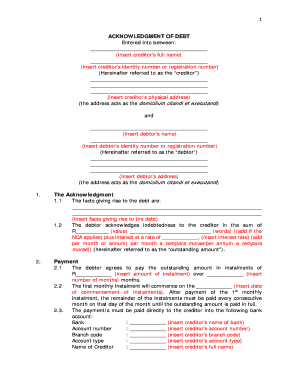
1 ACKNOWLEDGMENT OF DEBT Entered into between: (insert creditors full name) (insert creditors identity number or registration number) (Hereinafter referred to as the creditor) (insert creditors physical.

How it works

  1. Open form

    Open form follow the instructions

  2. Easily sign form

    Easily sign the form with your finger

  3. Share form

    Send filled & signed form or save

How to fill out the Domicilium Citandi Et Executandi online

Filling out the Domicilium Citandi Et Executandi is an essential step in formalizing agreements between creditors and debtors. This guide provides clear instructions to ensure that users can complete the form efficiently and accurately, even with little legal experience.

Follow the steps to fill out the Domicilium Citandi Et Executandi form online:

  1. Click ‘Get Form’ button to obtain the form and open it in the editor.
  2. Begin with the section labeled ‘Creditor Information’. Enter the creditor’s full name, identity number or registration number, and physical address, which also serves as the domicilium citandi et executandi for the creditor.
  3. Proceed to the ‘Debtor Information’ section. Insert the debtor’s name, identity number or registration number, and address, which acts as their domicilium citandi et executandi.
  4. In the ‘Acknowledgment’ section, provide detailed information about the facts leading to the debt. This includes a clear description of the circumstances giving rise to the debt.
  5. Next, acknowledge the indebtedness by inserting the total amount owed in both numeric and written form. If applicable, include the interest rate and specify whether it is calculated monthly or annually.
  6. In the ‘Payment’ section, outline the payment plan by entering the amount of each installment, the total number of months for payment, and the starting date of the payment plan.
  7. Input the bank details where payments should be made, including the bank name, account number, branch code, account type, and any necessary reference required by the creditor.
  8. Address the ‘Default’ clause, ensuring that the debtor understands the implications of failing to make payments on time and the rights of the creditor in such cases.
  9. In the ‘General’ section, confirm the agreements made, including the addresses of both parties for legal correspondence.
  10. Finally, complete the form by signing and dating it. Ensure that witnesses also sign where required.
  11. Once finished, save the changes to the form, and download, print, or share it as necessary.

Complete your documents online with confidence!

Get form

Experience a faster way to fill out and sign forms on the web. Access the most extensive library of templates available.
Get form

Related content

EXHIBIT 4.96
DOMICILIUM CITANDI ET EXECUTANDI. 5.1. The Parties choose as their domicilia citandi et...
Learn more
International Shoe in Sub-Saharan Africa:...
citandi et executandi.200 Also, courts have insisted that a plaintiff must substantiate...
Learn more

Related links form

Iv Therapy Intake Form Being An Equity-Oriented School Psychologist - Michigan ... Patient Education: Acute Sinusitis (sinus Infection) (Beyond The Basics ... Biology 12 /15 Case Study: Cell Organelles And Their Functions

Questions & Answers

Get answers to your most pressing questions about US Legal Forms API.

Contact support

An operative clause defines the primary obligations of each party within a contract. It specifies what actions a party must take, such as making payments or delivering goods to the domicilium citandi et executandi. Understanding these clauses is essential for compliance and successful contract execution.

A delivery clause states the obligations of all parties regarding the method and timing of delivering documents or goods. For instance, it may stipulate that notices must be sent through registered mail to the domicilium citandi et executandi. This ensures that both parties fulfill their responsibilities and have a clear understanding of the procedure.

Domicilium citandi et executandi refers to the address designated in a legal document where a party agrees to receive notifications and legal documents. This address plays a critical role in ensuring all parties are informed of actions related to contracts or legal proceedings. Understanding this concept can lead you to adequately address any legal matters that may arise.

If you lose your domicilium, you may face challenges in legal communications and processes. Missing notifications or deadlines can impact your legal and financial interests. Therefore, it's critical to establish and maintain a clear domicilium citandi et executandi to protect your rights and ensure you're always informed.

An example of a domicilium clause could state that all legal notices must be sent to a specific address, ensuring clear communication. This clause often appears in contracts, outlining the agreed-upon location for all legal documentation. Including a domicilium citandi et executandi in your agreements can help mitigate misunderstandings.

A domicilium is a legal term that designates a person's or entity's official address for the purpose of receiving legal documents. It's essential in various legal processes to ensure communication flows smoothly. Establishing a clear domicilium citandi et executandi can help you meet your legal responsibilities effectively.

The domicilium rule mandates that a designated place must be established for legal notifications and documentation. This rule helps ensure that all parties involved are informed and can respond appropriately to legal proceedings. By establishing a domicilium citandi et executandi, you strengthen your legal standing and facilitate smoother interactions.

Individuals and businesses involved in legal matters may need a domicilium. It provides a recognized address for receiving legal notifications, which is critical in maintaining communication. If you engage in contracts or legal actions, establishing a domicilium citandi et executandi can benefit you greatly.

A domicilium is not always required in every legal context, but it plays a crucial role in many legal proceedings. In specific situations, like court cases or contract agreements, having a clear domicilium citandi et executandi can ensure proper communication and compliance. It’s wise to consider the implications of not having one to avoid potential legal challenges.

Losing your domicilium can create significant legal challenges, such as difficulties in receiving notices or being summoned to court. Without a recognized domicilium, you may face the risk of default judgments against you. It is essential to promptly establish a new domicilium to ensure you remain informed about legal actions. US Legal Forms can assist you in updating and securing your domicilium to avoid these potential setbacks.

Get This Form Now!

Use professional pre-built templates to fill in and sign documents online faster. Get access to thousands of forms.
Get form
If you believe that this page should be taken down, please follow our DMCA take down processhere.

Industry-leading security and compliance

US Legal Forms protects your data by complying with industry-specific security standards.
  • In businnes since 1997
    25+ years providing professional legal documents.
  • Accredited business
    Guarantees that a business meets BBB accreditation standards in the US and Canada.
  • Secured by Braintree
    Validated Level 1 PCI DSS compliant payment gateway that accepts most major credit and debit card brands from across the globe.
Get Domicilium Citandi Et Executandi
Get form
  • Adoption
  • Bankruptcy
  • Contractors
  • Divorce
  • Home Sales
  • Employment
  • Identity Theft
  • Incorporation
  • Landlord Tenant
  • Living Trust
  • Name Change
  • Personal Planning
  • Small Business
  • Wills & Estates
  • Packages A-Z
  • Affidavits
  • Bankruptcy
  • Bill of Sale
  • Corporate - LLC
  • Divorce
  • Employment
  • Identity Theft
  • Internet Technology
  • Landlord Tenant
  • Living Wills
  • Name Change
  • Power of Attorney
  • Real Estate
  • Small Estates
  • Wills
  • All Forms
  • Forms A-Z
  • Form Library
  • Legal Hub
  • About Us
  • Help Portal
  • Legal Resources
  • Blog
  • Affiliates
  • Contact Us
  • Delete My Account
  • Site Map
  • Industries
  • Forms in Spanish
  • Localized Forms
  • State-specific Forms
  • Forms Kit
  • Real Estate Handbook
  • All Guides
  • Notarize
  • Incorporation services
  • For Consumers
  • For Small Business
  • For Attorneys
  • USLegal
  • FormsPass
  • pdfFiller
  • signNow
  • altaFlow
  • DocHub
  • Instapage
Form Packages
  • Adoption
  • Bankruptcy
  • Contractors
  • Divorce
  • Home Sales
  • Employment
  • Identity Theft
  • Incorporation
  • Landlord Tenant
  • Living Trust
  • Name Change
  • Personal Planning
  • Small Business
  • Wills & Estates
  • Packages A-Z
Form Categories
  • Affidavits
  • Bankruptcy
  • Bill of Sale
  • Corporate - LLC
  • Divorce
  • Employment
  • Identity Theft
  • Internet Technology
  • Landlord Tenant
  • Living Wills
  • Name Change
  • Power of Attorney
  • Real Estate
  • Small Estates
  • Wills
  • All Forms
  • Forms A-Z
  • Form Library
Customer Service
  • Legal Hub
  • About Us
  • Help Portal
  • Legal Resources
  • Blog
  • Affiliates
  • Contact Us
  • Delete My Account
  • Site Map
  • Industries
  • Forms in Spanish
  • Localized Forms
  • State-specific Forms
  • Forms Kit
Legal Guides
  • Real Estate Handbook
  • All Guides
Prepared for you
  • Notarize
  • Incorporation services
Our Customers
  • For Consumers
  • For Small Business
  • For Attorneys
Our Sites
  • USLegal
  • FormsPass
  • pdfFiller
  • signNow
  • altaFlow
  • DocHub
  • Instapage
Social Media
Call us now toll free:
+1 833 426 79 33
As seen in:
© Copyright 1999-2026 airSlate Legal Forms, Inc. 3720 Flowood Dr, Flowood, Mississippi 39232
  • Your Privacy Choices
  • Terms of Service
  • Privacy Notice
  • Content Takedown Policy
  • Bug Bounty Program