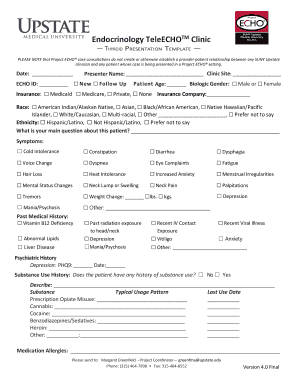
Endocrinology TeleECHOTM Clinic THYROID PRESENTATION TEMPLATE PLEASE NOTE that Project ECHO case consultations do not create or otherwise establish a providerpatient relationship between any SUNY.
Open form follow the instructions
Easily sign the form with your finger
Send filled & signed form or save
How to fill out the SUNY Upstate Medical University Thyroid Presentation Template online
This guide aims to provide comprehensive instructions on completing the SUNY Upstate Medical University Thyroid Presentation Template online. Each component of the form is outlined in detail to support users in accurately providing essential patient information.
Follow the steps to successfully complete the thyroid presentation template online.
- Click the ‘Get Form’ button to access the thyroid presentation template and open it in the designated editor.
- Fill in the date of the presentation in the designated field.
- Enter the presenter's name and the clinic site information as required.
- Provide the ECHO ID, selecting whether this is a new consultation or a follow-up by checking the appropriate box.
- Input the patient's age and select their biologic gender from the provided options.
- Indicate the insurance type and fill in the name of the insurance company if applicable.
- Select the patient's race and ethnicity from the provided categories.
- Clearly state the main question regarding the patient.
- Check any relevant symptoms from the provided list and enter additional symptoms as necessary, including weight change details.
- Document the patient's past medical history by selecting relevant conditions and filling in any additional information.
- Record any psychiatric history, including PHQ9 scores and substance use history, with detailed descriptions.
- List current medications, vitamins, herbs, and supplements, ensuring to provide name and dosage.
- Describe the diagnosis intended to be addressed, including the date of diagnosis and any social repercussions.
- Note previous treatments received by the patient.
- Indicate family history related to thyroid disease and capture smoking and alcohol consumption status.
- Complete the vitals section with the patient's measurements and record any abnormal physical exam findings.
- Fill out the current lab results, including thyroid tests and other relevant markers.
- Input details regarding pertinent imaging studies and cytology, as applicable.
- After verifying all entered information for accuracy, save changes, download, print, or share the filled form accordingly.
Start filling out your thyroid presentation template online today to streamline patient consultations.
Experience a faster way to fill out and sign forms on the web. Access the most extensive library of templates available.
Related content
Nov 6, 2025 — The Council was formed to facilitate interagency planning and...
PLEASE NOTE that Project ECHO® case consultations do not create or otherwise establish a...
Get answers to your most pressing questions about US Legal Forms API.
How do you describe a thyroid physical exam?
A thyroid physical exam involves inspecting for size and shape, palpating for nodules, and checking for tenderness. You’ll also assess for any signs of associated conditions, such as goiter or lymphadenopathy. For a more structured approach, consider using the SUNY Upstate Medical University Thyroid Presentation Template to present your findings clearly.
What are 5 common assessment findings with hypothyroidism?
Common findings with hypothyroidism include fatigue, weight gain, cold intolerance, dry skin, and hair loss. During your examination, assess these symptoms thoroughly. Using the SUNY Upstate Medical University Thyroid Presentation Template can enhance your assessment documentation and ensure you address these critical findings comprehensively.
How to present a thyroid examination?
To present a thyroid examination, start by outlining the patient’s history, followed by the findings from your physical exam. Discuss any relevant imaging or lab results clearly and concisely. The SUNY Upstate Medical University Thyroid Presentation Template offers a structured way to convey this information effectively.
How do you test your thyroid?
Testing your thyroid generally involves a blood test to check hormone levels, such as TSH, T3, and T4. Additionally, imaging tests like ultrasounds may be used to assess any abnormal growths. Utilizing the SUNY Upstate Medical University Thyroid Presentation Template can help you organize test results and communicate them efficiently.
What is the physical description of the thyroid?
The thyroid is a butterfly-shaped gland located in the front of the neck, just below the Adam's apple. It typically consists of two lobes connected by a thin isthmus. For clarity in your examinations, refer to the SUNY Upstate Medical University Thyroid Presentation Template, which visualizes the thyroid's anatomical features effectively.
How to perform a thyroid physical exam?
Performing a thyroid physical exam involves inspecting and palpating the thyroid gland. You should check for any enlargement or nodules while also assessing the surrounding areas for lymphadenopathy. Incorporating the SUNY Upstate Medical University Thyroid Presentation Template will guide you through the essential steps and ensure you cover all necessary aspects.
How to document thyroid nodules?
To document thyroid nodules effectively, start by noting the size, shape, and consistency. Include any associated symptoms, such as difficulty swallowing or changes in voice. Utilizing the SUNY Upstate Medical University Thyroid Presentation Template can streamline this process, making it easier to communicate findings clearly during patient assessments.
How to document goiter on physical exam?
To document goiter on a physical exam, describe the size, shape, and consistency of the enlargement. Note whether it is symmetrical and any accompanying symptoms. Using the SUNY Upstate Medical University Thyroid Presentation Template will help streamline your documentation process, ensuring clarity and thoroughness.
How to take a history of a thyroid patient?
To take a history of a thyroid patient, start by asking about their medical history, including any previous thyroid conditions. Inquire about family history, symptoms, and any treatments they have received. The SUNY Upstate Medical University Thyroid Presentation Template can serve as an excellent resource to ensure you cover all necessary aspects.
How to document thyroid on physical exam?
Documenting the thyroid during a physical exam requires a systematic approach. Note its size, consistency, and any abnormalities found during palpation. Leveraging the SUNY Upstate Medical University Thyroid Presentation Template can streamline this process, ensuring you capture all essential details effectively.
Use professional pre-built templates to fill in and sign documents online faster. Get access to thousands of forms.
If you believe that this page should be taken down, please follow our DMCA take down process here.