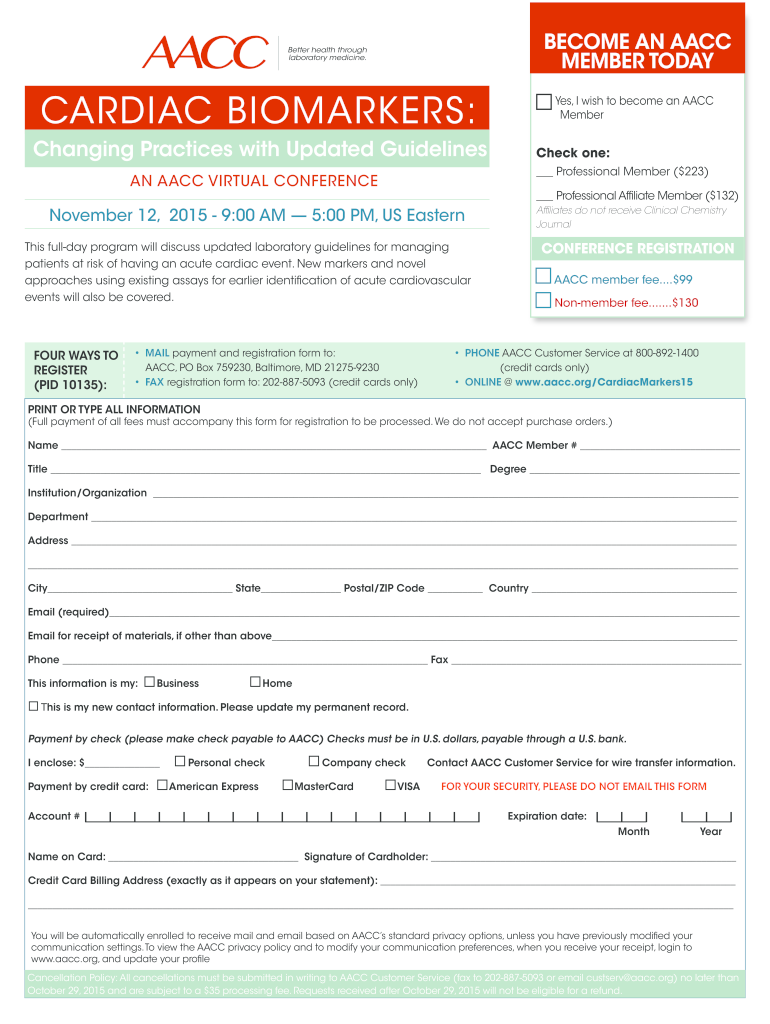
132) Affiliates do not receive Clinical Chemistry Journal November 12, 2015 9:00 AM 5:00 PM, US Eastern CONFERENCE REGISTRATION This full-day program will discuss updated laboratory guidelines for managing patients at risk of having an acute cardiac event. New markers and novel approaches using existing assays for earlier identification of acute cardiovascular events will also be covered. FOUR WAYS TO REGISTER (PID 10135): Yes, I wish to become an AACC Member AACC member fee.
Loading

Open form follow the instructions

Easily sign the form with your finger

Send filled & signed form or save
How to fill out the AACC Cardiac Biomarkers: Changing Practices With Updated Guidelines online
Filling out the AACC Cardiac Biomarkers form is essential for participation in the program focusing on updated laboratory guidelines. This guide will provide you with clear, step-by-step instructions to help you complete the form accurately and efficiently.
Follow the steps to complete your registration process
- Click the ‘Get Form’ button to access the form and open it in a suitable online platform.
- Begin by completing the membership selection section. You can choose between a professional member or a professional affiliate member. Check the appropriate box to indicate your choice.
- Fill in your personal information. This includes your full name, AACC member number (if applicable), title, degree, institution/organization, department, and complete address details. Be sure to type or print all information clearly.
- Provide your email address. This field is required to ensure that you receive all communications and materials correctly.
- Indicate the contact method you prefer by selecting either business or home. If the contact information you provided is new, mark the corresponding box to update your record.
- Select your payment method. Choose whether you will pay by credit card or check. If using a credit card, fill in the account number and expiration date. Ensure the billing address matches your credit card statement.
- Review the cancellation policy carefully. If you plan to cancel your registration, you must submit your request in writing by the specified date.
- Once all information is complete, save the form. You can download it, print it for your records, or share it as needed.
Complete your document online today to ensure your participation in the event.
Experience a faster way to fill out and sign forms on the web. Access the most extensive library of templates available.
Related content
by AHB Wu · 2018 · Cited by 502 — ... (AACC) Academy] Laboratory Medicine Practice...
Feb 26, 2021 — 2020 AHA/ACC guideline for the diagnosis and treatment of patients with...
May 9, 2016 — Current Advisories and Guidelines. Currently there are no federal...
Get answers to your most pressing questions about US Legal Forms API.
What is the CCD guideline?
The CCD guideline, or the Clinical Care Document guideline, provides a framework for documenting and sharing patient information effectively. These guidelines focus on enhancing communication among healthcare providers. Understanding AACC Cardiac Biomarkers: Changing Practices With Updated Guidelines reinforces this efficient documentation as part of comprehensive cardiac care.
How to do cardiac markers?
To perform cardiac marker tests, healthcare professionals collect blood samples and conduct laboratory analyses to assess specific markers. The process is typically straightforward and can provide quick insight into heart health. Utilizing the AACC Cardiac Biomarkers: Changing Practices With Updated Guidelines helps ensure consistency and accuracy in these tests.
What is the gold standard of cardiac biomarkers?
Troponin is considered the gold standard among cardiac biomarkers due to its high sensitivity and specificity for myocardial injury. Its effectiveness makes it essential in diagnosing acute myocardial infarctions. Embracing the AACC Cardiac Biomarkers: Changing Practices With Updated Guidelines helps clinicians utilize troponin effectively for improved patient care.
What are the guidelines for post PCI management?
Post-percutaneous coronary intervention (PCI) management guidelines focus on patient care to prevent complications. These include monitoring vital signs, using appropriate medications, and scheduling follow-up visits. By following the AACC Cardiac Biomarkers: Changing Practices With Updated Guidelines, healthcare providers can enhance post-PCI recovery and outcomes.
How to do cardiac biomarkers?
To measure cardiac biomarkers, blood samples are collected from the patient, usually through a standard blood draw. These samples are then analyzed in a laboratory setting for specific markers. Adhering to AACC Cardiac Biomarkers: Changing Practices With Updated Guidelines ensures accurate and timely results, leading to better patient management.
What are the 8 cardiac markers?
The eight key cardiac markers include troponin I, troponin T, creatine kinase-MB, myoglobin, BNP, NT-proBNP, D-dimer, and C-reactive protein. Each marker serves a unique purpose in diagnosing and managing heart conditions. Staying updated with AACC Cardiac Biomarkers: Changing Practices With Updated Guidelines ensures you know when to use each marker effectively.
What are the current guidelines for dual antiplatelet therapy?
The current guidelines recommend dual antiplatelet therapy for patients who have undergone stenting or coronary artery interventions. This approach reduces the risk of thrombotic events. By following the AACC Cardiac Biomarkers: Changing Practices With Updated Guidelines, patients receive tailored care to improve outcomes.
How do cardiac biomarkers work?
Cardiac biomarkers, such as troponins and BNP, are substances released into the bloodstream when the heart is damaged or stressed. They help healthcare providers identify heart conditions quickly and accurately. Understanding AACC Cardiac Biomarkers: Changing Practices With Updated Guidelines empowers practitioners to implement these tools effectively in patient care.
How to obtain cardiac biomarkers?
To obtain cardiac biomarkers, healthcare professionals typically perform a simple blood test. This procedure usually involves drawing blood from a vein, which is then analyzed in a lab for various biomarkers. By implementing the AACC Cardiac Biomarkers: Changing Practices With Updated Guidelines, healthcare providers can select the most appropriate tests and ensure accurate results for their patients.
What are cardiac biomarkers?
Cardiac biomarkers are substances released into the blood when the heart is damaged or stressed. These markers help diagnose various heart conditions, including heart attacks and heart failure. By following the AACC Cardiac Biomarkers: Changing Practices With Updated Guidelines, healthcare providers can make informed decisions based on these biomarker values, improving treatment pathways.
Use professional pre-built templates to fill in and sign documents online faster. Get access to thousands of forms.
If you believe that this page should be taken down, please follow our DMCA take down process here.