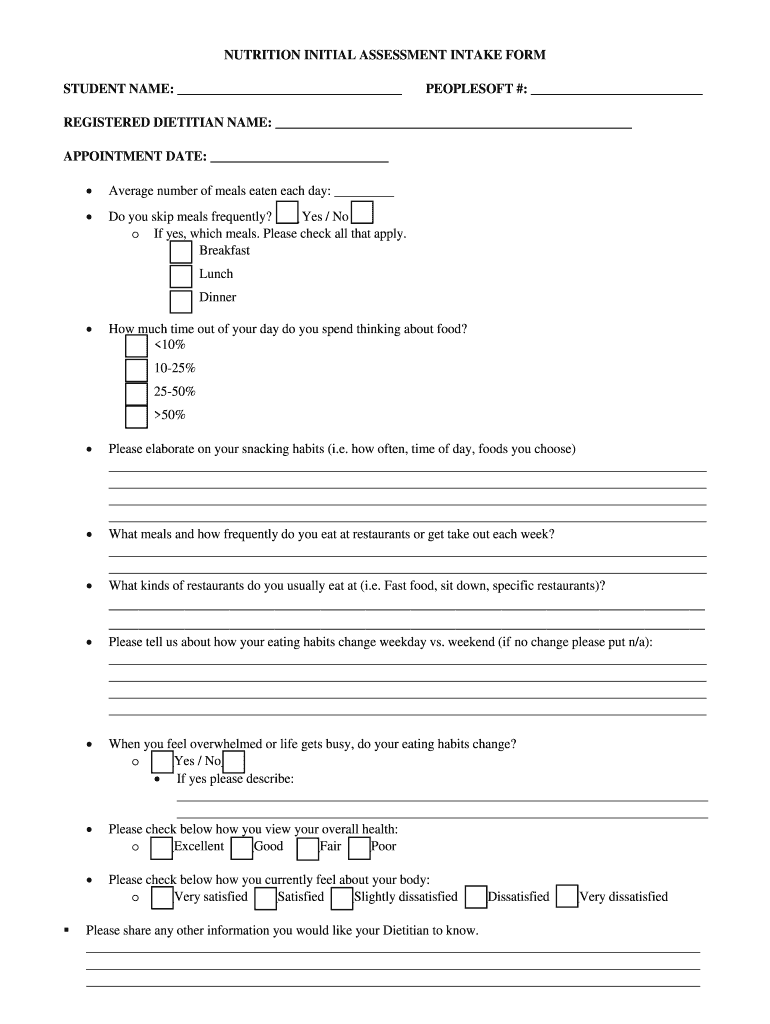
APPOINTMENT DATE: Average number of meals eaten each day: Do you skip meals frequently? Yes / No o If yes, which meals. Please check all that apply. Breakfast Lunch Dinner How much time out of your day do you spend thinking about food? o 50% Please elaborate on your snacking habits (i.e. how often, time of day, foods you choose).

Open form follow the instructions

Easily sign the form with your finger

Send filled & signed form or save
How to fill out the UConn Nutrition Initial Assessment Intake Form online
The UConn Nutrition Initial Assessment Intake Form is an essential tool for gathering important information about your dietary habits and nutritional needs. This guide provides step-by-step instructions to assist you in completing the form online effectively.
Follow the steps to complete the form accurately.
- Click ‘Get Form’ button to obtain the form and open it in the editor.
- Begin by filling in your personal details, including your name and PeopleSoft number. This ensures that your information is correctly linked to your health records.
- Next, provide the name of your registered dietitian and your appointment date. This information helps the dietitian prepare for your consultation.
- Indicate the average number of meals you eat each day. Additionally, specify if you skip meals frequently and check the relevant options for meals skipped.
- Reflect on how much time you spend thinking about food daily and select the appropriate percentage.
- Describe your snacking habits in the given space, mentioning how often and what types of snacks you consume.
- Record how often you eat at restaurants or order takeout each week, including the types of restaurants you prefer.
- Explain any differences in your eating habits between weekdays and weekends. If there's no change, simply write 'n/a.'
- Answer whether your eating habits change when you feel overwhelmed by selecting 'Yes' or 'No' and elaborate if you answered 'Yes.'
- Evaluate and select how you view your overall health and your feelings about your body by checking the corresponding boxes.
- Share any additional information you would like your dietitian to know, ensuring they have the context needed for your assessment.
- For the one-day food record section, start by noting the date and time of each meal and snack. Record the type of food consumed in detail.
- In the 'Amount' column, specify the quantity of food consumed using recognizable measurements or household items.
- Indicate the location where you consumed each item and, if relevant, describe your emotions during the eating experience.
- Once all sections are completed, review the form for accuracy. You can then save your changes, download, print, or share the form as needed.
Complete your UConn Nutrition Initial Assessment Intake Form online today for a tailored nutrition assessment.
Experience a faster way to fill out and sign forms on the web. Access the most extensive library of templates available.
Related content
Participants will be in the study for approximately 4 months, which will include the...
NUTRITION INITIAL ASSESSMENT INTAKE FORM ... Upload your food record and intake form to...
an initial form was fulfilled online and sent to the NBA. For accession to biological...
Get answers to your most pressing questions about US Legal Forms API.
What to ask in a nutritional assessment?
In a nutritional assessment, ask about dietary preferences, medical history, lifestyle habits, and specific health goals. Understanding the individual’s unique needs is essential to tailor an effective nutrition plan. The UConn Nutrition Initial Assessment Intake Form includes key questions that help capture this critical information, setting the stage for meaningful dietary improvements.
How to perform a nutritional assessment?
To perform a nutritional assessment, follow these steps: gather dietary information, evaluate nutritional status through various methods, and identify specific nutritional needs. It is crucial to take a comprehensive approach to ensure accurate results. The UConn Nutrition Initial Assessment Intake Form offers a practical guide to assist you in collecting and interpreting vital dietary data.
What are the 5 methods of nutritional assessment?
The five methods of nutritional assessment involve dietary assessment, clinical evaluation, biochemical analysis, anthropometric measurements, and environmental assessments. These methods provide a holistic view of an individual's nutritional status and needs. Utilizing the UConn Nutrition Initial Assessment Intake Form can simplify these evaluations, allowing for a more structured and efficient assessment process.
What are the 4 steps in nutrition assessment?
The four steps in nutrition assessment are data collection, data analysis, diagnosis, and intervention planning. First, gather information through various methods, followed by analyzing that data for patterns. The UConn Nutrition Initial Assessment Intake Form helps streamline data collection, paving the way for informed interventions that enhance nutritional health.
How to make a nutritional assessment?
To make a nutritional assessment, start by collecting data on dietary habits, health status, and lifestyle factors. Follow this by analyzing the information gathered, comparing it against standards, and identifying areas of concern or improvement. Using the UConn Nutrition Initial Assessment Intake Form simplifies this process, making it easier to compile and evaluate your findings.
What are the 5 diet assessment methods?
The five diet assessment methods include 24-hour dietary recall, food frequency questionnaires, diet diaries, direct observation, and anthropometric measurements. Each method provides unique insights into an individual's nutritional intake. By utilizing the UConn Nutrition Initial Assessment Intake Form, you can effectively gather comprehensive dietary information, ensuring a thorough assessment.
What is an example of a nutrition assessment?
An example of a nutrition assessment may involve using the UConn Nutrition Initial Assessment Intake Form to gather information from a client. This assessment can illustrate a person's dietary habits, health concerns, and lifestyle factors leading to tailored nutritional guidance. For instance, based on the collected data, a registered dietitian could recommend specific dietary changes to improve the client's overall health. This personalized approach is key to effective nutrition management.
How to write a nutritional assessment?
When drafting a nutritional assessment, focus on clarity and accuracy in reporting the data collected. Base your writing on findings from the UConn Nutrition Initial Assessment Intake Form and ensure that it summarizes the individual's health history, dietary practices, and assessment results. Organize the content logically, making it easy to follow for anyone who may refer to it later. This structured approach enhances the usability of the assessment.
What are the four components of a nutritional assessment?
The four core components of a nutritional assessment are dietary intake analysis, clinical evaluation, anthropometric measurements, and biochemical tests. Each component plays a vital role in understanding a person's nutritional status. The UConn Nutrition Initial Assessment Intake Form streamlines the collection of this information, ensuring that you gather comprehensive data effectively. Together, they create a well-rounded assessment to support informed nutrition advice.
What 5 assessments must be included in a patient assessment for nutrition?
A comprehensive patient assessment for nutrition should include a dietary history, physical examination, anthropometric data, laboratory results, and lifestyle evaluation. These five assessments provide a holistic view of an individual’s nutritional health. Utilizing the UConn Nutrition Initial Assessment Intake Form can facilitate the efficient collection and analysis of these critical components. This integrated approach enables tailored nutrition guidance.
Use professional pre-built templates to fill in and sign documents online faster. Get access to thousands of forms.
If you believe that this page should be taken down, please follow our DMCA take down process here.