Loading
Form preview
  • US Legal Forms
  • Other Templates
  • Industry Forms
  • Industry Legal Forms
  • Chapter 540 Actions Against Tenants

Get Chapter 540 Actions Against Tenants

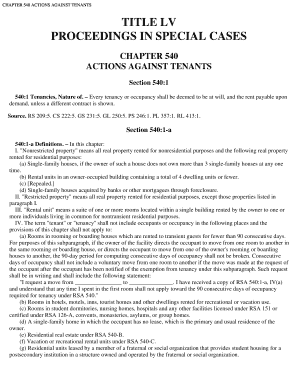
L be deemed to be at will, and the rent payable upon demand, unless a different contract is shown. Source. RS 209:5. CS 222:5. GS 231:5. GL 250:5. PS 246:1. PL 357:1. RL 413:1. Section 540:1-a 540:1-a Definitions. In this chapter: I. "Nonrestricted property'' means all real property rented for nonresidential purposes and the following real property rented for residential purposes: (a) Single-family houses, if the owner of such a house does not own more than 3 single-family houses at any o.

How it works

  1. Open form

    Open form follow the instructions

  2. Easily sign form

    Easily sign the form with your finger

  3. Share form

    Send filled & signed form or save

How to fill out the Chapter 540 Actions Against Tenants online

Filling out the Chapter 540 Actions Against Tenants form online can be a straightforward process if you follow the appropriate steps. This guide will provide you with clear instructions to navigate through each section of the form effectively.

Follow the steps to complete the Chapter 540 Actions Against Tenants form online.

  1. Press the ‘Get Form’ button to access the form and open it for editing.
  2. Start by entering your personal information, including your name, address, and contact details. Ensure that all information is accurate and clearly legible.
  3. Next, specify the type of tenancy and provide details about the property in question. Indicate whether it is considered restricted or nonrestricted property as defined in the document.
  4. Proceed to outline the grounds for the action against the tenant. This might include failure to pay rent or violation of lease terms. Be as specific as possible, citing relevant sections from Chapter 540.
  5. Include the notice requirements you have followed. Detail the dates and methods of any service of demand or eviction notice. This is crucial for legal compliance.
  6. Review all the entered information for accuracy and completeness. Double-check that all required sections have been filled out.
  7. Once satisfied with your form, you can save your changes, download the form, print it for your records, or share it as needed.

Complete your Chapter 540 Actions Against Tenants form online today for a smooth process.

Get form

Experience a faster way to fill out and sign forms on the web. Access the most extensive library of templates available.
Get form

Related content

RSA 540-A Information Sheet and Filing...
Jan 1, 2021 — A 540-A Petition is a request for court assistance to protect the rights...
Learn more
Inadequate Protection of Tenants' Property During...
by L Weiser · 2008 · Cited by 6 — Irene Parker, an 82 year-old single woman with...
Learn more
Remedies for Real Property Disputes in Florida
A default under a contract for the sale and purchase of real estate in Florida must be...
Learn more

Related links form

Nevada Medicaid And Nevada Check Up Rehabilitation FA-11A Authorization Request Montana Child Support Guidelines - Financial Affidavit - Dphhs ATTN: Duplicate Diplomas Pca 301

Questions & Answers

Get answers to your most pressing questions about US Legal Forms API.

Contact support

NH statute 540-A governs eviction procedures in New Hampshire. This statute outlines the necessary steps landlords must follow to legally evict a tenant for non-payment or lease violations. Understanding this statute helps both tenants and landlords navigate their responsibilities. Leveraging Chapter 540 Actions Against Tenants, you can find the information needed to proceed correctly.

Tenants in New Hampshire have several rights, including the right to a habitable living environment and protection against unlawful eviction. They can also request repairs and maintenance from landlords within reasonable timeframes. It’s important for tenants to understand their rights, especially during disputes. Knowing about Chapter 540 Actions Against Tenants empowers tenants to assert their rights confidently.

In New Hampshire, tenants can sue their landlord for various damages, depending on the nature of the dispute. This may include unpaid security deposits, violation of lease terms, or failure to provide necessary repairs. While there are no strict limits, it's crucial to gather all relevant evidence. Utilizing Chapter 540 Actions Against Tenants may offer pathways to recover damages effectively.

The most common action landlords take against tenants in breach of contract is filing for eviction. This process typically begins with a formal notice outlining the reasons for eviction. If the tenant does not comply, landlords may proceed with legal action. These Chapter 540 Actions Against Tenants provide landlords the means to protect their rights and reclaim their property.

The most common cause for breaching a lease is late or non-payment of rent. Financial difficulties can arise for many tenants, leading to potential breaches. Chapter 540 Actions Against Tenants allows landlords to take action to recover lost income or regain possession of their property. It's vital for tenants to communicate with their landlords when issues arise, as finding a solution can often prevent severe consequences.

A serious breach of the lease occurs when a tenant fails to meet significant obligations contained in the lease agreement. This may involve non-payment of rent, unauthorized occupants, or property damage. Understanding what constitutes a serious breach is essential, especially in the context of Chapter 540 Actions Against Tenants. Documenting these breaches can strengthen your case should you need to take legal action.

Yes, you can evict a month-to-month tenant in California, but you must follow proper legal procedures. Typically, you must provide a written notice of termination, often with either 30 or 60 days' notice, depending on the situation. Familiarizing yourself with Chapter 540 Actions Against Tenants will guide you in ensuring that all requirements are met. Legal resources can assist you in handling the eviction process correctly.

Writing a quit notice involves stating your intentions clearly and concisely. Start by identifying the tenant and the property in question, then specify the time frame for them to vacate, in accordance with Chapter 540 Actions Against Tenants. Ensure the language is direct yet courteous, urging them to comply with the notice while providing necessary details for their understanding.

The speed at which you can evict a tenant largely depends on your state laws and adherence to legal processes. Generally, after providing proper notice as outlined in Chapter 540 Actions Against Tenants, you may be able to complete the eviction process in a matter of weeks. However, the efficiency of this process can improve with guidance from legal resources, like uslegalforms, to ensure no steps are overlooked.

When writing a letter to remove a tenant, make sure to include your contact information, the tenant's name, and the address of the rental property. Clearly state the reason for their removal and reference Chapter 540 Actions Against Tenants if applicable. Your letter should present a firm yet respectful tone, ensuring your intentions are understood while following legal protocols.

Get This Form Now!

Use professional pre-built templates to fill in and sign documents online faster. Get access to thousands of forms.
Get form
If you believe that this page should be taken down, please follow our DMCA take down processhere.
Get Chapter 540 Actions Against Tenants
Get form
  • Adoption
  • Bankruptcy
  • Contractors
  • Divorce
  • Home Sales
  • Employment
  • Identity Theft
  • Incorporation
  • Landlord Tenant
  • Living Trust
  • Name Change
  • Personal Planning
  • Small Business
  • Wills & Estates
  • Packages A-Z
  • Affidavits
  • Bankruptcy
  • Bill of Sale
  • Corporate - LLC
  • Divorce
  • Employment
  • Identity Theft
  • Internet Technology
  • Landlord Tenant
  • Living Wills
  • Name Change
  • Power of Attorney
  • Real Estate
  • Small Estates
  • Wills
  • All Forms
  • Forms A-Z
  • Other Templates
  • Legal Hub
  • About Us
  • Help Portal
  • Legal Resources
  • Blog
  • Affiliates
  • Contact Us
  • Delete My Account
  • Site Map
  • Industries
  • Forms in Spanish
  • Localized Forms
  • State-specific Forms
  • Forms Kit
  • Real Estate Handbook
  • All Guides
  • Notarize
  • Incorporation services
  • For Consumers
  • For Small Business
  • For Attorneys
  • USLegal
  • FormsPass
  • pdfFiller
  • signNow
  • altaFlow
  • DocHub
  • Instapage
Form Packages
  • Adoption
  • Bankruptcy
  • Contractors
  • Divorce
  • Home Sales
  • Employment
  • Identity Theft
  • Incorporation
  • Landlord Tenant
  • Living Trust
  • Name Change
  • Personal Planning
  • Small Business
  • Wills & Estates
  • Packages A-Z
Form Categories
  • Affidavits
  • Bankruptcy
  • Bill of Sale
  • Corporate - LLC
  • Divorce
  • Employment
  • Identity Theft
  • Internet Technology
  • Landlord Tenant
  • Living Wills
  • Name Change
  • Power of Attorney
  • Real Estate
  • Small Estates
  • Wills
  • All Forms
  • Forms A-Z
  • Other Templates
Customer Service
  • Legal Hub
  • About Us
  • Help Portal
  • Legal Resources
  • Blog
  • Affiliates
  • Contact Us
  • Delete My Account
  • Site Map
  • Industries
  • Forms in Spanish
  • Localized Forms
  • State-specific Forms
  • Forms Kit
Legal Guides
  • Real Estate Handbook
  • All Guides
Prepared for you
  • Notarize
  • Incorporation services
Our Customers
  • For Consumers
  • For Small Business
  • For Attorneys
Our Sites
  • USLegal
  • FormsPass
  • pdfFiller
  • signNow
  • altaFlow
  • DocHub
  • Instapage
Social Media
Call us now toll free:
+1 833 426 79 33
As seen in:
© Copyright 1999-2026 airSlate Legal Forms, Inc. 17 Station Street, Suite 303, Brookline, MA 02445
  • Your Privacy Choices
  • Terms of Service
  • Privacy Notice
  • Content Takedown Policy
  • Bug Bounty Program