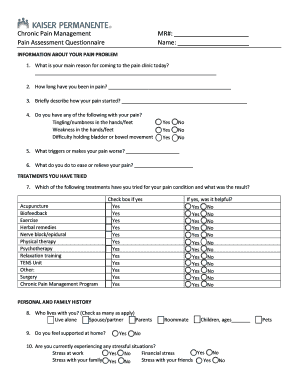
Clinic today? 2. How long have you been in pain? 3. Briefly describe how your pain started? 4. Do you have any of the following with your pain? Tingling/numbness in the hands/feet Weakness in the hands/feet Difficulty holding bladder or bowel movement Yes Yes Yes No No No 5. What triggers or makes your pain worse?.
Open form follow the instructions
Easily sign the form with your finger
Send filled & signed form or save
How to fill out the Kaiser Permanente Pain Assessment Questionnaire online
Filling out the Kaiser Permanente Pain Assessment Questionnaire online is an essential step in communicating your pain experience to healthcare providers. This guide will help you navigate the form with clear instructions, ensuring that your responses are accurate and comprehensive.
Follow the steps to successfully complete the questionnaire.
- Press the ‘Get Form’ button to access the questionnaire and open it in the designated format.
- Begin by entering your medical record number (MR#) and your name at the top of the form.
- In the 'Information About Your Pain Problem' section, answer questions regarding the reason for your visit, duration of pain, and how your pain started. Be as detailed as possible.
- Indicate any accompanying symptoms such as tingling or weakness by checking 'Yes' or 'No' for the corresponding questions.
- List triggers that worsen your pain and actions you take to relieve it. This information is crucial for understanding your pain management.
- In the 'Treatments You Have Tried' section, check all the treatments you have utilized and specify if they were helpful.
- Provide details in the 'Personal and Family History' section regarding your living situation, support system, and any stressful experiences you are currently facing.
- Indicate any relevant history of mental health issues or familial conditions that may affect your pain.
- Complete the 'Information About Your Habits' section, documenting your usage of caffeine, alcohol, tobacco, and cannabis.
- Address your sleep information, including troubles with sleep patterns and any additional comments that may clarify your pain condition.
- Fill out the brief pain inventory by shading in areas of pain and answering questions about its interference with daily activities.
- Answer the SOAPP (Screening for Opioid Abuse Risk) questions to gauge any risks associated with opioid treatment.
- Complete the AOQ (Anxiety, Obsession, and Depression questionnaire) and total your scores at the end of the section.
- Once all sections are completed, review your answers. Save any changes and proceed to download, print, or share the form for your records.
Complete your assessments online to enhance your pain management journey.
Experience a faster way to fill out and sign forms on the web. Access the most extensive library of templates available.
Related content
by C Taub · 2023 · Cited by 11 — Findings highlight categorical differences captured...
The confidential questionnaire is your personal health assessment, providing you with a...
by RZ Goetzel · 2011 · Cited by 91 — 1. Balance comprehensiveness of assessment with...
Get answers to your most pressing questions about US Legal Forms API.
What is the Kaiser pain scale?
The Kaiser pain scale is a tool used within the Kaiser Permanente Pain Assessment Questionnaire to measure pain intensity. This scale typically ranges from 0, indicating no pain, to 10, representing the worst pain imaginable. Understanding your place on this scale assists healthcare providers in formulating the best treatment plan for your comfort. Utilizing this tool ensures a more tailored approach to pain management.
How do you complete a pain assessment?
Completing a pain assessment involves following a structured approach to gather essential information. Start with the Kaiser Permanente Pain Assessment Questionnaire to standardize your process. Ask the patient about pain characteristics, duration, and effects on daily life. Thorough completion of this form will provide valuable insights for effective treatment.
What is an example of a pain assessment?
An example of a pain assessment could involve using the Kaiser Permanente Pain Assessment Questionnaire to evaluate a patient's chronic back pain. The questionnaire may include questions about pain intensity on a scale, triggers, and relief measures. This example illustrates how targeted questions help clinicians gather important data. Using clear assessments enhances treatment planning.
How to document a pain assessment?
Documenting a pain assessment effectively involves recording patient responses accurately. Use the Kaiser Permanente Pain Assessment Questionnaire to structure your documentation, as it emphasizes key areas like pain characteristics and severity. Ensure that you include any treatments provided and the patient's reaction to those treatments. This thorough record will support ongoing care.
How to fill a pain assessment form?
To fill out a pain assessment form, begin by familiarizing yourself with the questions asked. The Kaiser Permanente Pain Assessment Questionnaire typically covers aspects like pain intensity and impact on functioning. Answer each question as thoroughly as possible, noting specific examples if required. This will ensure your assessment reflects your true experience.
How to fill out a pain questionnaire for disability?
Filling out a pain questionnaire for disability requires careful consideration of your experiences with pain. The Kaiser Permanente Pain Assessment Questionnaire can be a valuable tool in this process. Be honest and detailed about how pain affects your daily activities, work, and overall quality of life. Accurate responses will help assess your needs for support.
How do you document a pain assessment?
To document a pain assessment, start by gathering information about the patient's pain level, location, and duration. Utilize the Kaiser Permanente Pain Assessment Questionnaire to guide your observations and record responses. Proper documentation includes noting the patient's description of pain and any related symptoms. This creates a comprehensive record that aids in ongoing treatment.
What are the requirements for pain assessment?
The requirements for a pain assessment generally include being honest and detailed about your pain experiences. When using the Kaiser Permanente Pain Assessment Questionnaire, be prepared to discuss various aspects of your pain, including its location, duration, and effect on your daily activities. Your healthcare provider may also require you to provide your complete medical history. This comprehensive approach aids in crafting a targeted treatment plan tailored to your needs.
How to ask for a pain scale?
To ask for a pain scale, you can directly approach your healthcare provider and express your desire to better understand your pain levels. You may refer to the Kaiser Permanente Pain Assessment Questionnaire as it includes specific scales for measuring pain intensity. Make sure to clarify that you are looking for a structured method to help express your symptoms. This proactive approach will facilitate clearer communication with your medical team.
How to do a pain assessment?
Performing a pain assessment requires you to evaluate your pain levels, using tools like the Kaiser Permanente Pain Assessment Questionnaire. Typically, this involves answering a series of questions about the location, intensity, and frequency of your pain. Make sure to take your time and reflect on your experiences so that the results accurately reflect your condition. Presenting this assessment to your healthcare provider can significantly impact your treatment plan.
Use professional pre-built templates to fill in and sign documents online faster. Get access to thousands of forms.
If you believe that this page should be taken down, please follow our DMCA take down process here.