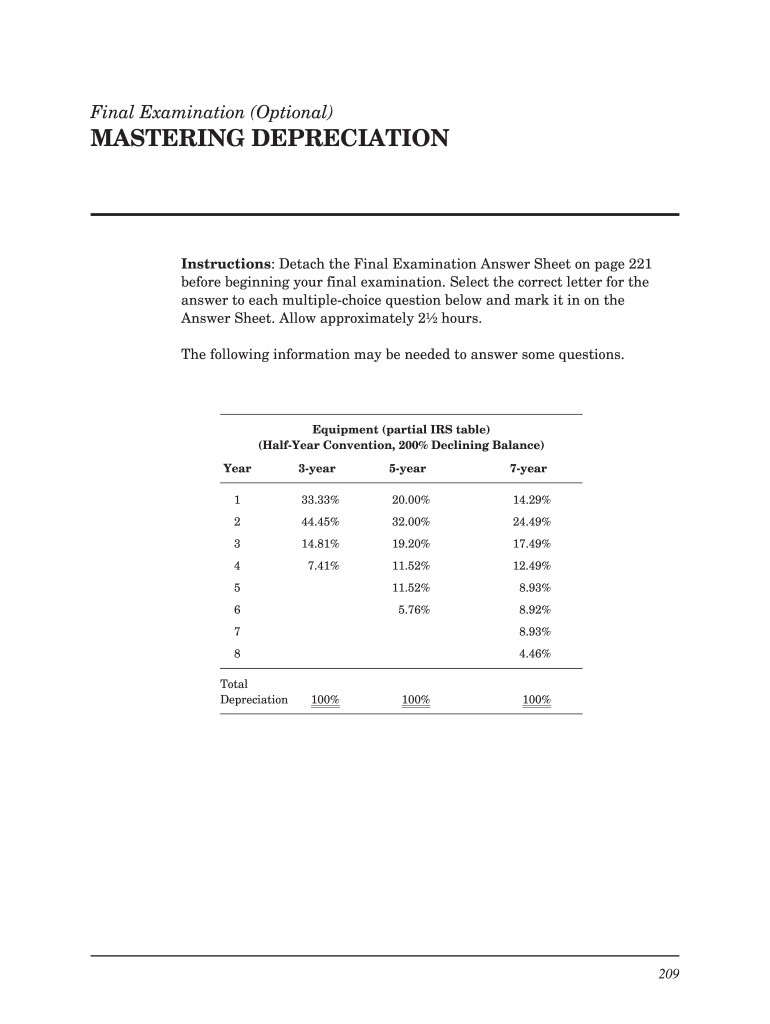
Er to each multiple-choice question below and mark it in on the Answer Sheet. Allow approximately 2 hours. The following information may be needed to answer some questions. Equipment (partial IRS table) (Half-Year Convention, 200% Declining Balance) Year 3-year 5-year 7-year 1 33.33% 20.00% 14.29% 2 44.45% 32.00% 24.49% 3 14.81% 19.20% 17.49% 4 7.41% 11.52% 12.49% 5 11.52% 8.93% 6 5.76% 8.92% 7 8.93% 8 4.46% Total Depreciation 100% 100% 100% 209 Mastering D.
Loading

Open form follow the instructions

Easily sign the form with your finger

Send filled & signed form or save
How to fill out the Mastering Depreciation Final Examination online
Completing the Mastering Depreciation Final Examination is a crucial step in demonstrating your knowledge of depreciation. This guide provides a straightforward approach to filling out the exam efficiently and accurately.
Follow the steps to complete your examination successfully.
- Click the ‘Get Form’ button to retrieve the Mastering Depreciation Final Examination. This action allows you to open the examination document online.
- Detach the Final Examination Answer Sheet provided within the document. This step is essential before proceeding with your answers.
- Read each multiple-choice question carefully. Each question will require you to select the correct answer by marking the corresponding box on the Answer Sheet.
- Utilize any reference materials or charts included in the examination, such as IRS depreciation tables, to assist in answering the questions accurately.
- After completing all questions, review your selections to ensure all answers are marked correctly.
- Save your completed Answer Sheet. You may choose to download, print, or share it as needed.
- Return the Answer Sheet to the specified address for grading. This is typically noted within the instructions of the examination.
Prepare and complete your Mastering Depreciation Final Examination online today!
Experience a faster way to fill out and sign forms on the web. Access the most extensive library of templates available.
Related content
The exams typically cover a variety of topics, including cost concepts, time value of...
Aipb Mastering Depreciation Final Exam Answer Key: Mastering Depreciation Garo...
by GS Becker · 1975 · Cited by 489 — The original aim of this study was to estimate...
Get answers to your most pressing questions about US Legal Forms API.
How to treat depreciation in final accounts?
In final accounts, treat depreciation as a necessary expense that decreases net income and adjusts asset values. Proper treatment ensures compliance with accounting principles and provides a realistic overview of asset performance. Understanding these nuances is essential for anyone preparing for the mastering depreciation final examination.
How to get total depreciation?
To get total depreciation, sum the depreciation expenses recorded over each accounting period for the asset. This total gives a clear view of how much value an asset has lost since it was acquired. Mastering the process of calculating total depreciation will greatly assist you in your final examination.
Where does depreciation go on a P&L?
On a Profit and Loss account, depreciation is listed among operating expenses, specifically under the section for fixed asset expenses. This inclusion allows stakeholders to see the recurring costs associated with asset usage. Recognizing this placement will prove beneficial as you navigate the mastering depreciation final examination.
How to get cumulative depreciation?
Cumulative depreciation is calculated by adding the depreciation expenses for each period until the current date. This total provides insight into how much of the asset’s value has been consumed over time. Understanding how to compute cumulative depreciation is vital as you prepare for your mastering depreciation final examination.
How is depreciation treated on a balance sheet?
On a balance sheet, depreciation reduces the book value of an asset under fixed assets. This adjustment helps reflect the economic reality of asset utilization over time. It's essential to grasp how these reductions impact financial summaries when studying for your mastering depreciation final examination.
How is depreciation treated in the final account?
In the final account, depreciation is recorded as an expense, reducing the net income reported. This treatment follows accounting standards that require businesses to account for asset depreciation. Learning how to treat depreciation accurately is crucial when preparing for your mastering depreciation final examination.
How to test depreciation?
To test depreciation, review the calculations and compare them against the asset’s projected wear and tear. Ensuring accuracy in your calculations can help prevent financial discrepancies. You can use tools and resources available on the uslegalforms platform as you prepare for your Mastering Depreciation Final Examination.
What is the 1.5 declining balance method?
However, many firms use a rate equal to 1.5 times the straight-line rate. This is called 150% declining balance depreciation. 150% declining balance depreciation is calculated in the same manner as is double-declining-balance depreciation, except that the rate is 150% of the straight-line rate.
What is the 150 declining balance method?
The 150% reducing balance method divides 150 percent by the service life years. That percentage will be multiplied by the net book value of the asset to determine the depreciation amount for the year.
What is depreciation in final accounts?
The term depreciation refers to an accounting method used to allocate the cost of a tangible or physical asset over its useful life. Depreciation represents how much of an asset's value has been used. It allows companies to earn revenue from the assets they own by paying for them over a certain period of time.
Use professional pre-built templates to fill in and sign documents online faster. Get access to thousands of forms.
If you believe that this page should be taken down, please follow our DMCA take down process here.