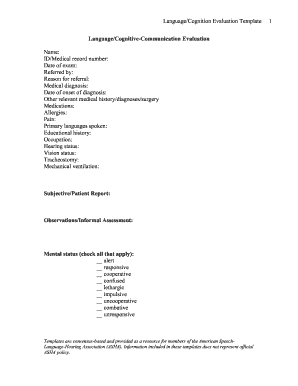
Get Adult Assessment Template: Language/cognitive-communication Evaluation Form - Asha
How it works
-

Open form follow the instructions
-

Easily sign the form with your finger
-

Send filled & signed form or save
How to fill out the Adult Assessment Template: Language/Cognitive-Communication Evaluation Form - Asha online
Filling out the Adult Assessment Template for language and cognitive-communication evaluation is an essential step in assessing and planning treatment for individuals with communication challenges. This guide will provide you with clear instructions and user-friendly tips to navigate the form effectively.
Follow the steps to complete the evaluation form online.
- Press the ‘Get Form’ button to access the evaluation template and open it in your preferred online editor.
- Begin by entering the individual's name, ID or medical record number, and the date of the assessment. This information helps in identifying the individual being evaluated.
- Fill out the referral information, including who referred the individual and the reason for the referral. Providing this context is crucial for understanding the evaluation purpose.
- Document the individual's medical diagnosis and the date of onset. Include any other relevant medical history or surgeries that may impact the assessment.
- List any medications and allergies the individual has. This section is vital for understanding their health and potential influences on communication abilities.
- Note the primary languages spoken by the individual, along with their educational history and occupation. These factors can affect communication styles and capabilities.
- Indicate the hearing and vision status, along with details about tracheostomy and mechanical ventilation if applicable. This information is essential for a comprehensive evaluation.
- Gather subjective reports from the patient regarding their communication experiences, and include observations and informal assessments to provide context to your findings.
- Evaluate the mental status by checking all applicable indicators. This will help in understanding the individual's responsiveness and cooperation levels.
- Complete sections for spoken language comprehension, spoken language expression, reading, writing, cognitive-communication status, and pragmatics. Document findings and scores based on the assessments administered.
- Assess the impact of cognitive-communication deficits on daily functioning, and rate activity limitations and safety risks as applicable.
- Provide a prognosis and recommendations for treatment, including suggested referrals if necessary.
- Incorporate patient, family, and caregiver education regarding the evaluation results, ensuring understanding and agreement with the treatment and goals.
- Finally, outline the long-term and short-term treatment goals based on your findings. Be sure to save your changes, then download, print, or share the completed form as needed.
Start completing your evaluation form online today!
To assess cognitive communication, practitioners can observe and evaluate an individual's ability to use cognitive skills such as attention, memory, and reasoning in communication situations. Standardized assessment tools, like the Adult Assessment Template: Language/Cognitive-Communication Evaluation Form - Asha, provide a structured way to gather information and insights about cognitive communication abilities. This structured approach is essential for developing effective treatment plans.