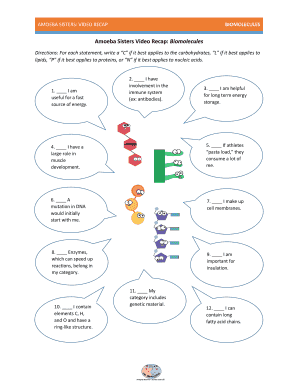
AMOEBA SISTERS: VIDEO RECAP BIOMOLECULES Amoeba Sisters Video Recap: Biomolecules Directions: For each statement, write a C if it best applies to the carbohydrates, L if it best applies to lipids,.

How it works
  • Open form

    Open form follow the instructions

  • Easily sign form

    Easily sign the form with your finger

  • Share form

    Send filled & signed form or save

How to fill out the Amoeba Sisters Video Recap Biomolecules online

This guide provides detailed instructions for completing the Amoeba Sisters Video Recap Biomolecules form online. It is designed to help users understand each component and fill out the form accurately.

Follow the steps to successfully complete the Amoeba Sisters Video Recap Biomolecules form.

  1. Click the ‘Get Form’ button to access the form and open it in your document editor.
  2. Begin by reviewing the directions provided at the top of the form. You will be asked to classify various statements according to their respective biomolecule categories.
  3. For each statement listed, select 'C' for carbohydrates, 'L' for lipids, 'P' for proteins, or 'N' for nucleic acids. Place the corresponding letter next to each statement.
  4. Move on to the table section that allows you to organize your knowledge about biomolecules. Fill in the columns for 'Makes Me Think of...', 'Monomer', 'Elements', and 'Example(s)' based on your understanding.
  5. Ensure that you carefully fill in the details for each biomolecule listed, including carbohydrates, lipids, proteins, and nucleic acids. Pay attention to any notes that provide additional context, such as the note about lipids.
  6. After completing all sections, review your answers to check for accuracy and completeness.
  7. Once you are satisfied with your entries, save your changes. Consider downloading or printing the form for your records, or sharing it as needed.

Complete the Amoeba Sisters Video Recap Biomolecules form online to enhance your understanding of biomolecules.

Get form

Experience a faster way to fill out and sign forms on the web. Access the most extensive library of templates available.

Related content

Amoeba Sisters Video Recap Biomolecules Worksheet

This article will explore the components of the Amoeba Sisters' video recap on...

Learn more
Amoeba Sisters Video Recap Enzymes

Their videos on enzymes are no exception, providing a fantastic introduction to these...

Learn more
Questions & Answers

Get answers to your most pressing questions about US Legal Forms API.

Contact support

What are the 4 types of biomolecules?

There are four major classes of biological macromolecules (carbohydrates, lipids, proteins, and nucleic acids), and each is an important component of the cell and performs a wide array of functions. Combined, these molecules make up the majority of a cell's mass.

There are four major classes of biological macromolecules (carbohydrates, lipids, proteins, and nucleic acids), and each is an important component of the cell and performs a wide array of functions. Combined, these molecules make up the majority of a cell's mass.

Proteins. Proteins are the primary building materials of the body. Your hair, skin, muscles, and organs are composed mostly of proteins. Proteins are strong yet flexible, and they have a complex 3-D structure.

A biomolecule refers to any molecule that is produced by living organisms. As such, most of them are organic molecules. The four major groups of biomolecules include polysaccharides, proteins, nucleic acids (DNA and RNA), and lipids. They are found in and produced by living organisms.

Biological macromolecules are large molecules, necessary for life, that are built from smaller organic molecules. There are four major classes of biological macromolecules (carbohydrates, lipids, proteins, and nucleic acids); each is an important cell component and performs a wide array of functions.

Which biomolecule is consumed when athletes "pasta load"? Carbohydrates are consumed when athletes "pasta load".

Definition: A biomolecule is a chemical compound found in living organisms. These include chemicals that are composed of mainly carbon, hydrogen, oxygen, nitrogen, sulfur and phosphorus. Biomolecules are the building blocks of life and perform important functions in living organisms.

Biomolecules are vital for life as it aids organisms to grow, sustain, and reproduce. They are involved in building organisms from single cells to complex living beings like humans, by interacting with each other. The diversity in their shape and structure provides diversity in their functions.

Get This Form Now!

Use professional pre-built templates to fill in and sign documents online faster. Get access to thousands of forms.

If you believe that this page should be taken down, please follow our DMCA take down process here.

Get Amoeba Sisters Video Recap Biomolecules