Nal Information: Gully shaping Total acres to be treated: Acres treated annually: Seeding mix used for reestablishment of vegetation: Planned date of construction: Additional Information: Streamside, pond, and wetland revegetation. Techniques used: Native hay bales Fencing Rip-rap, etc. stream crossings Planned date of construction: Additional Information: Filter strips Other: Seeding upland buffer Herbaceous and/or woody plant establishment on critical areas (erodible) Establish windbrea.
Loading

Open form follow the instructions

Easily sign the form with your finger

Send filled & signed form or save
How to fill out the 1 D 1 Open Space Agricultural Valuation online
Completing the 1 D 1 Open Space Agricultural Valuation form is an essential step for property owners engaged in wildlife management. This guide provides clear, step-by-step instructions to help you accurately fill out the form online, ensuring compliance with local requirements and maximizing your potential benefits.
Follow the steps to successfully complete the 1 D 1 Open Space Agricultural Valuation online.
- Press the ‘Get Form’ button to obtain the form and open it for editing.
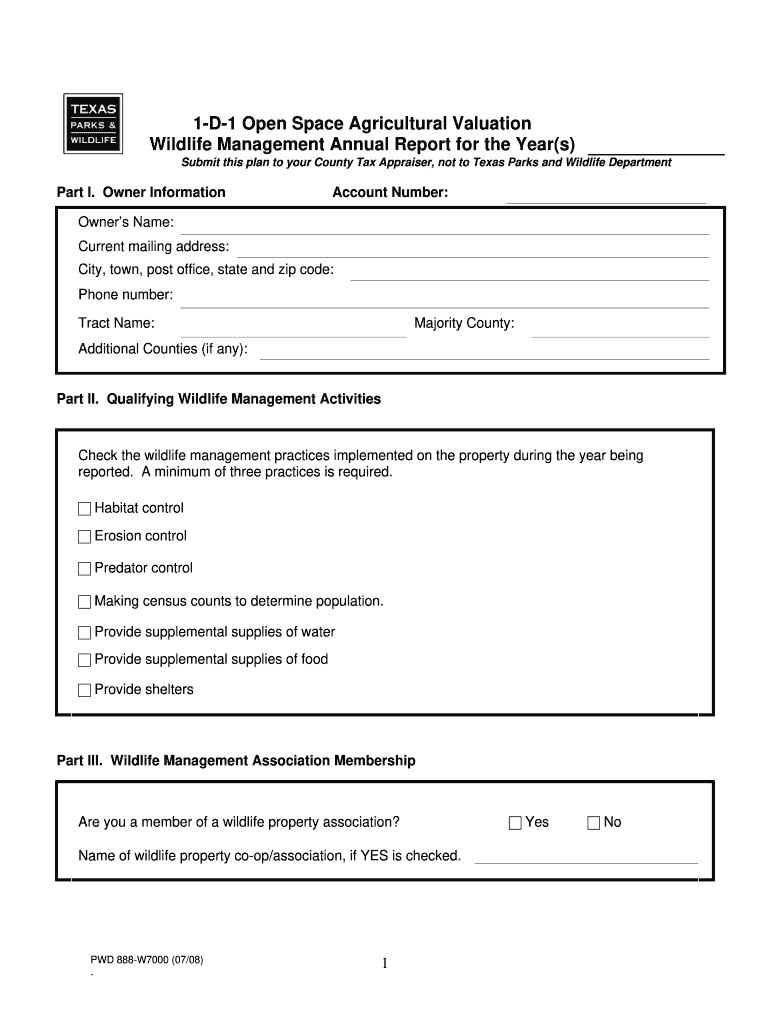
- Begin with Part I, which requires your owner information including account number, owner’s name, mailing address, city, state, zip code, phone number, tract name, and any majority or additional counties.
- Move on to Part II where you must check a minimum of three wildlife management practices that you have implemented on your property during the reporting year.
- In Part III, indicate whether you are a member of a wildlife property association. If 'Yes', provide the name of the association.
- Part IV entails detailing the specific wildlife management activities you have performed. Check the relevant actions under each subsection like habitat control, erosion control, predator control, supplemental water, supplemental food, and shelter.
- For each activity in Part IV, provide additional information as required, such as acres managed, methods utilized, and specific species involved.
- Complete the census data by filling in any required counts and supporting observations as described in Part VII.
- Finally, attach copies of any supporting documentation such as receipts or maps in Part V and ensure that you include your signature and date to certify the information's accuracy.
- Once all sections are completed, you can save your changes, download the form, print it, or share it as necessary.
Start completing your 1 D 1 Open Space Agricultural Valuation form online today to ensure proper filing and management of your wildlife activities.
Experience a faster way to fill out and sign forms on the web. Access the most extensive library of templates available.
Related content
Page 1. 1-D-1 Open Space Agricultural Valuation. Wildlife Management Plan for the Year(s)...
Land qualifies for special appraisal (1-d-1 appraisal) if it has been (1) used for...
Oct 19, 2017 — You are in the business of farming if you culti- vate, operate, or manage...
Get answers to your most pressing questions about US Legal Forms API.
What qualifies for a wildlife exemption in Texas?
In Texas, a wildlife exemption is available for landowners who actively manage their property to promote wildlife conservation practices. This can include activities such as habitat management, population monitoring, and the establishment of wildlife corridors. By applying the principles of the 1 D 1 Open Space Agricultural Valuation, landowners can benefit from tax savings while contributing positively to the environment.
What are the requirements for agricultural property tax exemption in Texas?
Requirements for agricultural property tax exemption in Texas include having land that is solely used for agricultural production and maintaining adequate records of that use. The 1 D 1 Open Space Agricultural Valuation stipulates that you must demonstrate a consistent history of agricultural activity, following state guidelines. Engaging with platforms like U.S. Legal Forms can simplify the process of gathering necessary documentation and understanding compliance.
How many acres do you need for ag exemption bees in Texas?
To qualify for an ag exemption related to beekeeping in Texas, you generally need at least five acres dedicated to managing bee colonies. The 1 D 1 Open Space Agricultural Valuation applies as long as beekeeping is your primary agricultural activity. This not only provides an exemption but also supports pollinator populations, which are crucial for agriculture.
What qualifies for agricultural exemption in Texas?
To qualify for an agricultural exemption in Texas, your land must be used primarily for agricultural purposes such as farming, ranching, or wildlife management. The 1 D 1 Open Space Agricultural Valuation requires a minimum production threshold to be met, which means actively engaging in agricultural activities. Documentation is necessary to prove and maintain your qualifying status.
How much does an ag exemption save you in Texas?
The amount you save through an ag exemption in Texas can vary widely depending on the property’s size, location, and agricultural use. Generally, property owners can save thousands of dollars annually due to the lower appraisal rates of the 1 D 1 Open Space Agricultural Valuation. It’s a significant benefit that encourages land stewardship and agricultural productivity.
What is a 1 d 1 agricultural exemption in Texas?
The 1 D 1 agricultural exemption in Texas provides property tax relief for land used exclusively for agricultural operations. This valuation method allows landowners to have their property appraised based on its agricultural productivity, rather than market value. By utilizing the 1 D 1 Open Space Agricultural Valuation, you can significantly reduce your tax burden, especially if you meet the necessary qualifications.
How many cows do you need per acre for ag exemption in Texas?
In Texas, the number of cows needed per acre for ag exemption can vary based on land quality and the specific practices you implement. Generally, an average of one cow per 5 to 20 acres is a common guideline. It's important to keep in mind that the 1 D 1 Open Space Agricultural Valuation allows property owners to use this exemption to manage their land for agricultural purposes effectively.
How many animals do you need to be tax exempt in Texas?
The number of animals required for a tax exemption in Texas varies depending on the type of livestock and the land's capacity. Under the 1 D 1 Open Space Agricultural Valuation, a general rule is to have enough animals to constitute agricultural management practices, which often translates to at least one productive animal for every 10 acres. It's crucial to maintain accurate records and to consult a local tax assessor for specific requirements.
How many acres do you need for wildlife exemption in Texas?
In Texas, you typically need at least 20 acres to qualify for a wildlife exemption. This exemption aims to promote land conservation and wildlife management practices instead of traditional agricultural use. The 1 D 1 Open Space Agricultural Valuation can also extend to include wildlife management activities, providing tax relief to landowners engaged in these efforts. Always verify specific county requirements, as they may differ.
What are the rules for agricultural exemption in Texas?
The rules for agricultural exemption in Texas focus on the principal use of the land. Landowners must demonstrate that they are using the property for agriculture purposes, as defined by the Texas Property Tax Code. Additionally, the 1 D 1 Open Space Agricultural Valuation emphasizes that the land should be managed in a way that supports agricultural activities, keeping records of production can strengthen your case. Regular assessments may be required to maintain the exemption.
Use professional pre-built templates to fill in and sign documents online faster. Get access to thousands of forms.
If you believe that this page should be taken down, please follow our DMCA take down process here.