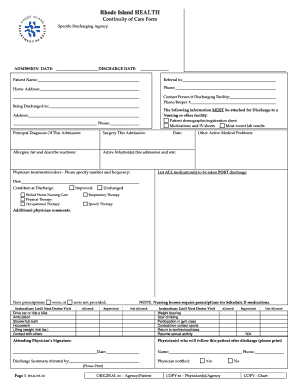
Rhode Island HEALTH Continuity of Care Form Specific Discharging Agency: ADMISSION DATE: DISCHARGE DATE: Referral to: Patient Name: Home Address: Phone: Contact Person Discharging Facility: Phone/Beeper.
Open form follow the instructions
Easily sign the form with your finger
Send filled & signed form or save
How to fill out the Continuity Of Care Form online
The Continuity Of Care Form is a vital document designed to ensure seamless care transitions for individuals moving from one healthcare setting to another. Completing this form accurately is essential for effective communication among healthcare providers and better patient outcomes.
Follow the steps to fill out the Continuity Of Care Form online:
- Press the ‘Get Form’ button to access the document and launch it in the editor.
- Begin by entering the specific discharging agency information as prompted. This will identify where the patient is being discharged from.
- Fill in the admission and discharge dates accurately to reflect the patient's care timeline.
- Input the patient's name in the designated field to ensure proper identification.
- List the referral destination along with the corresponding phone number to facilitate communication.
- Provide the contact person at the discharging facility and their phone number to assist with any follow-up queries.
- Complete the home address of the patient, ensuring it is correct for future follow-up.
- Specify where the patient is being discharged to, including the address if necessary.
- Attach required documents such as the patient demographic sheet, medication lists, and recent lab results as indicated.
- Detail the principal diagnosis of the admission, any surgeries performed, and other active medical issues.
- List any allergies along with a description of the reactions to ensure comprehensive care.
- Document any active infections noted during the admission, ensuring clarity for further treatment.
- Specify the physician's treatments or orders, detailing the frequency and nature of care required.
- Compile a list of all medications the patient will need to take post-discharge.
- Indicate any dietary restrictions or needs that should be recorded for follow-up care.
- Assess the patient's condition at discharge and select the appropriate options for care requirements.
- Include the attending physician's signature and ensure contact information is available.
- After all fields are completed, save the changes, and utilize options to download, print, or share the form as needed.
Complete your documents online today for a smoother care transition.
Experience a faster way to fill out and sign forms on the web. Access the most extensive library of templates available.
Related content
Continuity of care is a process that allows continued care for members who change plans...
A separate Continuity of Care form must be completed for each condition you and/or your...
The Model of Care (MOC) is Molina Healthcare's documentation of the CMS directed plan for...
Get answers to your most pressing questions about US Legal Forms API.
What is in a continuity of care document?
A continuity of care document contains vital information such as the patient's demographic details, medical history, current medications, and any known allergies. Additionally, it includes relevant clinical findings and future care plans. By ensuring this information is accurately documented and shared through a Continuity Of Care Form, healthcare providers can offer seamless care and improve patient outcomes.
What is a CoC in healthcare?
A CoC, or Continuity of Care, in healthcare refers to the ongoing process of delivering consistent, coordinated, and comprehensive medical care to patients. It emphasizes the importance of maintaining communication among healthcare providers, especially when patients transition between different levels of care. Utilizing tools like the Continuity Of Care Form can significantly enhance the CoC, ensuring patients receive the highest quality of care.
What is included in a continuity of care document?
A continuity of care document typically includes the patient's medical history, medication list, allergies, and recent treatments or procedures. Furthermore, it details the patient's care plan and any follow-up appointments or recommendations. This comprehensive information allows healthcare providers to deliver coordinated care and ensures a smooth transition for patients.
What are the five C's of documentation?
The five C's of documentation are completeness, clarity, consistency, conciseness, and correctness. These principles ensure that health records accurately reflect patient care and facilitate effective communication between providers. Utilizing a proper Continuity Of Care Form can enhance these documentation practices, ensuring that essential patient information is recorded correctly and delivered clearly.
What does continuity of care include?
Continuity of care includes various aspects such as the ongoing relationship between a patient and their healthcare provider, effective communication, and coordinated care across different specialists. It ensures that important health information is available whenever needed, often through tools like the Continuity Of Care Form. This approach leads to improved treatment adherence and better management of chronic conditions.
What is the CCD format?
The Continuity of Care Document (CCD) format is a standard for sharing patient information between different healthcare providers. It organizes essential health details, including medications, allergies, and diagnoses effectively. By using the CCD format, healthcare providers can easily exchange information and support seamless patient transitions, promoting better health outcomes.
What is an example of continuity of care?
An example of continuity of care is when a patient moves from one healthcare provider to another and their medical history is shared to ensure consistent treatment. For instance, if a primary care doctor refers a patient to a specialist, they use a Continuity Of Care Form to communicate important health information. This collaboration helps maintain the same level of care and avoids unnecessary tests or procedures.
How do you create continuity of care?
Creating continuity of care involves several steps, including gathering comprehensive patient information and ensuring regular updates to medical records. Healthcare teams must work together to communicate effectively and share care plans. Implementing a Continuity Of Care Form can simplify this process, allowing healthcare providers to easily access and manage patient data.
What are examples of continuity of care?
Examples of continuity of care involve coordinated efforts during patient treatment, such as when specialists collaborate on a treatment plan for a complex health issue. Another example is when a patient moving to a new location shares their medical history with a new provider using a Continuity Of Care Form. This document helps ensure that the patient receives consistent and informed care regardless of where they are treated.
What are some examples of continuity?
Examples of continuity can include smooth transitions from one healthcare provider to another, ongoing monitoring of chronic conditions, and consistent follow-up care. In addition, maintaining organized patient records facilitates communication among diverse healthcare professionals. The Continuity Of Care Form plays a key role in documenting these transitions and keeping everyone aligned.
Use professional pre-built templates to fill in and sign documents online faster. Get access to thousands of forms.
If you believe that this page should be taken down, please follow our DMCA take down process here.