Loading
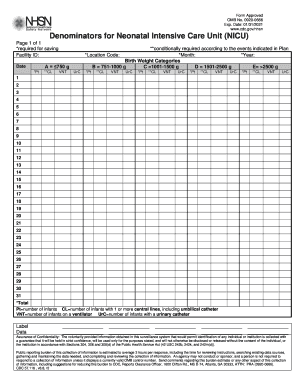
Get Denominators For Neonatal Intensive Care Unit Form 2014-2026
How it works
-

Open form follow the instructions
-

Easily sign the form with your finger
-

Send filled & signed form or save
How to fill out the Denominators For Neonatal Intensive Care Unit Form online
Filling out the Denominators For Neonatal Intensive Care Unit Form online is essential for accurately reporting neonatal care data. This guide provides clear and detailed steps to help you complete the form effectively.
Follow the steps to fill out the Denominators For Neonatal Intensive Care Unit Form online
- Click ‘Get Form’ button to obtain the Denominators For Neonatal Intensive Care Unit Form and open it in your preferred online editor.
- Enter the Facility ID in the designated field to identify your facility.
- Select the Month and Year using the dropdown menus provided. These fields are required in order to save the form.
- Select the Birth Weight Categories according to the defined ranges: B for 751-1000 g, C for 1001-1500 g, D for 1501-2500 g, and E for greater than 2500 g.
- Specify the Location Code using the appropriate letters provided: A for ≤750 g.
- For each day of the month, input the required data in the fields labeled Pt, CL, VNT, and UrC, where Pt indicates the number of infants, CL represents the number of infants with one or more central lines, VNT signifies the number of infants on a ventilator, and UrC denotes the number of infants with a urinary catheter.
- Continue entering data for each day from 1 to 31 as necessary. Ensure accuracy in the total calculations.
- Once all sections are filled, you can save your changes, download, print, or share the form as needed.
Complete your forms online to ensure accurate data collection and reporting.
Organizing a neonatal intensive care unit requires a combination of strategic planning and staff training. Establish clear protocols, maintain open communication among team members, and involve families in the care process. The Denominators For Neonatal Intensive Care Unit Form can serve as a helpful tool in developing organizational strategies that promote effective patient care.